Showing posts with label polotmave. Show all posts

Thursday, April 21, 2022

The Full Schilling - druhý díl

A quick recap...this happened:

Those 2 cases/trays of Schilling beer in 16oz cans consisted of:

  • Malý 8° - Czech style session pale lager
  • Nordertor - Northern German style pilsner
  • Paulus - Munich style helles
  • Rennsteig - schwarzbier
Schilling beers already in my fridge when I got home were:
  • Palmovka 12° - Czech style pale lager
  • Augustin 13° - Czech style amber lager
  • Karlův 13° - Czech style dark lager
To round out the selection nicely, I popped into Beer Run and picked up a four pack of Alexandr as it is most reliably available Schilling beer in this neck of the woods. For this here second installment of The Full Schilling, I made sure all the Czech styles were suitably refrigerated...


Having made sure that suitable glassware was clean and ready for use, I didn't buy a Schilling glass while I was up there as the style I wanted was not available, I set about going from left to right...starting with Malý 8°.

Malý 8°

  • Sight - crystal clear golden, inch of beautiful white foam, great retention
  • Smell - spicy hops, lemongrass, crusty bread and crackers, second son Bertie thought it smelt "peppery and juicy"
  • Taste - crusty bread, lemony zing, clean hop bite to finish
  • Sweet - 2/5
  • Bitter - 2.5/5
Simply magnificent beer. Medium-light body, not watery or thin in the finish, this is a drinker's session beer, the kind of thing that you can sit on your deck in the sun and guzzle all afternoon and evening without ever getting bored, the voice of experience may be speaking. The finish is clean, dry, and just pulls you back for more, and more, and more. I almost wish I had bought 2 cases...


Alexandr
  • Sight - dark straw, white foam, beautiful clarity and excellent head retention
  • Smell - citrus, lemon and key lime, hay, water biscuits
  • Taste - dollops of citrus bittering, bordering on pithy, more crackers and some floral notes in the background, like a summer meadow
  • Sweet - 2/5
  • Bitter - 3/5
Again a beautifully balanced beer, the bitterness is very much front and centre, but it doesn't overwhelm the malt character. Has the snap that I expect of well made lagers that brings everything into sharp focus and then demands you have another mouthful. I just love this beer, it is right up there with anything I drank in Czechia.


Palmovka 12°
  • Sight - rich golden, white foam that lingers well, again beautiful clarity
  • Smell - toasted crusty bread, spicy hops, freshly mown hay
  • Taste - juicy sweet decocted malt, crusty bread, specifically like the crusty end of a loaf, grassy hop with a clean hop bitterness
  • Sweet - 2/5
  • Bitter - 3/5
This is not hyperbole, but there is something about Palmovka that reminds me of Pilsner Urquell, though a little stronger. That crusty bread character coupled with a very light butterscotch note just feels so much like Prazdroj that I fear if I had to try both side by side and blind I would struggle to guess which was which - there may be a blog post in the making right there. The bitterness, again, is firm, clean, and finishes off the beer delightfully.


Augustin 13°
  • Sight - light red, ruby highlights, off white foam that stays the course
  • Smell - brioche, subtle hay, floral hops
  • Taste - ovocní knedlík, stone fruit, breadiness in the background
  • Sweet - 3/5
  • Bitter - 2/5
This is quite a complex beer, with lots of malt flavours floating around. I realise that ovocní knedlík, fruit dumpling in English, is not particularly helpful if you've never had them, but imagine a plum wrapped inside a yeast dough, enriched with egg and milk, simmered and then served with a touch of sugar and cinnamon, and you kind of get what I am saying. It's complex, but clean in the finish and maybe a little thin for a 13° lager, but that's me quibbling, it's still a grand beer.


Karlův 13°
  • Sight - very dark brown, mahogany edges, solid inch of tan foam
  • Smell - bitter chocolate, toasted brioche, subtle floral hop notes
  • Taste - dark chocolate, nutty, imagine bitter chocolate Nutella, sachertorte, some grassy hop notes
  • Sweet - 2.5/5
  • Bitter - 2/5
A wonderful way to nightcap my little Schilling Czech tasting. Not stodgy in the slightest but with plenty of sweet malt flavours. The finish is somewhere between the soft sweetness of a dunkel and the dry crispness of schwarzbier. Again a very moreish beer that is an excellent interpretation of the Czech tmavé/černé "style".

I seriously considered trying to rank this set of beers by preference, but it would be a fool's errand to bother. They are all excellent examples of the kind of beers I love to drink, and this is what makes Schilling such an exciting brewery for me, they do everything so damned well that it is almost irrelevant what is in your glass, it will be superb.

Wednesday, January 12, 2022

In Praise of Obergäriges Lagerbier

Every January it is the same.

I resolve to finally invest in the necessary equipment to make lager brewing a regular part of my thoroughly irregular brewing schedule. With the twins now four years old, perhaps this is the year when I can get back to homebrewing with something approaching regularity. As I say though, every January I promise myself that I will get a second hand fridge or something so that I can do the cooler fermentation necessary for using bottom fermenting yeast, and yet every year I end up not bothering.

This January is different.

I am not resolving to spend money on a fermentation chamber, having accepted that with such an irregular brewing schedule it would end up just using electricity. Nope, instead I plan to take full advantage of what I already have in order to make beers like those I love to drink. I am somewhat lucky that my beer cellar, such as it is since I had a major clear out of crap - seriously, who actually needs 16 growlers clogging up space? - has a fairly steady ambient temperature of about 65° Fahrenheit, right inside the optimal temperature range for both Wyeast 1007 and Safale K-97, which is to be expected since they are both apparently the Zum Uerige strain.


I have used this yeast in my last pair of homebrew projects, an altbier type beer with lots of Munich malt, and also a 10° beer with lots of Saaz that had it been bottom fermented would have been a very Czech brew. My experience with the 10° convinced me that if I want to make clean, crisp beers then sod buying a fermentation chamber, I will just use Zum Uerige's yeast, as well as lagering for a decent length of time, and following some tips from folks online, gelatin finings to clear things up as alt yeast is a low flocculator.


The other day as I will plotting my first brewday of 2022, I was digging through the freezer, where I store my hops, and discovered to my delight a lot more Saaz. Having taken a quick look at the liquid malt extracts I have to hand, I resolved that brewday number 1 this year will be to make a top fermented 14° polotmavé, that's Czech style amber to most folks.

My recipe is simplicity itself:
  • 4.65lb Briess Pilsen LME
  • 3.15lb Briess Dark LME
  • 9 IBU Saaz for 60 minutes
  • 8 IBU Saaz for 45 minutes
  • 7 IBU Saaz for 30 minutes
  • 4 IBU Saaz for 15 minutes
  • Safale K-97 yeast
According the brewing software I use, this will give me:
  • OG: 14° (1.056)
  • FG: 2.8° (1.011)
  • ABV: 5.9%
  • SRM: 12 (medium amber)
  • IBU: 28
I plan to do my usual 2 week primary fermentation, followed by 6 weeks lagering in my kegerator fridge. So if everything works out I'll have a nice svrchně kvašené specialní polotmavé pivo for the middle of March.

Sure the purist in me would still rather spend the money to buy a fermentation chamber, but the same purist in me would also want to do it all grain, with a double decoction mash. Sometimes you just have to be a pragmatist, and if this gets me a decent polotmavé for the vernal equinox then happy days.

Thursday, November 2, 2017

17° Perfection

Goodness me it's been a while since I posted.

Mitigating circumstance is that just 5 days after my previous post, Mrs V gave birth to our twin sons, the malé Aličky as they have been nicknamed, and we are getting to grips with this whole parenthood thing.

On Saturday, we introduced the malé Aličky to that most august of establishments, the pub. I fear that in the rampantly puritanical mind of the Institute of Alcohol Studies (for those unaware, a front organisation feigning academic respectability for the heirs of the Temperance League and their prohibitionist cohorts) the boys are already scarred for life as I have had several beers right in front of them already.

Said introductory pub was the original Devils Backbone brewpub down in Nelson County, and the occasion was the tapping of the beer I brewed with them back in August, a Czech style Polotmavý Speciál. Polotmavý because it is neither light nor dark, but a deep red kind of in between, and Speciál because it has an original gravity of about 17° Plato. In keeping with Czech tradition the name of the beer is Granát, which is "garnet" in Czech, a reference to the famous gemstones from Central Bohemia.


"But how did the beer turn out?" I hear you say....

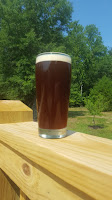
Well, it pours a really rich deep auburn, that the picture above maybe doesn't capture fully, and yes I am biased but I think all my children are gorgeous. The head is a healthy inch of ivory foam that lingers for the duration and leaves some lovely lacing down the glass. Aroma wise, there are some traces of a lightly herbal hop character, but given the beer is more balanced toward the malt, the classic Central European smells of fresh bread and a sweet malt aroma (I can't think of a better description honestly, when you smell CaraBohemian malt you get what I mean). In terms of taste, there is lots of breadiness, and a healthy dollop of sweetness, think dulce de leche and you're close, all backed up by a firm hop bite that stops the beer from being sickly - is there anything worse than a sickly sweet beer? Having lagered for a nearly 10 weeks, the finish is clean, crisp, and despite the malt forward nature of the beer, refreshing.

You know, the more I think about it, the more it reminds me of a 14° Polotmavý Speciál from Minipivovar Hukvaldy that I relished back in 2008 over lunch with Max in Prague.

So yes it turned out exactly as I wanted it to, and my only regret is that it won't ever see the light of day at Pivovarský klub. Given the volume of the batch, I expect it will only be on at Devils Backbone for a few weeks, so if you are in the area get along and try the first recorded authentic Czech style Polotmavý in Virginian history.

Friday, August 4, 2017

Halfway to Darkness

I have a habit of getting interested in, and advocating for, beer styles that are perhaps out of the mainstream of craft beer. What kind of loon starts American Mild Month, for example, or convinces a brewery to make a 1920s Burton Ale, a Czech tmavé, or thinks that best bitter could actually be appreciated by American drinkers? This kind of loon, that's what. Well the loon is at it again.


Tomorrow I will be taking the wonderfully scenic drive down to the Devils Backbone Basecamp, their original brewpub in the hills, and once again we are visiting the Czech brewing world to brew one of my recipes for a rare beer style, a 'polotmavé.


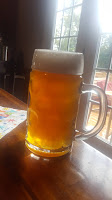
The word 'polotmavé' literally means 'half-dark', and is a style of beer that sits somewhere between pale and dark lager, the one above being from Klášterní pivovar Strahov. Generally speaking, polotmavé lagers use the same malts as a tmavé, just less of the specialty malts so the beer has an amber or red colour. There is a school of thought that says polotmavé lagers descend from the Vienna Red lager tradition of the 19th century, but I don't want to jump into that today.

If advocating for Burton Ale, bitter, and mild was crazy, then I think this project is proof it is time to be packed off to the beer equivalent of the loonie bin. According to RateBeer, there have been a grand total of 15 polotmavé lagers made by US brewers, though I can't verify the faithfulness of those beers to the stuff I would drink from time to time back in Prague. In a purely Virginian context, I believe this will be the first genuinely Czech inspired polotmavé brewed in the Commonwealth. There is one other on RateBeer but the description says it was just a pilsner with a bit of roast malt chucked in to change the colour, not really in keeping with Czech tradition, so I am discounting that.

With our project, we are planning a 16° beer, which should probably finish out at about 6% abv and using the same specialty malts as for Morana, namely CaraBohemian, Carafa II Special, and Munich. On the hops front we are using a blend of Kazbek and Saaz, to give us about 30 IBUs, and of course we'll be using the Augustiner yeast strain for that clean lager bite that I love so much (especially lagers from Devils Backbone!).

The beer, which as yet doesn't have a name, should be on tap some time in October. Just in time, hopefully, to wet the heads of my soon to turn up twin sons...

Monday, April 15, 2013

It's Real!

I noticed on Friday that Ratebeer has finally caught up with the real world and accepted that Polotmavý, which is Czech for 'half dark', is a distinct beer 'style' from Vienna lagers or the more generic 'amber lager'. They describe the 'style' as follows:
'This is the amber lager style of the Czech Republic. The character that the brewery usually aims for with this style is a hybrid between the dark lager and the pale pilsner. The result has a richer malt character than the American Dark/Amber Lager/Vienna style and more hop than the Oktoberfest/Marzen style'.
While I understand what they are trying to say here, let me just clear something up, Polotmavý is not a 'hybrid' of pale lager and tmavý, which is dark lager, it is a descendent of Vienna lager. For a better idea of these beers, this is what Evan Rail says about it in the 'Good Beer Guide - Prague and the Czech Republic':
'Unlike Pilsner-style brews, which usually require extremely soft water, half-darks can be made with a higher carbonate content and can include caramel and dark malt to various degrees, as well as Pilsner malt. Extremely clear and reddish-amber in colour, they are perhaps closest to the Vienna lager invented in the 19th Century by Anton Dreher'.
Something that is important to remember with Czech brewing though is that what we in the Anglo-American centric beer world call a style, such as polotmavý, is really just a definition of the general colour of the beer. Most examples range from a rich amber to a garnet red, as such you'll see beers marketed as 'jantar' and 'granát' respectively. Remembering that fact is important, because under the current Czech brewing laws there are 4 categories of beer based on strength, each of which can be Polotmavý:
  • Stolní pivo or 'table beer', up to 6° Plato OG (up to 1.024 and rarer than hen's teeth)
  • Výčepní pivo or 'tap beer' between 7° to 10° (1.028-1.040)
  • Ležák or 'lager' 11° and 12° (1.044-1.048)
  • Speciální pivo or 'special beer' 13° and higher (1.052+)
Another thing to be aware of is that Polotmavý is not the same as a řezané, which is a blend of dark and pale beers, both should be the same gravity, to make a Czech lager equivalent of the black and tan.

As for how a Polotmavý will taste, again let me quote Evan (admittedly for the Ležák variant but applicable across the board really):
'a lightly toasted taste and some serious malt complexity followed by a balanced hop finish'.
As with most Czech beers, the hops in question are likely to be Saaz, so expect lots of that wonderful lemony, hay, grassy thing that is so characteristic of the most noble of noble hops.

To mark Polotmavý's acceptance on Ratebeer, I cracked open some of my homebrew version, which I call Dark Island Granát, on Friday afternoon, when Mrs V got home from work....


Is it 'to style' (such a bullshit phrase)? I like to think so, is it dangerously moreish to drink? Oh yes.

Friday, January 11, 2013

To the Half-Dark Side

As I alluded to on Monday, I don't think it is possible, or even desirable, to force Czech beer into an essentially Anglo-American taxonomy. As such even I cringe when I use the term 'Bohemian Pilsner' as a catch all for the wonderful pale lagers produced throughout the Czech Republic, and think it should only apply to pale lagers made in the city of Plzeň itself. Anything from outside the city, though it may be made in the style of a Pilsner beer, is a Bohemian Pale Lager.

I am sure that some will see that as splitting hairs, especially given that the essential process of making Plzeňský Prazdroj, Budvar or Svijany Rytíř is the same, but I think it is a question of respect. A sparkling wine that comes from California, Spain or Australia is not a Champagne, even though it may share may characteristics, the same holds true for Pilsner. When I first moved to Prague I noticed that often Prazdroj drinkers didn't like Budvar, and vice versa. For many years I much preferred Budvar to Prazdroj, though now I like them both equally, depending on my mood and in my opinion tankový Budvar is every bit as good as tankový Prazdroj.

Anyway, back to my original, though so far unstated, theme for today. I plan to brew my first beer of the year on Monday, a polotmavé výčepní or 'half-dark tap' beer. If you want to force it into an entirely made up style for the Anglo-American mind, you could call it a 'session Vienna lager'. Of course polotmavé pivo is related to Vienna lager, although this type of beer was practically dead until 1999 when, to use Evan Rail's turn of phrase, Staropramen 'in a strangely heroic move' gave new life to it with Millennium. The recipe for my beer is as follows:
  • 48% Bohemian Pilsner malt
  • 42% Munich malt
  • 9% CaraMunich I malt
  • 1% Carafa II Debittered malt
  • 17 IBU 8% AA Kazbek for 60 mins
  • 10 IBU 3.9% AA Saaz for 15 mins
  • 0.5 IBU 3.9% AA Saaz for 1 min
  • Saflager S-23
The vital stats for this beer will be, hopefully:
  • OG 10.2° Plato (1.041)
  • FG 2.6° Plato (1.010)
  • ABV 4.1%
  • SRM 13 - copper to red
I plan to ferment the beer in my garage, which is sitting at about 49°F, or 9.5°C, at the moment, for about 2 weeks, with a diacetyl rest indoors at 60° for a week thereafter, followed by 4 weeks in the fridge, lagering at 38°. I haven't decided yet if I am going to attempt any decoctions for this one, though I am tempted to try a single decoction.

In theory in should be ready for March, and perhaps the National Homebrew Competition, though quite which category I would enter it in I have no idea.

Wednesday, May 18, 2011

What Does A Czech Have To Do?

I have found in my almost two years of living here in the United States that amongst the beer loving community there is a reverential awe that comes out whenever it comes up in conversation that I lived in Prague for the best part of a decade. I was going to write "beer fraternity" rather than "beer loving community" but equating the fine people I have met through beer with the boorish, obnoxious pillocks that are the stereotype of "frat boys" would be doing many a top bod a disservice.

Czech beer has, quite rightly in my opinion, an aura of excellence associated with it, and several people I have come in contact with talk about their few days drinking in Prague as one of the highlights of their beer drinking lives. However, the ignorance in the beer community over here about Czech beer never fails to astound me, and as ever it is Those Sites (how Shakespearian, like calling MacBeth "the Scottish play") that unwittingly, or otherwise, promulgate such ignorance through their rigid misunderstanding of beer styles in central Europe.

I have argued at length, both on here and on one of Those Sites, that tmavé should be a separate style for ratings, rather than being lumped together with either Dunkel or Schwarzbier. The knee jerk response is that there are too many styles already and it would just sow confusion amongst the ranks. Suggest however that Black IPA should be style and hey presto, a new style is born with an almost religious anti-critical fervour.


Czechs, however have another style of beer which is misunderstood and neglected on such sites. Polotmavé, which translates literally as "half-dark" is usually lumped together with Vienna lager, usually on the basis of them both being the same(ish) colour. Using such logic, I guess then that Schwarzbier is in fact a porter. The problem with calling polotmavé a Vienna lager is that Vienna lager as originally created by Anton Dreher used a single malt, can you guess what it was called? Most modern Vienna lagers, from what I have learnt, use a base of pilsner malt with a hefty dose of Vienna malt. Personal aside here, if you are making a Vienna with none of the eponymous malt then it isn't really a Vienna lager, regardless of the colour.


Polotmavé on the other hand, as the name kind of suggests, uses the same malts as tmavé but less of the specialty malts that make tmavé darker. As with many things in Czech brewing, their is a huge spectrum covered by the term polotmavé - from the 13º version made by Primátor to the insanely gorgeous 16º beer from Hotel Pegas that I drank in Brno. There is at least one brewery in the Czech Republic that makes both a polotmavé and a Vienna lager, called a Vídeňské červené or "Viennese Red", which to me at least suggests that Czech brewers understand the styles differently.


I guess what I am really trying to say here is that Czech beer, just as much as British, German, Belgian or American, must be understood on its own terms and not forced into artificial categories just because it makes life easier for some. It is this false categorisation that makes ratings from certain sites for some beer styles entirely irrelevant, because the model against which the beer is judged is not the same as the model from which the beer is made.

Wednesday, April 20, 2011

The Nature of the Relationship

It is clear that beer doesn't exist within a vacuum, in the sense that brewers don't sit on the steps of their brewhouse and invent entirely new beers without the years of knowledge and expertise the brewing community has acquired. The development of Pilsner was not a case of Josef Groll going into isolation and suddenly creating this pale lager that would revolutionise the beer map in Europe. He bought with him the tools and knowledge of centuries of Bavarian lager brewing to create a beer using the ingredients native to Bohemia - which raises the question again in my head, what was pre-1842 Pilsner beer like?

Tmavé is similar, in that at around the same time as Baltic Porter went from being primarily warm fermented to cold fermented, so did it. Putting pay in many respects to the lunacy of labelling tmavé as either a dunkle or a schwarzbier, it is neither, though possibly related to both. It would almost be like calling the English language either French or German because it is influenced by both. Personally I have a notion that the old Pilsner beer was a warm fermented tmavé, but I can't prove that at the moment.

There is, however, a third common beer style in the Czech lands that deserves more attention than it gets, polotmavé - literally a "half-dark". From my understanding of the style, it was an old lager style which went belly up and was eventually resurrected by Staropramen when they brought out Millenium back in 2000, replete with misspelling. These days Millenium is known as Granát, Czech for garnet, and that has become a fairly common name for breweries making a polotmavé, the other being "Jantar", which means "amber".

Something I am researching and trying to figure out at the moment is the relationship between Vienna lager and polotmavé, if such a relationship exists of course. Yes, there is a overlap in terms of colour, but is that where the relationship ends? Vienna lager was, at least in the 19th century, made with mostly Vienna malt, if not entirely, yet polotmavé appears to be made with the same malts as tmavé but proportionately less of the dark caramel and black malts.

All this theorising about cold fermented beers of varying traditions is really making it a necessity in the near future to work out a suitable method for fermenting and lagering so I can put my theories to the test. One idea I have is to brew a single gallon of them at a time, ferment in the fridge - a 1 gallon jug will stand up quite nicely. Then for lagering, pack ice into a bottling bucket, put the jug into the bucket and then surround and cover with more ice, and store in my cellar - changing the ice as required.

Any thoughts?

Of Guards and Fathers

It was 7.30am when my plane landed at Heathrow, the beginning of my 9 days back in the United Kingdom. Given the fact there was only an hour...