Showing posts with label beer business. Show all posts

Friday, June 19, 2026

Good News!

A quick break in the scheduled postings - trust me, I carried on my bitter and pub adventures in the UK after flying to and from Inverness - but this is good news that needs sharing.

On Wednesday an email was sent out that I have actually been expecting for a few weeks now, but I didn't want to let the cat out of the bag. Simply put, Murphy & Rude are not going out of business.

But first, a tale of how I learnt that news. When it became public that Jeff and co were going to be closing down, I said to Mrs V that I needed to make a big order of malt to see me through the rest of my brewing year. To that end I bought a 50lb/22.7kg of Virginia Pils, and one of English Pale - they are, after all the base of pretty much all of my beers. Also as part of that order I got 25lb/11.4kg bags of Vienna and Biscuit malts; 10lb/4.5kg bags of white wheat and brown malts; and 5lb/2.3kg bags of Munich 9, Munich 15, and Americano (basically pale chocolate) malts; oh and a packet of Greenmont Mother hops for good measure. A total then of 185lbs/84.1kg of malt.

When I swung by their old location to collect my order, Jeff was there and the very first thing he said to me was "Murphy and Rude will abide my man, Murphy and Rude will abide". He then proceeded to tell me the story behind the demise and resurrection of Murphy & Rude. The demise was basically a perfect storm of increased rents, heat affected green barley, and climate change impacted agricultural loss, resulting in a lack of product to tide the company over a planned move to a new location about 35 miles from Charlottesville.

The resurrection, which is the important part of this story, is the result of an agreement with Carolina Malt House, based in Cleveland, North Carolina, just north of Charlotte. As a result of their partnership, production of Murphy & Rude malt is moving to North Carolina, but importantly (at least in my opinion) Carolina Malt House will continue to purchase barley from M&R's Virginia farmers specifically for Murphy & Rude products, which will be malted to M&R's product specifications. So, Virginia Pils will still be Virginia Pils, made with Virginia grown Violetta barley.

While production is moving to North Carolina, Jeff will still be leading the sales, product development, and order fulfillment for the Murphy & Rude brands throughout Virginia. For homebrewers, like myself, Jeff is working on a solution to keeping the Grain Store going, which is fantastic as I really want to continue using Murphy & Rude malt in my beer.

In a time when we are seeing brewery, and allied industries, closings regularly, it is great that a solution has been found that keeps alive Virginia malt, made from Virginia grain, turned into Virginia beer. Here's to years more of brewing with Murphy & Rude malt!

Wednesday, April 29, 2026

Some Closing Thoughts

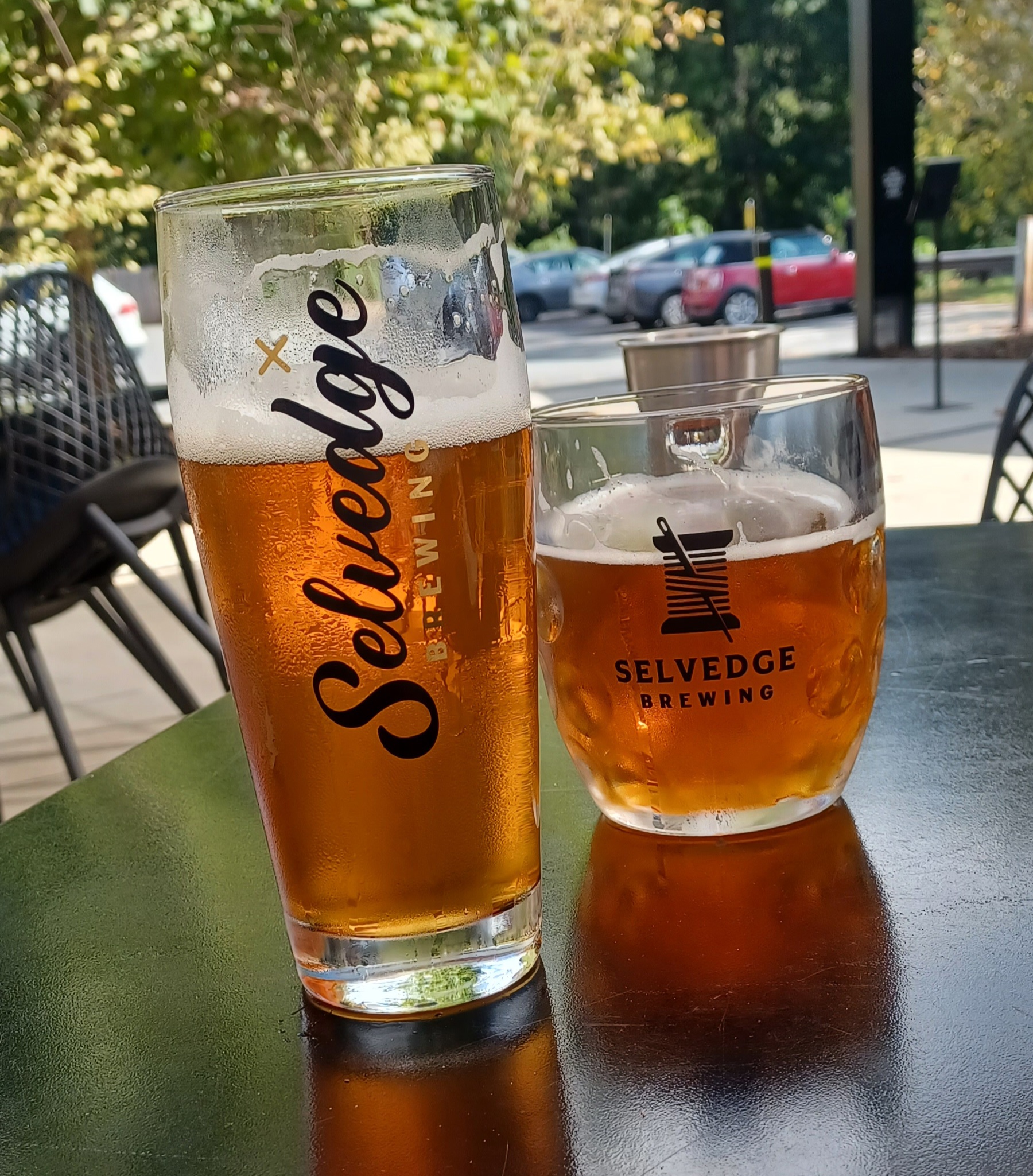
On Friday afternoon, with work concerns disappearing into the rear view mirror, and a little time to go until I had to pick up the twins from school, I was having a very fine pint of lager (but which one?? It was Vested Interest, a Franconian-style kellerbier) at the bar in the Selvedge Brewing taproom. As I reveled in the magnificence of that beer, which is a stunner in an already superb lineup, I heard news that instantly yucked my yum.

Virginia's only craft malting company, my good friends Murphy & Rude, are closing their doors at the end of May.

To be honest, I don't know the ins and outs of why Jeff has decided to shut up shop, so I am not going to speculate on that. From what Murphy & Rude have told customers though, they were looking to scale and it became clear that the challenges of scaling made it unfeasible. What I do want talk about though is the ramifications of their coming demise.

From a very personal, and entirely self-centred, perspective, I am bummed that I am going to have to re-formulate all my homebrew recipes. For several years now, I have committed myself to brewing as much as possible with only their malt. My reasons are pretty simple, they are local, they malted, for the most part, Virginia grown grain, oh and their malt made my beer a lot better. While my best bitter was perfectly good with Maris Otter or Golden Promise, when I switched to using Murphy & Rude English Pale malt, the ante was upped quite significantly. Fresh malt makes a massive difference in terms of flavour. I also have recipes that I have designed specifically for Jeff's malt, my Haus Lagerbier is built on his Virginia Pils malt, which uses the Violetta strain of barley, as has the most recent versions of LimeLight, my lime witbier. As such, I will have to drop some dollars on stocking up on my preferred malts, and some containers to keep rodenty bastards at bay, so I can carry on brewing my favourite recipes for as long as possible.

Taking a broader perspective, there are several local breweries who are now in a similar position, though obviously with far more at stake as they make their living from Murphy & Rude malt. If I remember rightly there were about 12 breweries in Virginia that only used Jeff's malt, but something like 50 outfits using it at some level, including in some wonderful award winning beers. All of these will have to be re-factored for different grains, and in some cases find new suppliers, set-up accounts, contracts, etc, etc.

Taking it slight broader yet, there are farmers with grain in the ground right now who will have to find a new customer for their harvests. Most of those farmers, as I mentioned earlier are in Virginia, with some in Maryland and Pennsylvania, according to the M&R website. Hopefully the malting companies in those states will be able to pick up those harvests.

I don't think it is overstating the case to say that the loss of Murphy & Rude is a tragedy for the craft brewing and allied industries in Virginia. As Josh Chapman commented in my article about Murphy & Rude in Pellicle:

"When you close the distance between supplier and producer, things can only get better".

With that distance inevitably widening again, we are all the poorer for it.

Note: all the pictures here are beers I made exclusively with Murphy & Rude malt.

Friday, April 25, 2025

Session 146 - What Value in Beer?


Yikes, where did the last couple of months go? The cynic side of me says "right down the shitter" whereas the more considered side says "life's just busy". Anyway, it's time for the Session again, and this month is being hosted by Ding and he has asked us to consider the "value" of beer, in the sense of:

"when I part with the cash, no matter how large or small the amount, does what I receive in return meet or exceed the value of said cash? Subjective? Sure, but we all have our own sense of value."

 Yeah, very subjective topic here, but one that I feel gets to the very heart of why we drink beer at all, or at least why we don't submit ourselves to the tyranny of the lowest common denominator brew that is ubiquitous with wherever we live. That's not to say that industrial brews like Budweiser, Carling Black Label, Stella Artois, or Gambrinus are inherently bad, just that they lack value for me.

So, yes, let's think about value, at least the word itself. Value is by its very nature relative, where I might balk at spending $5 on a pint of a given pale lager, I am more than happy to spend $7 on a pint of some alternative lager. For the sake of discussion, let's assume both beers are of the same style, similar ABV, and fairly equivalent IBUs derived from the same family of hops. What factors then make me willing to spend more money on the beer with the higher price point?

My first consideration is likely to be process. If said beers are of a Czech lager style, regardless of strength and colour, then I would be asking questions like "was the mash a decoction?", "how long did it lager for?", as well as expecting a voluminous foam head when poured. I will put this out there from the start, I don't give a flying monkeys if it is poured from a Lukr tap. For nearly the entire time I lived in Czechia, Lukr taps were not a thing, they really only started showing up in around 2008, oh and I don't recall ever seeing the choice for different pours. You asked for a beer, you got a beer, a well poured beer more often than not, with a voluminous foam head, from a flow control beer tap like the ones in this picture*.

All of that is not to say I won't drink beers if poured from a Lukr tap, just that I don't buy the marketing that has built up around it - after all it's not as if Czechia was a beer desert in the half century or so between the original side pour taps being replaced by modern flow control taps and their making a re-tooled with filter screen re-introduction.

Anyway, got a bit off topic there. Yeah, process, why do I care if a Czech style lager has been made with a decoction mash and extensive lagering more so that how they are poured? Well for starters even when ripping our the original side pour taps, the breweries weren't ditching their process for actually making the beer. From my reading of history, there was no en-masse move to step mashing, there was no trimming of lagering times to get product out the door as soon as possible, there was a well established way of doing things that didn't need changing, so why bother? 

Part of the value then of a beer for me comes from the brewer's own sense of wanting to make an authentic product. Sure you can make a tasty pale lager with an infusion mash, a touch of melanoidin malt, and Saaz hops, but it will never be a truly Czech style lager, and I value that authenticity. Coming back to Lukr taps for a moment, I actually love them when the beer being served from them has been produced in a manner that a Czech brewer would recognise as the correct way to make it. Like this 12° pale lager from Selvedge here in Charlottesville.

Even then this brings up the question of "what is authenticity?". If a pastry stout, hazy IPA, or syruped up fruity gose is an genuine expression of the brewer's view of beer then fine, I am not going to drink it, but everyone has their own thing and will likely find a market for it. And that is another question in my mind that creates that additional value, does the brewer actually drink what they are putting out? If I am in a taproom and see the brewer drinking the only pilsner on the menu, for example, then I am more likely to try that than all the variants of IPA on offer - let's not deny it, we all know many a taproom with 25 taps of IPA, a lager, and Guinness as the guest stout. The beer that the brewer drinks most, is likely to be the only they pour the most of themselves into, and thus it becomes the one that is their "house beer", and that adds value.

Value is intangible, personal, difficult to really describe. What I value in a beer, or even entire breweries, others don't give a rat's arse for, and maybe that comes to the crux of why I am such a crap beer tourist, when I find a place that makes the kind of beers I like, in a way that feels authentic, whether to the brewer themselves or my own little collection of prejudices, then I am a happy, loyal, and potentially slightly tipsy customer.

* - the picture is by my good friend Mark Stewart, was taken at my old local in Prague, Pivovarský klub, on the occasion of my wedding reception.

Thursday, February 15, 2024

Homebrew - Cheaper than the Pub?

The price of beer has been on my mind a fair bit lately.

At the weekend I kicked my first keg of homebrew for the 2024, a 5.1% amber kellerbier that I brewed on New Years Eve. The recipe was nothing spectacular:

  • 6.5lb Murphy & Rude Vienna malt
  • 3.5lb Murphy & Rude Munich 9 malt
  • 0.5oz Magnum
  • 2oz Saaz
  • 1oz Hallertauer Mittelfrüh
  • 2 packets Saflager 34/70
If anything were out of the ordinary about this beer, it was that it marked the first time I did a decoction mash. The beer that eventually came out of the tap was lovely, and looked like this:


Admittedly I was somewhat gutted that it had kicked so quickly as it was a lovely, lovely beer, still I am planning my next brew of it, especially as I finally caved and bought a chest freezer to set up as a fermentation and lagering chamber.

As I said though, the price of beer has been on my mind. Part of me was a little confused as to why the keg kicked so quickly, after all a 5 gallon keg is supposed to be about 40 pints. Yes, when I filled the keg, I think there was only 4.5 US gallons in the keg itself, which is 17 litres for the cool, modern, kids using metric, even with a 10% wastage factored in, that would be about 35 beers. It was then I had a brain wave and remembered that by far and away I do most of my drinking from half litre glasses like the Tübinger mug in the picture, so maintaining 10% wastage, we are down to 31 half litres, but if I actually fill my keg with 5 gallons/19 litres, with wastage it becomes 34 half litres, or 36 US pints.

If I were to drink 36 US pints at current standard prices in the Charlottesville area, that would be $252 for a full keg, but with only 4.5 gallons in the keg, it becomes $230. I decided then to calculate how much said beer cost to make, and it break down something like this:
  • grist: $25.84
  • hops: $12.22
  • yeast: $17.98
  • total: $56.04
My water is free as I have a well, but if I include that at the rate of $1.30 for a gallon of Walmart bottled water, I used 8 gallons for a total of $10.72, making our ingredient total $66.76, or $2.15 per half litre of beer. Now, it would be completely disingenuous of me to say my beer only cost $2.15, as I haven't included costs for labour and buildings, etc.

My single decoction brewday for this beer consumed about 7 hours of my time, so if I calculate that at $14.30 per hour as the lowest hourly rate for a brewer in Virginia. Apparently the average in Virginia for a professional brewer is $18.25 per hour. My keg has now cost me an additional $100, so we are at $166.76. Brewing the beer though is not my only labour here, I also have to serve it to myself and my friends. So let's say at a party, a 5 gallon keg of beer kicks in about 3.5 hours - based on my experience of providing kegs to parties - at the minimum wage for Virginia tipped employees of $12 per hour, that would add $42, so we're at $208.76 for brewing and serving a 5 gallon keg of a fairly standard beer. I haven't even factored in rent for my few square feet of garage where I do my brewing and store the product while it is fermenting, but let's call that $10 a month based on the size of my house and my mortgage, with bills chucked in there too. So now my keg has cost $218.76 to brew, store, and serve. If I get a full 34 half litres out of that, we are at $6.43 per half litre.

Thankfully, I don't have to pay myself to make beer, neither do I pay myself to serve the beer, and so the real cost for a half litre of my own beer at home is about $2. One thing though that is really clear to me from this little exercise is that ingredients are not the bulk of the cost of making the beer, it is a the people, equipment, and place to do so. Obviously I am also not able to take advantage of the economies of scale that a commercial brewer (sorry idealogues, if your favourite beer is made by a company that does so for a living it IS a commercial brewery), especially when it comes to non-linear increases such as the ingredients, and don't forget to factor in that a single decoction brewday in my garage takes about as long as a single decoction brewday at a professional brewery with the appropriate kit. 

It is ultimately scale that makes such comparisons effectively futile.

Is it enough to make me give up brewing my own beer because what is the point in saving less than a dollar a pint? Not in the slightest, because here in the real world it is a hobby where I just so happen to make beers that I really enjoy brewing, drinking, and sharing with friends. I also feel that reducing the hobby down to just the financials is to lose sight of why I brew - to have on tap beers most US breweries don't touch with a ten foot barge pole, the creative urge to develop and improve recipes, and when you live in a place where the absence of walkable pubs is stark, being able to have a draft beer whenever you feel like it - is to miss the point at the end of the day.

Wednesday, February 7, 2024

A Loss for Virginia

The Virginia brewing scene is a poorer place today.

Do we still have around 350 breweries in a state with a population of 8.6 million, giving us a brewery for approximately every 24,000 people? Yes we do. Can you go in pretty much any decent sized store and get beer brewed in Virginia? Yes you can.

Still, the Virginia brewing scene is a poorer place today.


"Why?" I hear you ask...

Yesterday, Josh Chapman, owner and brewer at Black Narrows Brewing on Chincoteague Island announced that they have decided to close their doors - their final weekend in operation will be February 16-18th. You may, or may not, know that I wrote a profile of Josh and his brewery for Pellicle just last year.  It was also just last year that their magnificent malted corn lager "How Bout It" was awarded a Good Food Award - the corn in the lager being an heirloom variety, grown on the Eastern Shore, malted by Murphy & Rude in Charlottesville, and fermented with a yeast strain derived from a Chincoteague oyster. Beer does not get much more local than that.


My few hours on Chincoteague with Josh was a shot in the arm for me. Here was someone making beer in ways that deeply resonated with me, on equipment that wasn't state of the art, in a manner that seemed to encapsulate the early pioneers of craft beer. Josh's hops were mostly from the Eastern Shore, he only used Murphy & Rude malt, which is all made from Virginia grown barley, he did interesting things, like using pine needles, oyster liquor, and eelgrass in his beer. He supported his community by taking what they could offer, and returning it to them in the form of insanely tasty beer.


Black Narrows was a local brewery in perhaps the purest sense of the word.

In announcing the closure, Josh noted that "we watched our ingredients, equipment and labor costs increase. It was all too much". In the end, the finances of being a hyper local, community supporting brewery just couldn't sustain the business, when I interviewed Jasper Akerboom noted that "If you start a brewery, you are not going to get very wealthy". Prescient words perhaps.

Thankfully, the beer scene on the broader Delmarva Peninsula is not losing Josh entirely, and there is something new in works, and when it opens you bet your life I'll be trekking up past northern Virginia to get there - and how much I hope the corn lager will be part of this new adventure.


I am not generally a sentimental person when it comes to the business of brewing, but when it came to Black Narrows, I genuinely wanted them to succeed and thrive as their vision of what local, community, brewing means is something I can readily sign up for, where a company is not just a local brewery, but a brewery for locals.

Thursday, October 26, 2023

What Price a Pint?

Yesterday, the following image popped up in my various socials:


Said image was accompanied by the following text:
"Starting today all pints will be $3.50. Share, spread the word, and show us some love so we can keep it going for the full month… or forever, should the response be undeniable; either way, this is the price that pilsners should be. Come and take advantage!"

Three things immediately sprang to mind, firstly that is a damned fine looking pint, secondly, I don't think I have ever paid $3.50 for a pint of beer in my 14 years living in Virginia, and thirdly bravo to Tabol Brewing!

Tabol Brewing are based in Richmond, and given that I very rarely go that way I have yet to actually get to their taproom, where all pints are now $3.50. I have, however, had a few of their beers in cans, on tap at Beer Run, or in the case of my favourite beer of late summer/autumn their collaboration Franconia inspired vollbier with Selvedge Brewing. Everything I have had from them has been superb, and the vollbier, Tabolcloth, is very much a contender for the Fuggled beer of the year.

A while back, I wrote a post about what the price of a pint would be if we followed the pricing restrictions of Reinheitsgebot as well as the ingredients, and unless my maths is entirely atrocious (eminently possible), based on the average daily wages of a manual labourer in Virginia and it's purchasing power compared to 16th century equivalents, Tabol's new price point is pretty close.

I reached out to Travis at Tabol to share the post I mention above, and while he admitted that he could "proffer zero opinions with regard to the maths of the various European currencies" he did tell me his reasoning behind the change:

"my cans are sold, to-go, at $3.50 a piece in their 4 packs and more expensive packaging. I figured I could cut my pint prices in half, and still be making as good or better profit than my to-go sales in cans".

I have long muttered under my breath about the price of a pint at a brewery's taproom, especially when you consider the number of markups removed from the brewery to drinker process when you buy a pint in the taproom. To see a brewery actually take action on behalf of the consumer then is both refreshing and in my opinion absolutely fantastic.

Travis continued:

"I'd like the working man's beverage to be affordable. I just want to know it it's enticing enough to drop the price. Instead of seeking hype and notoriety for a brand, maybe my traditional style lagers should be more traditional in price? If we can make it work".

I am pretty sure this move it going to stir the pot in craft brewing circles in Virginia, especially given the number of breweries where they are changing $7 and upwards for a pint at their taproom. I am sure that Travis and the Tabol team have considered all the economic implications around the change, and to be perfectly honest I desperately want them to succeed, even though I am unlikely to get to Richmond any time soon and take advantage of $3.50 pints of superb lagers.

I also love the fact that Tabol don't shy away from the fact that beer is the everyman drink rather than a niche product for the upper middle classes. I realise every brewery is different, and for many where their primary outlet is a brewpub, dropping prices so dramatically might not be possible given the added overheads of being a restaurant. But where a brewery's taproom is exactly that, a place to drink a brewery's beer, in situ, as fresh as fresh could possibly be, without the additional logistical steps that drive up the price, then cheaper than draft or packaged retail should be the norm. If this move drives down the cost of a beer, that is a good thing in my world. After all, isn't that one of the supposed benefits of increased competition? 

We have shit loads of breweries now, so why are prices not coming down in line with the alleged economic orthodoxy that increased competition is good for consumers?

Tuesday, June 13, 2023

Terroir: Bollocks for All?

Matt at Pellicle stirred things up a bit yesterday with his post titled "There is No Such Thing as Terroir in Beer". There followed a raft of commentary on Twitter, which I got engaged in as a result of retweeting the article:

This got me thinking more about the concept of terroir in general and so I figured I'd do a little research and put my thoughts down in a blog post.

The first thing I wanted to make sure of was that I had a proper understanding of "terroir", what it is, what it isn't, and for that I turned to the world of wine, in particular this video by Konstantin Baum:

In the video, Konstantin lays out 2 competing visions of "terroir", the "naturalist" approach that focuses purely on the impacts of the soil, geology, and climate on the fruit, and the "culturalist" approach that also includes the impact of human activity on the wine. As Konstantin points out the "naturalistic" approach "is misleading in its mythic simplicity, vineyards are not naturally occurring, they are cultured land, managed by people".

I also discovered that UNESCO actually has a definition of "terroir" as being:

"a living and innovative space, where groups of people draw on their heritage to construct viable and sustainable development."

I think it is clear then that the naturalist approach to terroir is unhelpful as it diminishes the key inputs of humans in the creation of wine. I love the phrase Konstantin uses in his video, that the naturalist approach almost has a vision that "the wine makes itself, or flows out of a crack in the soil like a miracle wine fountain".

It is true that grapes will ferment in nature, as they overripen and the sugars turn to alcohol - ever wondered why wasps are more aggressive in the autumn? It's because they are pissed on fermenting fruit. However, simply fermenting fruit does not make wine, cider, or perry, if that were the case there would be no need for wine makers, cider makers, or perry makers.

So much of what I learnt about the culturalist approach to terroir actually chimes deeply with me with regard to the segment of craft brewing that I find myself drawn to, and it clarifies some of my thoughts around the problem of "local" beer. I have basically got to the point that I can no longer think of a factory that makes beer in a given location, whilst importing grain from Canada, hops from Germany, yeast strains from the UK, and removing all the mineral distinctions from their water as a "local" brewery. This is not to say that I won't drink their beer, or that I don't like them as a brewery, but they are no more special to me than a brewery making similar beers in North Carolina, California, or Germany. Surely there must be more to local than just location?

In this sense, what Matt says in his article is true. Terroir for industrial brewing is bollocks, and when I say industrial I mean it in the sense that the beer is made in a factory with a globalised supply chain that could, if the owners so desired, be picked up and plonked somewhere on the other side of the planet and make the exact same beer.

However, that is not true for all beer. 

Here in Virginia we have a distinction made in the brewing laws for a business that functions as a "farm brewery". A farm brewery is required to grow a minimum portion of their ingredients on their own land. It is a very pre-Industrial Revolution model, and one that I find deeply appealing. Just up the road from me is Lickinghole Creek Brewing, I think they were the first farm brewery in Virginia, and they grow a substantial amount of their ingredients on their 305 acre farm. Given the culturalist approach, I would argue that for Lickinghole Creek, and other farm breweries, and breweries that source the vast majority of their ingredients from their locality, the concept of terroir is most definitely not bollocks.

I think this comes back to the parting of the ways I wrote about a few weeks ago, where you have "craft" brewing as an expression of modernity (or post-modernity if they are self-consciously cool), industrial lite you could say, and then you have "artisanal" brewing which roots itself in a sense of place and tradition, where terroir is very real, and cherished.

Wednesday, May 17, 2023

The Price of Reinheitsgebot

Anyone with even the most cursory interest in German beer knows about Reinheitsgebot, the famed Bavarian "Beer Purity" law enacted in 1516 that defined the ingredients allowed in Bavarian beer as "barley, hops, and water", with yeast being added later. It is, however, not the brewing aspects of this law that I have been pondering lately, rather it is this bit:

"the following rules apply to the sale of beer: From Michaelmas to Georgi, the price for one Mass or one Kopf, is not to exceed one Pfennig Munich value, and from Georgi to Michaelmas, the Mass shall not be sold for more than two Pfennig of the same value, the Kopf not more than three Heller. If this not be adhered to, the punishment stated below shall be administered. Should any person brew, or otherwise have, other beer than March beer, it is not to be sold any higher than one Pfennig per Mass."

and further

"Should, however, an innkeeper in the country, city or market-towns buy two or three pails of beer (containing 60 Mass) and sell it again to the common peasantry, he alone shall be permitted to charge one Heller more for the Mass or the Kopf, than mentioned above."

First some background, Michaelmas is celebrated on September 29th in the western Christian tradition, and "Georgi" refers to Saint George's Day, which is April 23rd. A "mass" in this context is slight more than the modern litre, while the "kopf" is a bowl type vessel that is just a bit smaller in volume than the mass. So far so easy, right? Money, there is nothing new under the sun, complicates everything. The law refers to Pfennigs and Hellers, and there were 2 Hellers to a Pfennig, and that's about all I can say for sure given the weird and wonderful world of Central European currency in the 16th century and it's thalers, florins, guldens, and schillings. 

Officially though, just a few years after Reinheitsgebot was decreed, Holy Roman Emperor Charles V declared that a Thaler (named for Bohemian town Joachimsthal, modern day Jachymov) consisted of 24 Groshen, 288 Pfennige, and 576 Heller. However, this being Central Europe it ain't that easy, because some areas used the Gulden as their top level currency, which consisted of 60 Kreuzer, 240 Pfennige, and 480 Heller. From what I can ascertain, Bavaria used the Gulden side of the equation, but just for fun also had coins called Thalers. Yeah, Central Europe - regardless of subject if anyone thinks understanding the lands that once made up the Holy Roman Empire of the German Nation is simple and neat, they are idiots.

Anyway...1516 and the Duke of Bavaria has decreed the price of a litre of beer is a single Pfennig in the dark and dreary winter months, and two Pfennigs in the busy summer season of sowing and harvesting etc. According to Ernest Bax, writing in "German Culture: Past and Present", published in 1915, a day labourer could earn up to 18 Pfennige a day without keep or 12 with, assuming a 6 day work week, our agricultural labourer could pocket between 72 and 108 Pfennige a week. According to Bax, a Pfennig would buy you a pound of sausage, and 2 Pfennige a pound of the best beef. All this got me thinking, how would modern beer prices stack up against Reinheitsgebot?

It is difficult to do a like for like comparison with prices from 500 years ago to today, and of course the market place is wildly different, but one thing I find particularly interesting with Reinheitsgebot is not just the ingredient defining, or even the price setting, but it also defined how much profit a retailer could make from selling beer to the general public:

"he alone shall be permitted to charge one Heller more for the Mass or the Kopf".

As such, in the summer months an innkeeper's markup would be 25%, while in the winter months it was 50% for a Mass and 33% for a Kopf. 

It's interesting to think about the role of beer in wider society, and why regulations are written the way they are. Reinheitsgebot makes beer cheaper in the dark miserable months of winter, which is also the time in a pre-industrial revolution world when there is less work to be had. The harvest has been gathered and the transient labourers have moved on to some other endeavour. When the farming world comes back to life the prices go up, after all you don't want your workforce getting merry on cheap beer when there is work to be done.

While direct comparisons are difficult, and perhaps even futile, it is interesting that the average price of beer, it would seem, in my part of Virginia is $7 for a 16oz pint. According to ZipRecruiter the average wages for a day labourer in Virginia would be $130.88 per day. In terms of purchasing power, a Bavarian day labourer without keep, if he spent a whole day's wage on beer could buy 18 litres of beer, or 38 16oz pints, while our modern labourer could purchase just shy of 19, basically half as much.

Perhaps we need a Reinheitgebot re-issue for the 21st Century?

Wednesday, May 3, 2023

A Definitive Thing

This reference will definitely give my age away...one of my favourite films as a kid was the Jim Henson classic, "The Dark Crystal". I also loved the Netflix prequel "Age of Resistance" and was heartbroken when the philistines in Scotts Valley cancelled it after a single season. I may have mentioned this before, but the mother of a friend was involved in the costume design of the original film, but that is irrelevant here.

If you haven't seen the film, then please do so, it is as I say an absolute classic, the basic premise is that in breaking the Crystal of Truth the UrSkeks split into two distinct races, the Skeksis and the UrRu, and it is at this point that using the Dark Crystal as my analogy of the beer world completely falls to pieces, like a Garthim at the end of the film - but heck, no analogy is perfect.

This post really has nothing to do with The Dark Crystal other than the fact that the existence of two distinct species where previously there was one came to mind as I mulled over the question "what is craft beer?"

Now, I have no interest in rehashing arguments about whatever small and independent means these days or whether certain business models are more "craft" than others, or even if ownership structures of the businesses making our favourite tipple have any real impact on the taste of the brew. It is very common though to hear the refrain, or at least some variant on it, "it's what's in the bottle that counts", and I think that phrase gets to the very core of how I have been feeling about the beer world for quite some time now.

I feel as though there is something of a parting of the ways in the offing between what I have started labelling in my own head "craft" beer versus "artisanal" beer. I am perfectly ok with the fact that "craft" and "artisanal" are largely synonymous, and there is an element of trying to define how many angels can dance on the head of a pin here, but I feel there is starting to be a divergence in perception, at least in my head, between "craft beer" and "artisanal beer".

When I think about what makes a beer "craft", my perception is broadly something that is distinctly "modern" - whether that be in the style, ingredients being used, the focus on being innovative, and using lots of what I would term non-standard ingredients, such as fruit syrups, breakfast cereals, sweets, and the like. In contrast, as I consider the concept of an "artisanal" beer my perception is one of being "old-fashioned" or traditional, again in terms of style, ingredients, and process. Of course there is a wealth of overlap between the two camps, after all it is a very rare brewery that can survive in the modern world by making a single beer.

I am perfectly happy to own the possibility that this mindset is purely a VelkyAl thing, and what is happening as I come to the latter stages of my 5th decade on earth is that I am not interested in chasing after whales any more. I actually have very little interest in trying every brewery in a 30 mile radius of my house, which is just as well as I haven't and I doubt I will ever bother. Even at the breweries I frequent on a regular basis there is often a choice between beers that I would label "craft" and those I would consider "artisanal", so this isn't a binary thing of "modern" bad, "traditional" good - traditions by definition change as they handed down through the generations.

Perhaps we should just give up on the adjectival epithets altogether and just drink beer that we like, regardless of how, who, and why it was made?

Wednesday, February 1, 2023

Could it Work Here?

A few weeks ago I decided to kill some time by finally getting round to watching the Craft Beer Channel series on YouTube about cask ale. If you haven't watched it, I heartily recommend it, as well as the 2 episodes about homebrew cask ale. One episode has stuck with me in particular since my little marathon, and that is the one about micropubs in Thanet.


I love the concept of the micropub, as it allows easier entry into the world of selling booze as well as allowing the business to be more of an expression of the owner as it is unbound by the conventions of "the pub". Since watching the video, and reading Boak and Bailey's fantastic post in BeerAdvocate about their local, The Draper's Arms, I have been thinking about micropubs a fair bit - coincidently, Boak and Bailey posted today about another micropub. Just last week, on our drive to do the weekly shop, Mrs V asked me if I would like to open a micropub, and I had to admit that I had been investigating some of the legalities in Virginia around boozer retailing.

One of the things that has always put me off opening some kind of establishment from which to sell beer is that if you have a "mixed beverage" license in Virginia you are required to also sell food. Said food, and non-alcoholic beverage, sales are required to be 45% of the business's gross food and mixed beverage revenues, and just the food revenues must exceed $4,000, of which $2,000 must be in the form of a "substantial meal". My gut reaction there is simple, fuck that. I don't want to be a place people go to eat meals, I want to be a place people go to enjoy good beer with their friends.

Virginia does though have a "Retail On- and Off-Premises Wine and Beer" license that would allow the licensee to "sell beer and wine for on-premises consumption and to sell wine and beer in closed containers for off-premises consumption". As such, if I understand the Virginia ABC website properly, it would be possible to open a micropub in the Commonwealth.

So while legally possible, I think (this is not legal advice, so don't quote me), there is still a big question pottering around in the back of my head. Would people in central Virginia frequent a place that is essentially an alehouse? My vision for a micropub would literally be a bar in the back corner of the premises, and I like the idea of using empty storefronts on the high street rather than being collocated with the very big box stores that have suffocated so many small towns to the point of becoming commuter dormitories - I won't use the word "community" here. The rest of the space would be a collection of mismatched tables, chairs, and benches, with no table service to speak of - come to the bar, get your drinks, pay for them, and find a space to sit. In the video, I have to admit that I love the idea of The Chapel, a place that is both micropub and bookstore rolled into one.

I can see pretty clearly what I would want my establishment to look like, and at the bar in corner, I'd have maybe 4 taps, constantly rotating through breweries and styles. Given that the license includes the ability to sell wine, sure I have a selection of that available too, though not being much of wine drinker I'd be relying on someone else to help me pick a selection - assuming it would be Mrs V, there would be Sauvignon Blanc from New Zealand for sure.

The nagging question at the back of mind however just won't go away...would people get it? Have we as a consumerist society become so accustomed to ease and convenience that the idea of going to a pub and not being able to get a cocktail is too much for some? With people so ready and eager to go online to write a misleading review of your establishment, is it worth trying to do something other than a restaurant with a good beer selection? Do people even just pop out to the pub for a quick drink on their way home from work?

What do you folks think, can micropubs work in small town America?

Tuesday, August 2, 2022

Distributed Denial of Standards

It should come as no surprise that I spent Saturday afternoon in the pub. It was, after all, the traditional English football season curtain raiser, the FA Community Shield - though my brain still thinks of it as the Charity Shield. I am a Liverpool fan, have been since I was knee high to a grasshopper, and so by virtue of winning the FA Cup last season we got to play Premier League champions Manchester City. Enough though of my footie choices, this is a booze blog after all.

I was sat in the pub, the kind of place that is owned by Brits looking to recreate something of the British pub on foreign shores, the kind of place that I love. Mismatched tables and chairs, dark wood, an almost forbidding air. Even though my first visit to the place was for the Champions League final that Liverpool lost, I had a great time and decided this pub would be a place to visit whenever I am in Mrs V's hometown of Columbia, South Carolina.

The pub in question has a decent number of taps, with a blend of well regarded national craft brands and a clutch of local brews from throughout South Carolina, as well as the stock in trade Guinness, and the usual domestic suspects in cans. The atmosphere during a match was almost like being back in Zlatá Hvězda, raucous, a distinct blue tinge, and not from cigarette smoke, with plenty of banter between fans of different clubs. I was kind of in my element, at least during the Champions League final, as the Community Shield didn't attract anything like a sizeable crowd, but I was cool with that given the ongoing pandemic.

Anyway, having tried a couple of local brews that didn't do anything for me, and the one I really enjoyed on a previous visit having kicked, I had a Guinness while I pondered my next beery move. They had Devils Backbone Vienna Lager on tap, so I decided on a pint of that. It was pure vinegar, a fact that my server recognised when she tried it and apologised, taking the beer off tap. That was how I got talking to Lesley (I am assuming on the spelling here), the Cicerone Certified Beer Server, who also works at Hunter Gatherer, Columbia's original craft brewpub that I have a massive soft spot for.

We got talking about line cleanliness in particular and I learnt something that was actually new information for me. Line cleaning, at least in the US (meaning this likely varies state to state), is a service provided by beer distributors. Having not heard this before, I sent a quick message to a mate of mine that used to work for a big Virginia distributor and is now general manager of a brewery near my house. He confirmed that it is indeed the standard that distributors clean lines, so I bluntly asked:

"So shit draft beer is the distributor's fault?"

His response was just as blunt...

"Yes"

Our conversation continued, and of course pubs can clean their own lines if they have the necessary equipment, which I get the sense many an American pub doesn't, and are thus at the mercy of the distributor's commitment to cleanliness. Imagine being at the mercy of the one part of the American beer system that gets precisely none of the shit for a bad beer. How many customers had the Devils Backbone Vienna Lager and decided that obviously the brewery is shit because it is owned by AB-InBev, when the problem is the distributor not caring for the product appropriately, and ensuring that it cleans lines regularly.

This experience left me wondering about beer distribution in this part of South Carolina in general as it was the second egregious experience with bad beer while I have been down here. I only realised the first when I got to Florida for our beach week, having muled a mixed case of beers down. The case included a couple of four packs of a go-to pilsner of mine, Eggenberg's lovely Hopfenkönig, I wish I had checked the bottom of the cans earlier...

I seriously purchased beer that was canned before the pandemic began...28 months ago. I opened a can and while it was far from terrible, it was not the great pale lager I have come to love. Of course there is a large dose of caveat emptor here, especially given I have had out of date beer from this retailer before. I have to admit that I feel far less sympathy with a bottle shop in this instance than with a pub, unless distributors actually have a sale or return element to their contracts by which they remove out of date goods from the shelves - which I believe is not a common thing here. Being an idiot I turned down the option of a receipt, and so have no recourse to get my money back, but I will be far more careful in future buying from this particular retailer.

Wednesday, February 23, 2022

Communal Brewing in Bohemia

I really don't have that many things I wish I had done in my ten years living in Prague. I do wish I had been more interested in hiking when I was there as I would love to get up into the mountains that form the borders between Czechia, Austria, Germany, and Poland. Probably my biggest regret, if that is not too strong a word, though is that I never went to Zoigl country.

I am not going to delve deep into the roots of Zoigl, what zoiglbier is or isn't, but it has been on my mind a bit lately because of a single word I came across in one of my jaunts through the Austrian National Library's newspaper archive (yes, again). If you are, though, interested here is an excellent video on Zoigl beer production in Neuhaus bei Windischeschenbach that is worth half an hour of your time. If you want to skip the wort production stuff and see the fermentation and serving arrangements, start from here, and wait for the side pour tap...

The word that leapt from the page as I was reading something completely unrelated in Der Böhmische Bierbrauer was "braucommune", which translates as "brewing commune". Naturally, given Czechia's proximity to Zoigl country over the border in the Oberpfalz, I wondered if what I was seeing here was the remnants of a Zoiglesque communal brewing setup in Bohemia?

Digging further, I discovered that in 1895 there were just 4 "braucommune" breweries operating in Bohemia that produced more than 10,000hl:
  • Asch (Aš)
  • Krumau (Český Krumlov)
  • Kuttenberg (Kutná Hora)
  • Náchod
I also found reference to several other "braucommune" breweries, that presumably had not reached the magic 10,000 hectolitre mark, including
  • Braunau (Broumov)
  • Petschau (Bečov nad Teplou)
  • Brüx (Most)
  • Sebastiansberg (Hora Svatého Šebestiána)
  • Trautenau (Trutnov)
  • Komotau (Chomutov)
  • Teplitz (Teplice)
  • Gottesgab (Boží Dar)
  • Bohdanetsch (Bohdanec)
Try as I might, I could find little more than names and production volumes for such "braucommune" setups. Was I really seeing Bohemian Zoigl or something different? As ever Google gave me a pointer in the right direction when doing a search I came across Braucommune Freistadt, apparently the last remaining "braucommune" in Europe. What then was the difference between a "braucommune" and a communal brewhouse in the Oberpfalz model?

Here I need to give a shout out to Andreas Krennmair for helping me with the meaning behind the words. While the concepts are similar in the sense that brewing rights are invested in houses within a given town, a "braucommune" employs professional brewers and manages distribution and sales on behalf of the braucommune. In the case of Freistadt for example, where the brewery used to give a share of the beer produced to those who lived within the walls of the city, they now pay dividends. If a person decides to sell their house, the dividend remains with the property rather than the person. In Zoigl world, the rights owners have access to the communal brewhouse to make the wort, which is then fermented, and the resulting beer served through their own "zoiglstub'n".

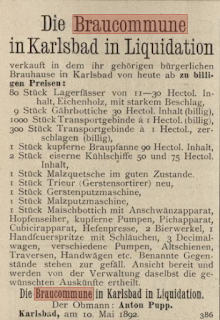
Given this, a "braucommune" was a type of business structure, based on ownership of property within town walls rather than shareholding. As to when the braucommune business structure came to its end in Bohemia, I believe it came during the Communist era of 1948 to 1989 first with nationalisation and then, somewhat ironically, collectivisation. The writing was perhaps on the wall in the latter 19th century as several of these braucommune breweries came up for sale or were placed in liquidation, such as the one in Karlsbad, modern Karlovy Vary, in 1892.


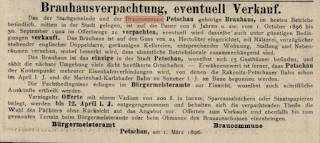
Sometimes it seems as though the braucommune decided to lease the brewery with a view to eventually selling up to a private concern, as was the case in Petschau (Bečov nad Teplou).


Interestingly, the advert above from 1896 touts the fact that this brewery had English malting technology, and that there were 15 taverns in the area as potential outlets. Unrelated, but is there a more perfect word for "hub" than "knotenpunkt"?

Will we ever see a revival in the braucommune concept? I doubt it given the mobility of the modern world, but I have to admit, if a house with rights came on the market in Freistadt...

Tuesday, January 18, 2022

For the Love of the Craft

I have long thought that the "Craft Beer™" industry's obsession with defining a craft brewery in terms that include elements of corporate structure is completely wrong headed. This thinking was validated last week by the speed with which the Brewers Association were letting the world know that Monster Beverage Corps purchase of, the frankly inanely monikered, CANarchy Craft Brewery Collective was 100% A OK with them and didn't mean the breweries lost the magical marketing cachet of "craft". It is almost enough to make me long for simpler times when a craft brewery had to be "small, independent, and traditional" to be in the club.

Thinking further on this, I wonder if making "traditional" the sacrificial lamb of the old description was likewise, wrong headed. I happily admit that the way "traditional" was defined back then was problematic, being:

"a brewer who has either an all malt flagship (the beer which represents the greatest volume among that brewers brands) or has at least 50% of its volume in either all malt beers or in beers which use adjuncts to enhance rather than lighten flavour".

As such, historic breweries like Schell's of Minnesota, and Pennsylvania's Yeungling were excluded from the club on the basis of having the wrong tradition. Anyone that knows the slightest thing about American brewing history will know that rice and corn found a home in American lager brewing because of the protein heavy worts that are a product of 6 row malt. These adjuncts weren't added to make beer cheaper or less flavourful, but to make it closer to what German immigrant communities were used to.

I actually kind of miss the days when "Craft Beer™" at least attempted to root itself in brewing history by encouraging tradition as a defining characteristic of craft beer. When I was at college, one of our professors spoke at length about the Greek word for tradition, "paradosis", which literally translates as things handed down from generation to generation. Tradition in brewing is not really about old ways of doing things but rather the collective wisdom of generations of craftspeople. This kind of tradition doesn't negate innovation, after all if it did we'd not have the hydrometer, pure yeast cultures, or modern malting technology.

This is one of the reasons I have so much time for breweries who do root themselves in traditional ways of making beer, even if those ways are not strictly speaking necessary. Take for example lager breweries such as Von Trapp and Devils Backbone who go through the rigmarole of decoction mashing, despite the witterings of people claiming it is not necessary because malt is more modified these days - as if Maillard reactions created during the decoction mash are of no significance whatsoever. While thinking about lager brewing, I love that Budvar still lager their 12­° ležák for 84 days, again an old tradition in central Europe where beers were lagered for 1 week per degree Plato. Is it necessary? Is it noticeable? Perhaps not to the majority, but to Budvar at least it is their tradition, and I love that they hold to it.

Tradition though must always play second fiddle to the craft of brewing itself though, and here I think it is important to remember that a brewer is a manual worker. Sure many brewhouses these days are automated to lesser or greater degrees, but still the brewer is someone who has honed their skills through training, education, and trial and error. If automated brewhouses were the be all and end all then brewing companies wouldn't need master brewers of any stripe, just people to load the ingredients and let the machine do its thing.

As a general rule I will only visit a new brewery once they have been open for 6 months, as it usually takes at least that long for a brewer to learn how to get the best out of their recently installed brewing system. If brewing were not an actual craft, that people have to learn and get better at, then all systems would be plug and play, the fact is that they are not. A master brewer is not just a master of malt, hops, water chemistry, and yeast management, but also getting the best out of complex machinery in a range of environments, walloping the pipework with hammers if necessary. 

I guess this is why my favourite breweries don't produce a million variations on the theme of IPA for the crowd with the attention span of a gold fish, and give their beers the time and attention they need to be just right.

Craft brewing is, or at least should be in my opinion, more than just ingredients, it is about process, it is about understanding why things are done in a certain way, and why some things are worth holding on to despite "progress". It is about understanding why open fermentation in shorter, wider vessels affects the mouthfeel of a beer by not stressing the yeast. It is about seeing the value in smoking your malt over beech logs because it is a vital part of your brewing tradition.

I would argue it is these things that make a brewery "craft", more so than being 25% or less owned by another brewing company, or making fewer barrels than whatever Boston Beer Company need the limit to be this month to keep the badge.

I would argue we need to restore tradition to the definition.

Wednesday, October 17, 2018

A Question of Locality

Everyone and his mate, it seems, loves to bang on about "local beer", even though as I have written before the whole concept of "local" beer is fraught with problems:
"so often the ingredients being used by "local breweries" are anything but local. Malts come from Canada, the UK, Belgium and sometimes Germany, hops likewise come from a raft of countries, including the latest craze for Antipodean hops. Yeast is sourced from multinational companies with libraries of strains again spanning the globe. Want to brew a witbier? No problem, order a Belgian yeast specifically for use in witbiers, use the Weihenstephan strain for making a German hefeweizen, Nottingham for an English ale, or even Prague's Staropramen for making that Bohemian pilsner you've been dreaming about.

That pretty much leaves the water as the only genuinely local element of a beer, but how many breweries strip their water of all the minerals and salts which make regional water a driving force in the history of developing beer styles and then add back the required minerals for a particular style? Imagine London and Dublin had soft water instead of hard, porter and it's offspring, stout, would likely be very different beers."
That may sound like a strange comment to make given that I am someone that drinks far more beer from the area in which I live than stuff brought in from the wider world. It just so happens that I live in a part of Virginia with plenty of good breweries. If my choices were a third rate local craft brewery and buying Sam Adams in the store, I'd be on the Sam Adams all day long. Drinking local only really works when the drinking is a pleasurable experience rather than an industry induced guilt trip. In all the industry's posturing and waffle about supporting and drinking local (and no doubt some people will say that you should drink local shit so the brewery has funds to improve, as if shiny toys make better beer for a brewer with no sense of taste), it feels as though the locals themselves get forgotten about.

Can a brewery for example truly call itself "local" if it relies on daytrippers and tourists for a large bulk of its revenue, or if the price of a pint excludes its nearest neighbours from being able to drink there? There was a story I read recently about a brewery owner looking for a new location because the expected gentrification of the neighbourhood in which he pitched his tent didn't happen and his target audience didn't feel safe enough to visit his brewery. Now, call me a miserable git, but if you expect your audience to take their lives in their own hands and come to a rough neighbourhood for a bevvy while you wait for potential gentrification then you deserve to go under. If you want "nice" people to come and drop $6+ for a 16oz pint of whatever you are selling then work that into your business plan and go to areas they frequent.

How exactly the presence of a new brewery in a rough neighbourhood benefits that neighbourhood often escapes me. Job creation is often lauded as being a benefit, but then the people that fill the jobs being created are often likewise bussed in from outisde the neighbourhood. Indirect benefits to other local businesses gets touted too, but as daytripping tourists come in their cars, drink their flight, then leave in their cars, I wonder what other neighbourhood businesses benefit? Unless there is a petrol station to hand.

For millennia beer has been the everyman drink and the pub a social leveller, but there are times when it seems as though craft beer is for white, college educated, middle class folks, and the craft beer bar/brewpub/taproom little more than a ghetto in which white, college educated, middle class folks can feel safe from the marauding hoard that is the working class of their imagination. It's almost as though there is an unspoken code that only acceptable people are worthy of craft beer, as the industry and its attendant hangers on sneer at the great unwashed and decree "let them drink Bud".

Tuesday, September 18, 2018

More Than Less

I will just come out and say it, I like a drink.

That fact is probably the main reason I seek out session beers whenever possible. Unless I am in the company of good friends, I am the guy that will sit at a table and be very much on the periphery of the conversation. It's just as well I am something of an amateur anthropologist, I love watching people and how they interact, though it does mean I tend to drink quicker than a lot of people I know, and that's where session beers come in. I simply wouldn't want to drink 5 or 6 imperial pints of standard strength craft beer (between 6.5% and 7% in this part of Virginia) and then drive myself home, regional public transport being something akin to unicorn shit and the Brexit dividend.

For a while a couple of years ago it seemed as though everyone and his mate was jumping on the session beer bandwagon, though this being the US they wanted to say 5.5% abv beer was sessionable. Given that my definition of a session begins at the fourth imperial pint, these beers felt like some cruel joke. For those unaware of Lew Bryson's vital work at The Session Beer Project, let's remind ourselves of his suggested guidelines for an American session beer:
  • 4.5% alcohol by volume or less
  • flavorful enough to be interesting
  • balanced enough for multiple pints
  • conducive to conversation
  • reasonably priced
Forgive me for being cynical, but there are times when I wonder if anyone is paying much attention to anything but the first point in the definition, maybe the second, though again being grumpy I would say that most session IPAs are too flavourful.

The other three points though appear to be willfully ignored. A sweet and sour fruit infused faux gose is not balanced enough to have multiple pints, remember a session begins at the fourth imperial pint - 4 imperial pints of a watermelon gose? Not fucking likely, most samples of the gack are difficult enough to get through, let alone a US customary pint.

Even though I tend to be the quiet guy on the edges, it is session beer that eventually gets me in to a place where I am happier to jump into conversation. God that makes me sound like some right uptight git, I am just not much of a talker when there are more people in a group that I don't know than I do. After a few pints though, I'll loosen up and dip my toe into the waters of the conversation, and we'll see where it goes, the beer though conducts me into the conversation.

Much like the pricing restrictions of Reinheitsgebot, the idea of reasonably priced beer is conveniently forgotten by all and sundry. For example, during American Mild Month I routinely saw dark milds between 3% and 4% being sold for between $5 and $7 for an imperial pint, the same price as some 7%-9% abv beers on the same beer list. Now, pardon my french, but that is taking the fucking piss. Charging the same price for a 3.5% mild as an 8% double IPA simply smacks of gouging the customer and reaping a much bigger profit margin on the beer.

There is more to creating a session beer than simply being technical with the ABV. To truly have session beer there needs to be an environment where the best bitters, dark milds, and pale lagers are as an attractive proposition as some extreme hop bomb or malt based fruity alcopop. Session beer thrives when the beer culture is one of drinking pints with your mates rather than cruising breweries doing flights. I fear we are starting to lose that culture.

Thursday, April 19, 2018

2 Years Later....

I realised the other day that it has been two years since the announcement was made that Devils Backbone Brewing had been purchased by the craft division of Anheuser-Busch, The High End. What followed on social media was the fairly predictable caterwauling and butt hurt statements about selling out and people never spending another penny on Devils Backbone beer, and even disgraceful abuse of Devils Backbone employees.


With it being two years out from the sale, I thought it would be good to reflect on how Devils Backbone is today. For the sake of full disclosure let me say that I am friends with several people that work at Devils Backbone, including Jason Oliver, and I have worked with them on a number of brewing projects to bring Czech style lagers to the drinkers of central Virginia.


I will admit that I don't get down to the brewpub location nearly as often as I would like, it is about an hour's drive from my house and since the birth of Mrs V and I's twin sons going anywhere much further than Charlottesville is an exercise in logistics. However, the times that we have gone down recently have been as they always were, superb. The beer has been excellent, the service on the ball, friendly, efficient, and it is great to see so many of the same faces as before the sale. I don't know how much airtime this got, but Devils Backbone have always believed in creating full time jobs, with benefits, and one plus of the sale was that DB immediately doubled the match for employee 401(k) pension plans from 3% of earnings to 6%.


This is though a beer blog and in my experience in the past 2 years I have not had a single bad beer. Have I had beers that were not my thing? Sure. Did that beer display poor brewing or quality traits? Nope, not once. Devils Backbone have, by virtue of the purchase, been able to invest in their equipment at the brewpub, and at the production facility, so that they can further explore the craft of making great beer, including getting in horizontal lagering tanks. That investment is paying off in the quality of the beer being made.

Every summer I produce a thoroughly subjective list of the best Virginia made beers that I have drunk in the previous year, and Devils Backbone are regulars because Jason and co know how to make great beer. As I said in my initial reaction to the sale "as long as the beer remains good, then I will remain a happy Devils Backbone drinker", 2 years later and I am still a happy Devils Backbone drinker.

Tuesday, March 20, 2018

A Hardknott Decision

There was sad news this morning when I opened Facebook. Dave Bailey, once of the Woolpack Inn and more recently of Hardknott Brewing has decided to call it a day with the brewery.

In Dave's post he cites the saturation of the craft beer market in the UK as one reason for deciding to close down. By the sound of it, the market is exceptionally tight for small brewers without their own tied estate to guarantee a route to market. That coupled with the parsimony of some real ale drinkers can only make life very challenging.

I am not sure if Dave's beers made it to this side of the Pond but I am confident they would have been well received here. When I was home in 2014, I made a point to try as many as I could lay hands on, and thoroughly enjoyed them all.

I want to wish Dave all the best in whatever comes next and sincerely hope he remains involved in beer as it would be a shame to lose his knowledge, passion, and drive from the industry.

Friday, September 9, 2016

Beer Snobs Are the Worst

Words fascinate me, the stories they tell, the culture they reveal, the way they change through time, how they can be used to comfort, heal, wound, and destroy. Whoever came up with the old rhyme that 'sticks and stones may break my bones but words will never hurt me' was an idiot. Words are, whether spoken or written, the most powerful thing the human race have ever created.

Etymology, the study of the origins of words, is one of those areas that I find particularly fascinating, and a word whose etymology is deeply interesting is 'snob'. According to a folk etymology the word came about in the great public schools of England, places such as Eton and Harrow, where the boys of non-noble families were listed as being 'sans noblesse', abbreviated as 's.nob'. Sans noblesse itself derives from the Latin 'sine nobilitate', in both cases means someone who is without nobility. Whether or not the folk etymology is correct is another thing, and according to the Oxford Dictionaries it isn't, the true origins being a term for a shoemaker's apprentice, however the point remains, a snob is one lacking in the traits usually associated with nobility, as opposed to traits associated with the nobility.

Unfortunately this lack of nobility is all too evident among the self styled beer snobs of the universe. When I worked in the Starr Hill tasting room you could usually rely, at least once a shift, on some gobshite spouting off about stuff he clearly knew little about, especially when it came to brewery relationships with bigger brewing companies. At the time Starr Hill had a distribution deal with Anheuser-Busch, which many an ignoramus took to meaning AB owned Starr Hill, and thus how could any of us truly love beer and work for an AB shill - usually they never saw the irony of their drinking in the brewery, but blinkers are a powerful device.

I have mentioned in previous posts my disdain for the ridiculous, and often vitriolic, comments made on various social media outlets about the purchase of Devils Backbone by AB-InBev, but a post by DB brewmaster Jason on Facebook caught my eye this week, I repeat here verbatim and with Jason's permission:
"I apologize for this beer realm rant, overt eyes - I don't care what your opinions are about ABI buying Devils Backbone Brewing Company but please don't come into any of our locations and impose your world view upon my co-workers. Please do not be rude to them and please do not act like you are all knowing about their situation. This is their work space and where they make a living. This is not a hobby or a diversion for them, unlike your visit. This is what we do! 99% of my co-workers had no idea about ABI purchasing DB. As soon as I was looped in, I ADVOCATED for it! ME, I did. I will debate anyone about this. Please direct your arguments to me. Everyone is entitled to their opinions but please do not be rude and callous to my co-workers. The ones with the strongest feelings are often the most ignorant. I don't expect to change anyone's minds but I can & will certainly make them look likes asses. It is so easy to do. Believe me. Case in point, on an un-related FB post about Goose Islands Bourbon County Stout someone suggested (with all the certainty in the world) to expect a cheapening of ingredients. Which in particular? Which malts & hops, what process?? The answer is that person was talking out of his ass like it was gospel but none of it is true. Yet confident to post such un-truths he was.Thousands of people toss that crap out there. Question the blanket statements. It's sad, dangerous, and distasteful, that people talk about peoples professions and livelihoods with such authority while knowing very little about it. If you are a beer aficionado, enjoy your hobby but please think twice about trying to bring other peoples businesses down with vitriol. This is our livelihood and you know less than you think. Trust me. I've been brewing for a LIVING for 20 years and I know so much more about beer, brewing, and the industry than most of you self satisfied, beer snobs. That is a FACT! Sorry to end on a negative note but god damn, what does it take to house train people these days? Why don't we speak about the things we know, celebrate the things we love, and think twice about chiming in on all the other shit?? Beer snobs are the worst thing about craft beer. Hands down."

I heartily agree with everything Jason says here. Beer geeks, lovers, appreciators, yes be that absolutely, Don't be a beer snob, and most definitely don't be a jerk to people at their livelihood.

For The Keepsake of It

Usually, when Mrs V and I drive back to central Virginia from South Carolina we stop at Olde Mecklenburg Brewing in Charlotte, mainly to swa...