Showing posts with label schwarzbier. Show all posts

Monday, December 29, 2025

Fuggled Beers of the Year: Dark

Given the inherent subjectivity of the BOAB category, it is always good to be back on more solid ground with dark beers, and I do love a good dark beer. That said, most of the dark beers I have drunk this year have been my own. In the spring I brewed my annual dry stout, imaginatively monikered "Virginia Stout", for Mrs V's fiddle teacher, who hosts a St Patrick's Day party every year, and it is just de rigueur to have a session stout at such events. In the summer I brewed a dark mild, again for a party, this time a birthday bash. Going through my records for non-VelkyAl brewed dark beers it is clear that the pickings are very slim...so I will pivot and just mention a single beer from each of the geographies, and name a winner.

Virginia

  • Tweed Dunkel - Selvedge Brewing, Charlottesville
Back at Yuletide 2024, I rocked up to the bar at Selvedge - gasp, shock, horror - and was given a bottle of Tweed, kellerbier style, in that it had been bottled straight out of the lagering tank with still a few weeks to go before being ready for prime time. When I cracked it open during the interregnum between Christmas Day and New Year, I thoroughly enjoyed it and partly rejoiced that it would be coming on tap once I was done with January being a month off the booze. If memory serves, this is double decocted, and all those extra Maillard reactions pay off in the silky smooth, deeply toasty flavours and mouthfeel of what was a great start to the drinking year.

Rest of the USA
  • Schwarzbier - Bierkeller Brewing, Columbia, SC
Among the various lager styles of the world, schwarzbier is the closest to my first beery love, dry stout. However, I think schwarzbier has an edge over stout in the wonderful effects of cold fermentation and long lagering giving the beer a crispness that showcases the roasty snap of dark malts. Anyway, it was summer, and we were in Columbia, en-route to Florida for beach week, when Bierkeller had their Schwarzbier on tap. It was probably obscenely hot in South Carolina, but this was a beer that simply worked because it is so damned tasty, roasty without being acrid, clean without being boring, and eminently drinkable, so I did, pretty often.

Rest of the World
  • Aecht Schlenkerla Erle - Heller-Bräu Trum, Bamberg, DE
As I mentioned in the BOAB post, rauchbier is one of my favourite types of beer in the world, I love a good slap across the face of beechwood, so when I saw Schlenkerla Erle at Beer Run, I bought a few bottles. Erle is another schwarzbier, but this time made with malts kilned over alder wood. Alder couldn't be more different from beech, deeply earthy, yet delicately sweet as well, paired with the roastiness of a schwarzbier and what you have here is a beer that speaks to the rustic peasant in me. I can only imagine how revelatory it would be from a stichfaß in the Dominikanerklause.


While the pickings may be slim for this category, the quality is far from wanting. I could happily drink these three beers all year round, but one stands out just ahead of the others, by virtue of being the confluence of two of my favourite things in beer, dark lagers and rauchbier. Yes, the Fuggled Dark Beer of 2025 is the magnificent Aecht Schlenkerla Erle from Heller-Bräu Trum in Bamberg - a beer that thankfully is still in stock in several bottle shops round here and will be finding its way into my fridge again very soon.

Tuesday, April 26, 2022

The Full Schilling - Der dritte Teil

I have owned this fact many a time on Fuggled, I am a Germanophile, especially when it comes to beer. One of the main reasons I go to Kardinal Hall as much as I do is that they are a reliable source of German beers, whether Rothaus, Köstritzer Schwarzbier, or something from Weihenstephan, as well as the near ubiquitous Bitburger (though I much prefer their stable mate König Pilsener). The fact that Schilling also produce a wide range of German styles, in addition to their Czech style stuff, is just another reason that I wanted to visit the brewery when we were up in New England a couple of weeks ago.


The other beers in the stash that made the trip back to central Virginia were:
  • Paulus - Munich style helles
  • Rennsteig - schwarzbier
  • Nordertor - northern German style pilsner
With those styles, this is basically a quick three beer tour of Germany from Bavaria in the south, to Flensburg in the north, with a quick stop in Thuringia in the middle.

Without further ado, then on to New Hampshire's interpretation of Munich. Fun side fact, not too far from Littleton is a place called Franconia...


Paulus
  • Sight - clear yellow, quarter inch white foam, wonderful clarity
  • Smell - doughy, lightly yeasty, floral hops, subtle citrus note (Tettnang perhaps?)
  • Taste - bready with a nice schmeer of honey, clean floral hops
  • Sweet - 2.5/5
  • Bitter - 2/5
Helles is one of those styles of beer that I think is best on tap, but this particular batch was canned just 11 days ago, so when I had it on Sunday it had been in the can a mere 9 days. Freshness matters, and this was as fresh as you will likely ever get in central Virginia. Full disclosure, I asked Beer Run to get me a case, and it was from that case that I drank, rather than one of the 4 packs that came back from NH with me, which was canned in mid-March. Anyway, the beer itself, gorgeous in a word, as good a helles as I have ever had. As I sat in my kitchen drinking it, looking out over my backyard, I realised I need to plant some more trees to convert a patch of the yard into my own little biergarten, just to enjoy Paulus in.


Rennsteig
  • Sight - deep mahogany, dark red edges, ivory foam
  • Smell - medium-dark roast coffee, crusty toast, subtle grassy/hay notes, hints of chocolate cake
  • Taste - cold espresso, singed toast, some floral character, bitter chocolate
  • Sweet - 2/5
  • Bitter - 3/5
Named, apparently, for the Rennsteig ridge walk in Thuringia and just a lovely schwarzbier. The balance is beautiful, making it insanely easy to drink while hitting all the right flavour notes. I think I am going to have to rehash my schwarzbier blind tasting of last year with this in the mix.


Nordertor
  • Sight - pale yellow, large white head, beautifully clear
  • Smell - crackers, hay, some herbal notes
  • Taste - more crackers, noticeable lemony zing, maybe some cantaloupe in the background
  • Sweet - 2/5
  • Bitter 2.5/5
When it comes to German style pilsners, I find myself preferring those more in the northern, drier, more pronounced bitterness camp. Nordertor, named for the eponymous gate in Flensberg on the Danish border and depicted on the label, sits very much in that camp, and I love it. The finish is cracker dry and lingers, begging to be followed up by another mouthful, and who am I to deny it?

As I mentioned in the first part of this little Schilling trilogy, I made a point to try all the German inspired beers on tap at the brewpub when we were there, but I wasn't taking notes or pictures - seriously, who does that when you are hanging with mates? Safe to say though that all of them were top class, especially the Seidla kellerbier, and whenever they make it down this way, I will continue to buy them, safe in the knowledge that Schilling know what they are doing, and they do it so damned well.

Thursday, December 9, 2021

Come to the Schwarz Side

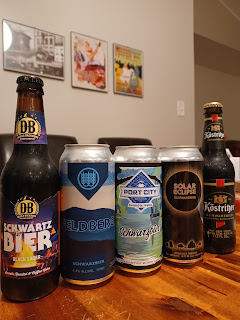
One of the reasons I had all the necessary dark lagers to do the dunkel-tmavé-schwarzbier triumvirate tasting in a previous post was because I have been stashing schwarzbiers since the end of October to do a distinctly schwarzbier tasting. My planned set of examples was complete when Mrs V and I headed back from South Carolina after Thanksgiving, picking up a couple of six packs of Olde Mecklenburg's Solar Eclipse that her cousin had put aside for me after one of his trips to Charlotte.

My collection of German style black lagers then was:


For those of you playing along at home, you may recall that I did a small schwarzbier tasting with three of these beers back in May, Devils Backbone, Köstritzer, and Schilling, but given examples from another couple of my go-to breweries, a do over seemed appropriate. Let's dive on in...


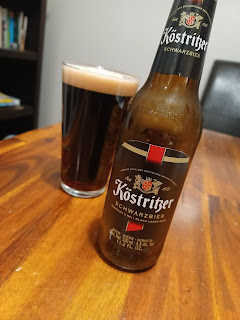
Köstritzer Schwarzbier
  • Sight - pitch black, dark brown edges, firm ivory foam, nice lacing
  • Smell - roasty, caramelised sugar, dark toast, some spicy hops
  • Taste - cold espresso, light cocoa, clean hop bite
  • Sweet - 2/5
  • Bitter - 2/5
There is a reason this is a classic, perhaps even the ur-typ of the style. It is freaking delicious, smooth, balanced, really easy to drink, and just reliable in the way that all the best archetypes are. It is perhaps a tad thin in the finish, but I quibble.


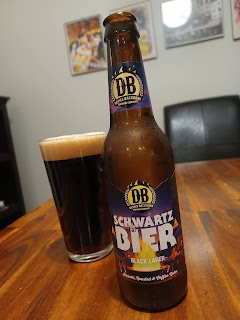
Devils Backbone Schwartz Bier
  • Sight - black, garnet highlights, solid ivory head
  • Smell - rich coffee, toasty, generally roasty
  • Taste - French roast coffee, sachertorte, clean hop bitterness
  • Sweet - 2.5/5
  • Bitter - 3/5
This beer has won multiple awards and for good reason. Sure it is a touch heavier than the Köstritzer, but it is just as smooth and drinkable. I have to admit that I go through times when this is a very regular part of my drinking, it just hits every note on the nail. Fun fact, my notes on this one are very close to when I took notes in May. Also, it makes an excellent řezané with Devils Backbone Gold Leaf.


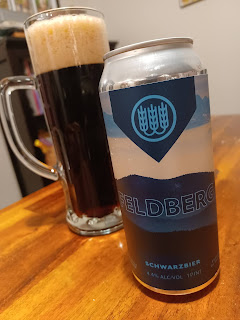
Schilling Feldberg
  • Sight - black, red highlights, tall ivory foam
  • Smell - molasses, subtle coconut, toasty
  • Taste - medium roast coffee, light molasses, dates
  • Sweet - 2.5/5
  • Bitter - 2.5/5
Another smooth bodied, tasty black lager. Schilling really have become something of a go-to brewery for this lager boy, when their beers actually make it to the central Virginia area. If there was one downer with Feldberg, and this may be a product of age, the finish felt slightly muddled, lacking a crisp snap that I usually associate with lager.


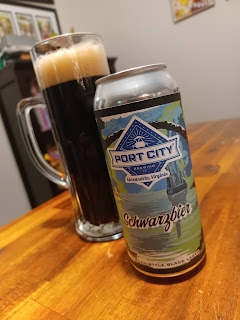
Port City Schwarzbier
  • Sight - inky black, dark brown edges, thinnish off white foam
  • Smell - well toasted bread, not burnt but well toasted, coffee hints, some treacle
  • Taste - espresso, light molasses, spicy hops
  • Sweet - 2/5
  • Bitter - 2/5
Port City make some of my favourite lagers, and their schwarzbier is definitely a good example of the style, if just a tad bit astringent in the finish. Speaking from pretty recent experience, it does make a fine beer round the firepit of an evening.


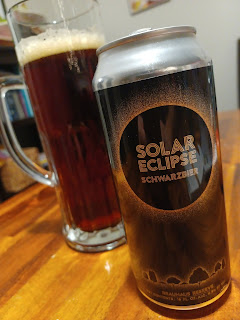
Olde Mecklenburg Solar Eclipse
  • Sight - dark brown, garnet at edges, thin off white head
  • Smell - light coffee, dark toast, spicy hops
  • Taste - toasty, think märzen but with extra deep sweetness and toast, lots of Munich malt?
  • Sweet - 3/5
  • Bitter - 2/5
I have to be honest, this one confused me from the get go as is poured so much paler than the others, I am not sure I would call it schwarz in any meaningful sense of the word. So confused was I that I checked out the BJCP style guidelines, which read:
Medium to very dark brown in color, often with deep ruby to garnet highlights, yet almost never truly black. Very clear. Large, persistent, tan-colored head.

Seemingly the colour is fine then, though every black lager I have had up until that point had been distinctly schwarz, as the GABF guidelines would expect, "dark brown to black". Even so, another cracking beer from the folks in Charlotte.

There we have it then, 5 excellent examples of one of Germany's most ancient beer styles. While I wasn't intending this tasting to rank the beers, there were two that stood out, Köstritzer and Devils Backbone. The others were all very good beers, but those two just had a little something more that appealed to me, and thankfully both are regularly available in this neck of the woods.

If I see more breweries making this style I will likely repeat this tasting and see if anything can match up to the original and the local hero.

Wednesday, November 17, 2021

All Consuming Darkness

Back in 2010 I wrote a post on the old RateBeer forums advocating for Czech tmavé to be recognised as a distinct beer "style" rather than simply lumped together with schwarzbier or dunkel. While I no longer bother with RateBeer or BeerAdvocate, and have never bothered with Untappd, it was interesting this morning to look at those sites and see how tmavé is being categorised in each instance. Ratebeer, seemingly in keeping with the consensus on the thread from 2010, has a broad "Dark lager" category, with dunkle and tmavé bracketed together. Over at BeerAdvocate, most versions of tmavé are seemingly put in one of the "Schwarzbier", "Munich dunkel", or "Lager - European Dark" categories. Untappd would seem to be the most simplistic option, going for just "Lager - Dark".

I don't want to rehash the arguments about whether Czech dark lagers are a unique beast when compared to their German counterparts, though I will continue to maintain that they are. The history of dark beer in Bohemia is fascinating, with it seeming that unlike their Bavarian neighbours, the Bohemians were top fermenting their dark beers until the very cusp of the 20th century. If you have ever had U Fleků's wonderful 13° lager you will know just how similar it is to a modern day stout. In the early years of the First Republic, the oldest brewery in České Budějovice (hint, it isn't Budvar) was advertising a dark beer with the name "Původní Českobudějovický Porter", or "Original Budweiser Porter". If I remember rightly, said beer was brewed to about 13° as well.

Sitting by our new firepit on Sunday afternoon, watching the twins charge around like maniacs, it occurred to me that I had examples of all three dark lager styles in my fridge. Do a tasting I thought, do a tasting I did! My three dark lagers were:

Starting at the beginning, to one of my favourite things...


Ah Von Trapp, goodness me how I love their on point lagers. Dunkel is, as if the name itself is not a hint, dark brown, with glints of garnet when held up to the light. The foam is firm, light tan, and doesn't disappear entirely as you drink. In one of my half litre krugs, it is a mighty damned fine sight. Ok, aroma, crusty toast, not burnt but definitely well toasted, with a light hop spiciness floating around in there too, think a märzen style Oktoberfest lager with more Munich malt oomph and you're not far off. The complexity of the malt really becomes evident when you finally stop looking and sniffing. Rich with toffee, toast, and subtle cocoa hints, there is a nice clean hop bitterness that cuts through it all, leaving the finish dry and moreish. Of the many dunkels I have enjoyed over the years this is one of the best, and one day I will get to Vermont to drink it at the Von Trapp Bierhall.


If Utepils beers were ever distributed to Virginia I would likely be a very happy man. As it is, I am grateful to my colleague Jerry for shipping this nectar to me, which likewise makes me a very happy man. Loonar Eclipse is their Czech style tmavé, which at 5.1% abv is likely to be a 13° Plato beer, and thus right in line with the U Fleků urtyp. It felt appropriate to pour this into my Purkmistr půllitr mug, and pour a very, very dark brown it did. The highlights were deeper than in the dunkel, gleaming like polished mahogany, topped with a healthy inch or so of dark ivory foam. Making their way gamely through the head were aromas of light coffee, a little unsweetened cocoa, and herbal hops, the nose was on the nose. One mouthful and I was transported to days drinking tmavé in Prague, in particular the autumn special from Klášterní Pivovar Strahov. Those coffee and cocoa notes were present in the flavour department too, joined by a bit of cola, and rich crusty, and slightly nutty, bread, almost like mazanec. Just plain lovely is what it is, beautifully rich and smooth, with a clean finish from the hops and fermentation character. My best friend is coming to visit this weekend, so we'll share the remaining pair of cans by the firepit.


Changing up the glassware for the third time, I poured the Port City Schwarzbier into my Chodovar Salzburg High mug, and living up to its name, this was black, black, black, with dark brown edges. The foam was again nice and healthy, but a touch darker than the previous beers, still it clung around for a while. The dominant aroma here was a combination of dark toast and espresso, backed up by a hint of cola. Again, the flavours paired up nicely with the aromas to be deeply rich layers of coffee, dark toast, a general roastiness, and a slightly herbal hop bite to keep everything in balance. Damn if this ain't a fine execution of the style. When I get back from South Carolina for Thanksgiving, I will be doing a comparative tasting of schwarzbiers, and with this teaser I am very much looking forward to it.

So, coming back to the original theme, this little experiment has me satisfied that dunkel, tmavé, and schwarzbier are distinct "styles", for want of a better word. Yes they are clearly similar, but I think that the differences in ingredients as well as flavour and aroma profiles show that the differences are sufficient to celebrate each in their own right. Of course, the challenge here with tmavé is that under Czech brewing law it can be 8° as much as it can 18° - though not above that, then it becomes a "Porter", such are the joys of trying to shoehorn Czech brewing traditions into an Anglo-American taxonomy, which applies just as much to světlé and polotmavé as to tmavé.

To thoroughly bastardise the maxim of Karl Barth..."let pivo be pivo"

Wednesday, May 12, 2021

Feel the Schwarz

I love doing a comparative tasting. I find that taking a selection of beers from a range of breweries really helps me calibrate my expectations of a given style. Given that part of the aim of a comparative tasting for me is to educate, or often re-educate, my palate on a given a style, I often make sure to have an archetype of the style being tasted in the mix.

A style that I have been keen to do such a tasting for is that Thuringian speciality, bratwurst, no wait sorry, I meant schwarzbier...though schwarzbier and bratwurst could easily be a weekend lunch or dinner.

The archetypal schwarzbier is of course from Köstritzer, and while I have regularly seen it on tap in my local area, only recently has it started turning up in packs of four half litre cans. At the same time, my Schilling Beer Company kick shows no sign of abating, and their Feldberg happened to be on the shelves of Beer Run when I popped in on Friday afternoon. No schwarzbier tasting would be complete without two time World Beer Cup medalist (one gold, one bronze) Schwartz Bier from Devils Backbone.

Having considered doing the tasting blind and ranking the three beers in order of preference, I opted just to drink them sequentially, starting in Germany...


Köstritzer Schwarzbier

  • Sight: dark brown, garnet edged, half inch tan head with decent retention
  • Smell: roasty, mostly well toasted bread, some dark caramel, slightly woody, earthy hops
  • Taste: again toast, not quite burnt toast, but not far off, some coffee, unsweetened cocoa
  • Sweet: 2/5
  • Bitter: 3/5
A good start to the tasting. While it is clearly a "big brewery" product, Köstritzer being part of the Bitburger empire, it is a big German brewery, which usually means the beer will at least be clean, technically proficient, and well made. It might be just a little thin and marginally one-dimensional, but would I drink it happily every day? Why, yes, yes I would.


Schilling Beer Co. Feldberg
  • Sight: dark mahogany, brown highlights, ivory head, good retention
  • Smell: earthy/oaky upfront, milk chocolate, grassy and floral hop aroma
  • Taste: rich chocolate, earthy, petrichor, traces of coffee
  • Sweet: 3/5
  • Taste: 3/5
The Schilling love in continues! This is one nicely balanced beer, rich without being overwhelming, there is something of a coconut character floating about that made me think of Bounty bars. The fuller mouthfeel and more medium body help to make this a more complex, and satisfying, beer.


Devils Backbone Schwartz Bier
  • Sight: near black, garnet edges, half inch light brown head, good retention
  • Smell: deeply bready, some cola, chocolate cake, floral hops
  • Taste: very well toasted bread, espresso, light cocoa
  • Sweet: 2.5/5
  • Bitter: 3/5
There is a reason this beer has a gold medal from the World Beer Cup for the schwarzbier style, it is a damned fantastic beer. Supremely balanced, the body is somewhere between Köstritzer and Schilling, and the finish is long and clean. Beautiful, simply beautiful.

As I said , the aim of this tasting was not to pick out a winner, but rather to calibrate my palate as well as take the opportunity to see where Schilling would stand in relation to the archetype and one of the world's best iterations of the style. Very handily is the answer to that particular question. However, at $7 for a couple of litres of good beer, it is difficult to look past Köstritzer, though it is great to finally have options when it comes to beer to drink with bratwurst...

Tuesday, March 8, 2016

Darkness Rising?

I have mentioned many times before that living in Virginia means that the lagerboy within me has plenty of good locally brewed options for satisfying the urge for clean, crisp beers. Whether it's Three Notch'd Of.By.For Pilsner (a beer that challenges all of my prejudices about what a pilsner is and I love all the same), South Street My Personal Helles, or Port City's simply divine Downright Pilsner, I never have to look too hard for a great pale lager.


Over the last year or so there seems to be a general popping up of dark lagers in the area, and I am wondering if this is part of a broader trend or whether it is serving a very localised taste. For as long as I have lived in Virginia, Devils Backbone have produced a schwarzbier, called Schwartzbier, which has found a regular place in my fridge. They also brewed Morana, a Czech style tmavé based on the magisterial Kout na Šumavě 14° tmavé, as well as Barclay's London dark Lager from a historic recipe for an English dark lager. From what Jason would tell me, dark lagers would also sell very well.


Recently I have noticed more dark lagers cropping up in the repertoires of local breweries. Last year South Street brought out Back to Bavaria, a Munich Dunkel that I drank almost exclusively for a couple of months and mentioned honorably in my review of 2015 - if Mitch at South Street is reading this, please bring it back, I loved it.

Speaking of Dunkels, just last weekend Mrs V and I met up with some friends for dinner at Blue Mountain and behold they too had one on tap, Blauerburg Dunkel, and I enjoyed several pints of it whilst half wishing it had been available at Edelweiss for Valentines Day. I am sure there is some level of crossover between the Back to Bavaria and Blauerburg given that the owners of Blue Mountain also own South Street, either way both were lovely beers.

This got me to thinking, is central Virginia something of an oasis for the dark lager arts, as it is in many ways for me with regards to pale lagers? Is it possible that after years of IPA domination, people are re-discovering the delights of lagers like dunkel, schwarzbier, and tmavé?

I for one certainly hope so.

UPDATE

I just got a message from Jason at Devils Backbone, and Morana is being brewed again this Friday. Keep your eyes peeled for a notice for when it will be released.

Thursday, March 28, 2013

Lagerboy Pride!

If you have been following Fuggled for a while now, you will doubtless know that I am a devotee of the lager arts.


Whether pale, amber, dark or pitch black, most of my favourite beers will have been cold fermented and then lagered before packaging. I am quite happily what some breweries like to disparagingly call a 'Lagerboy'. It therefore seriously pisses me off that 'lager' is used as shorthand for lowest common denominator beer.


Lager, as I have said many times before, is a labour of love from beginning to end, especially if a brewer is going to do a decoction mash, which makes the brewday longer. Then there is the lagering of the beer itself, tying up the brewer's capital for a long period of time, whether it be 4 weeks or 90 days - did you know that a batch of 12° Budvar takes 102 days to make, 12 days in primary fermentation followed by 3 months lagering? In a world that seems to love talking about beers being made with 'passion', it takes real passion and dedication to doing things properly and give your lager the time it needs to be ready.


I have said it before, and will continue to bang the drum, but a well made lager is, in my unhumble opinion, the height of the brewers' craft. Sure you can make your triple black IPA aged in soured gorilla snot barrels, but if a brewer is incapable of making a clean, crisp, refreshing and flavourful pale lager then are they really all that great, despite the ravings of those advocating the rating of beer?


Using the term 'lager' as a cover all for the lowest common denominator brews churned out by multinational breweries does a disservice to a family of beers as diverse and varied as ales. Whether drinking a Bohemian Pilsner packed with the flavours and aromas of Saaz, downing a pint of Schwarzbier with its clean roastiness, or supping gently on a powerful yet balanced Baltic Porter, there is little in life as satisfying as well made lager, where the brewer has nowhere to hide flaws.


So brewery marketing departments, cut it out with the lager hating, beer geeks, cut it out with phrases like 'it's good, for a pilsner'.


To paraphrase a cliche from self-help groups....my name is Velky Al, and I'm a Lagerboy.

Friday, October 26, 2012

Mmmmm.....Lager.

You know me by now, unless this is your first visit to Fuggled, in which case welcome, I am a lager drinker, nay a lover of lager. Whether it is a Bohemian Pilsner, Schwarzbier, Vienna or Baltic Porter, the lager 'family' of beers is the one I like to spend as much drinking time as possible with. That's not to say that warm fermented beers aren't wonderful as well, but just that beer that takes its own sweet time to be ready is my preferred tipple. Given a bank of taps pouring pale ales in various states of Indianess, stouts, porters, brown ales and wheat beers, if there is a solitary good lager available then I will gladly ignore everything else, even if it is super rare, super strong and aged in gorilla snot barrels.

Without being mean, any brewer can chuck more hops into the kettle, or add spices to secondary and get something that is at least drinkable, but it takes a master brewer to have the confidence to brew a great lager, such as Devils Backbone Vienna Lager, Victory Prima Pils, or Kout na Šumavě 18° (it also takes a master brewer to do the whole extra hops and spice thing well without turning the beer into a flavour mess). We can argue all day about the merits or otherwise of decoction mashing, for the record I think it makes a better beer though I know at least one of my favourite lagers is done with infusion mashing, but one thing is clear, lager is a labour of love, and if a brewery does it properly then it ties up capital and equipment for a very long time.


Take Budvar for example. I remember reading that each batch of their flagship 12° lager takes 102 days to make, from start to finish. Primary fermentation lasts 12 days and then the beer sits in the lagering tanks for 90 days, that's three months, 12 weeks (1 week for each degree of Plato as used to be the norm), just sitting around. Would most people recognise a difference if they brought it out after 60 days? Probably not, but some traditions are worth keeping regardless of what science tells us with numbers.

Brewing, any brewing, is not just about the numbers. Sure your pilsner might have a starting gravity of 1.048 (12° Plato), you might even have gone crazy and hopped it to 40 IBUs but it might still suck because there is too much alcohol from the yeast over attenuating and making it thin in the body (more alcohol is not always a good thing). Perhaps you used some high alpha hops for bittering rather than Saaz all the way through. Perhaps you didn't wait for the lager to tell you when it was ready and just pulled it from the tanks after 28 days regardless. Lager, in  my thoroughly unhumble opinion is not something to be taken lightly, and one of the reasons I brew them so infrequently is simply because I want to do them justice and I don't really have the equipment to do so.

This is one of the reasons I enjoy living in this part of Virginia, I have access to great local lager whenever I want it, made by brewers who do it properly and rightly win awards as a result.

Monday, August 27, 2012

On the Judge's Bench

Saturday was my kind of day. The temperature was pleasant, it rained for about 9 hours and I was a at a beer festival. The festival in question was the Virginia Craft Brewers Festival being hosted at Devils' Backbone, and I had been asked if I would like to steward at the Virginia Beer Cup part of the festival.

Having driven for an hour or so to get there, Devils Backbone being even further away since we moved into our new house, I got myself checked in and promptly asked if I wouldn't mind being a judge for the day rather than a steward. Thus it was that I found myself in the august company of several BJCP Master and National judges, as well as the executive director of the Brewer's Association of Maryland - who I also enjoyed a good chat with over a re-competition pint in the brewpub itself.

Judging a commercial beer competition is slightly different from judging homebrew. For a start you can generally assume that the brewers know what they are doing, and don't need to be reminded off the importance of sanitation and such like, and using the GABF style guidelines means you don't have to discuss the nature of a black IPA.

With something like 70 beers to judge, in 5 categories, I was very happy to be given the task of judging dark beers in the first session and then lagers in the second. Dark beers covered a multitude of styles, from brown ales to stouts and pretty much everything in between, my personal favourite was an oatmeal stout, while in the lager category a schwarzbier stood head and shoulders above the competition. I am still not sure who the oatmeal stout was from, but the schwarzbier, which eventually took best in show and hence the Virginia Beer Cup itself, was a Devils Backbone brew.

One thing that became abundantly apparent during the competition was that what Virginia perhaps lacks in the quantity of breweries, when compared to say North Carolina, is more than made up for in the quality. We have some damned good breweries in the Commonwealth, and hopefully the many startups that are in the works will add as much to the quality of our local beer as to the quantity.

Monday, September 19, 2011

Austria. Thuringia. Bavaria. California?

There are some breweries that never, ever, fail to impress, or at least make beers that I enjoy and want to drink multiple pints of. Word on the street is that one such brewery is looking to open an East Coast operation and one of the options is just a few hours south of where I live. I am, of course, talking about Sierra Nevada, who, rumour has it, have a site near Roanoke as one of their options for the new operation.


My first beer from Sierra Nevada is the one in the picture, sat in the magnificent, and sadly defunct, Sheridan's On The Docks in Galway, watching Ireland play New Zealand with the supreme company which is The Tale of the Ale's Reuben and his wife. Before splashing the cash to buy it, I had sent a quick message to Evan Rail to ask his opinion, and he was right, it was a delight.


Since moving to the US, I have enjoyed every Sierra Nevada beer I have encountered, from the comforting autumnal Tumbler to the smooth yet zingy Glissade. Their stout and porter both make regular appearances in the cellar and the fridge, and I'm even partial to a drop of their IPA, Torpedo.

On Thursday night, there was a Sierra Nevada invasion at Beer Run. Every tap, including the hand pull was dedicated to Sierra Nevada. On a side note, I enjoy these "tap takeovers" because you get to see how good a brewery actually is as a result of lesser known beers being available. Having dropped Mrs V off at the library so she could crack on with her latest paper for her Masters degree, I headed over for a couple of pints.


A quick glance at the menu revealed the words that immediately make me want to try a beer, "lager", "pilsner", you know by the now the stuff I like. So a pint of Vienna Lager was ordered. I had never seen a Sierra Nevada Vienna Lager before, hardly surprising as it is one of their "Specialty Drafts" according to their website. 4 mouthfuls later and the glass was empty. That is one delicious beer, clean and crisp, yet laden with toasty malt sweetness. Had it not been for the limited time available to me, and the dark winkings of the Schwarzbier, I could have drank that all night. But turn to the dark side I did. The Schwarzbier was, um, schwarz, and roasty, full of flavour and just bursting with goodness and again with a nice clean finish. Perhaps this explains my love of lager, I like clean flavours. My final pint was the FOAM Pilsner, a German Pilsner, and a very decent brew it is too. Had it been served in a biergarten in Central Europe it would have been the lubricant to a night of conversation and revery.

I also did a side by side tasting of Torpedo, one from keg and one from cask. The cask version was sparkled, as is the correct method, and the difference was startling. The hop aromas were much more pronounced in the cask version than the regular keg, and the body slightly fuller. Whilst not a cask fundamentalist, if I was I would be pretty much teetotal in this country, I am yet to be convinced by the argument that keg is better for highly hopped brews. Every time I have the opportunity to compare the same beer side by side from keg and cask, it was been a highly hopped pale ale, and the cask was won hands down.

My only wish is that these lagers were more regularly available in this neck of the woods. It is clear that not only do Sierra Nevada make some exceptional ales, their lagers are right up there as well, but sadly not getting the distribution and praise they clearly deserve.

Tuesday, July 7, 2009

Samuel Adams - Brewmaster's Collection

Craft beer is not always synonymous with small breweries, I for one would include Budvar in my world of craft brewers simply because they use traditional ingredients and continue to make their, oh so lovely, lager traditionally, without cutting costs and corners by using maltose syrup or that nebulous ingredient in Pilsner Urquell and Gambrinus, "hop products". Likewise Fuller's in the UK is a craft brewer, and here in the US companies like the Boston Beer Company, who trade under the brand name Samuel Adams, would also qualify despite the fact that their beers are readily available and for all intents and purposes mass produced.

I have something of a soft spot for Samuel Adams because their Summer Ale was the first beer I had in the USA when I first came in 2007, it was also the first beer I had after 6 months abstinence in an attempt to lose weight (I lost 50lbs eventually, although I have regained a little of that, such is the price to pay for a love of beer). After a 9 hour flight from Prague to Atlanta, and then the short hop to Columbia, not to mention the fact that our bags where held back due to some lunatic driving his burning Jeep into Glasgow airport, it hit the nail right on the head. Thus, one of my aims once Mrs Velkyal and I arrived here to stay was to get to grips with the entire Samuel Adams line, a task which may take a while of course, however I made a start by picking up a boxed Brewmaster's Collection containing the following beers:

  • Blackberry Witbier
  • Irish Red
  • Black Lager

First up was the Blackberry Witbier, made with Oregon blackberries according to the blurb on the neck label, and a fairly new addition to the product line apparently. It certainly pours like a witbier, cloudy amber, slightly off-white head which did a vanishing trick fairly sharpish. This has lots of fruity flavours going on, the nose was like mixed fruit jam, while tastewise some sweet maltiness underlay the fruit flavours again. There was some spice, although I would like to have more as I think the fruit overpowers it and about half way down the glass it becomes boring and even flaccid.

On to the Irish Red then, a style I am planning to brew myself once in Virginia (actually I am planning to cross an Irish Red with an India Pale Ale and make an India Red Ale with lots of C-hop flavours!). Can you guess what colour it was, yes that's right, it was red, and the head was a big fluffy ivory affair. Caramel and cocoa dominated the nose, with some subtle earthy aftertones - my brain immediately said English hops, and thankfully the neck label said East Kent Goldings! The beer itself is quite sweet, with lots of syrupy caramel flavours, which put me in mind of a slightly thinner version of London Pride - which is never a bad thing in my world.

Last up and the most anticipated was the Black Lager, I was eager to see whether this would be a more Bohemian or German interpretation of the dark lager genre. It pours a very dark red with a tan head, and even on popping open the bottle their is a rush of roasted smells, with a light touch of coffee in the background. The roasted theme continues in the drinking, bittersweet and with more than a hint of coffee, with touches of burnt sugar and caramel ending in a gentle dry finish. Yup it's a schwarzbier for sure, and a mighty fine one at that.

For me the Blackberry Witbier does nothing, that is not to say it is a bad beer per se, just that it doesn't rock my boat. The Irish Red is a nice smooth ale which will no doubt make the occasional appearance in the fridge, although given that Irish Red is a style I haven't explored much it will need trying alongside others to get a handle on it properly. The Black Lager will no doubt become a regular in the cellar, it really is lovely and I can imagine that it would be very useful in some of my cooking ideas floating around my brain.

With another 8 styles in the Brewmaster's Collection, not to mention the very nice Boston Lager, I am fairly sure I will be returning time and again to Samuel Adams.

Skoro Doma

Having arrived in Denver on a Saturday afternoon, clearly these posts are not in any particular chronological order, I got myself unpacked a...