Showing posts with label Der Böhmische Bierbrauer. Show all posts

Sunday, January 25, 2026

Lost Breweries of Egerland

Along the north western edges of modern day Czechia lie the Ore Mountains, known in Czech as Krušné hory, and in German as Erzgebirge. The mountains themselves straddle the border between Czechia and Germany, and as the name makes patently obvious mining was for centuries the primary industry.  It is actually from the town of Jáchymov that we get the word "dollar" as a name for many currencies, though obviously from it's German name Joachimsthal - the silver that was mined here was minted into the standard coin for trade throughout Europe, the Joachimsthaler, which was shortened to just "taler", and eventually became "dollar". For centuries the mountains and their hinterland to the east formed a region known as Egerland, known in Czech as Chebsko.

As early as the 11th century, German speakers were invited to Bohemia to work the mines that generated some of the most industrialised areas of the Austro-Hungarian empire, with glass works, lace making, and textiles also prevalent. Where you have industry you have workers in need of a pint, and so you have breweries to meet that need. All of which brings me to the year 1913, when one "F. Zodel", the business manager of the Eger Chamber of Commerce wrote an article for Der Böhmische Bierbrauer, giving an update on the state of brewing the Eger region. Eger is today called Cheb, and lies almost as far west as you can go in modern Czechia.

In the article, Mr (I assume) Zodel lists the brewing totals for the extant breweries in the region for the 1911/1912 season, though the German word is "kampagne", which sounds so much more workmanlike. The list consists of 37 breweries, all of whom produced over 10,000 hectolitres/8400 barrels of beer that season:

These 37 breweries produced nearly 1.3 million hectolitres/1.1 barrels. Being something of a nerd, I know, shocking, right? I decided to plot the towns these breweries were in, yay for Google Maps!

As you can see, a decent sized local brewery could be found throughout the Ore Mountains in 1913. The red pins are towns where the brewery had closed down the year before the season being reported upon, and the eagle eyed amongst you will probably spot the couple of green pins, those are breweries mentioned in the list that are still operating, Žatecký Pivovar, and Pivovar Chodovar. Unfortunately, Zodel's report doesn't list the 53 other breweries in the area that produced an additional 200,000 hectolitres/167,000 barrels, or the 8 breweries with a production of less than 1000 hectolitres/840 barrels. Imagine that map, with nearly 100 breweries on it. 100 breweries in an area of just short of 1000km2/390 square miles, and between them a production total in the 1911/12 season of 1.5 million hectolitres/1.3 million barrels.

While this all sounds impressive, the 1911/1912 season was 2.3% less than the 1910/1911 season, mainly as a result of 6 breweries closing down, caused apparently by a cold and rainy summer and the impacts on the barley harvest, as well as increased prices for hops. Zodel notes that the breweries in his district were sourcing most of their ingredients from the region itself, making it a truly local beer culture.

However, as Zodel looks to the upcoming brewing season, he strikes a downbeat note, claiming that it "is highly probable that a further significant decline in beer production will occur in the current operating season", citing the ongoing war in the Balkans, a shortage of ready cash, and the rising cost of living, claiming that any "restriction in the lifestyle of the working class and the middle class consequently leads first and foremost to a decrease in beer consumption". Sounds all too familiar really.

While his report doesn't give specifics as to what kinds of beer were being produced in Egerland, Zodel does mention that the cost of a hectolitre of "draft beer (schankbier) or the so-called double beer (Doppelbier)" is about 16 Crowns, though he doesn't mention the price of a half litre of such beer in the pubs.

In modern Czechia, the area we are looking at is mostly part of the Karlovy Vary district, which had as of 2024 a population just under 300,000 people, compared to one of 470,000 in 1910 though it peaked in 1930 at over half a million. The area that today has just a handful of breweries, and as I noted earlier it appears only 2 of the companies mentioned by Mr Zodel in 1913 are still extant, once had a large, local, beer culture. 

Yet, today, in many of the towns and villages of modern Chebsko, I am sure you are more likely to find Gambrinus on tap than you are Chodovar, and I find that deeply sad.

Wednesday, February 26, 2025

Singing The Pub's Praises

I never imagined that I would stumble across a song whilst digging through the online version of Der Böhmische Bierbrauer, but low and behold that's exactly what I found.

I was just searching for any information in the journal about pubs and drinking establisments as opposed to the beer brewing industry, so my search term was "kneipe". Weirdly, one of my core memories of learning German as a kid is being 13 years old and asking the teacher what the German for "pub" was, and nearly 37 years later it is stuck in my brain.

The song though is called "Lob der Kneipe", or "Praise of the Pub" and should be sung to the tune of "Das war der Zwerg Perkeö ..." or "Ich weiss nicht, was soll es bedeuten." I think the tune is the same regardless of the name, at least to my ears, and so here is an example...

Ah but the lyrics, the lyrics...

And here they are in English...

The pub is my life,
The pub is my downfall;
Can there be anything more beautiful
In this valley of misery?
Yes, I live in the pub
As a human being and as a student,
And I strive for the pub
Until my blessed end.

When the beer foams in the glasses
Brown and light,
How divine it dreams are.
Time passes so quickly!
You drink and slurp and drink
One glass after another empty,
You wave happily to the bartender
Over and over again.

And songs ring out happily,
Full of youthful joy,
The soul wants to struggle
From the oppressed breast.
Clouds of smoke drift
Through the sacred space,
And sparks of speech fly.
For me, only vain foam!

But when the witching hour
starts to strike,
the table closes
for the happiest of feasts.
How wonderful is such a stay
with unadulterated liquid!
It cannot be described
such an excess of happiness.

Let us raise our glasses
therefore full of enthusiasm:
The pub should live.
It keeps us all young!
Booze, that is the real thing.
The element of life,
from the cradle to the grave,
to a blessed end!
Obviously, speaking only for myself here, but what a lovely song...

Thursday, February 20, 2025

So...You Want to Be A Brewer?

No...don't worry, this isn't a post about being a homebrewer with vague fantasies of upscaling my 5 gallon batches of beer to something that could become a lifestyle business. Nope, I have, sometimes reluctantly, accepted that I will never own my own brewery, for various reasons. So, I will content myself with the occasional brewing project with professionals - if anyone in Virginia is interested, drop me a line, it's been a while since I had a recipe on tap somewhere.

However, there were 66 intrepid souls in 1906 setting out on their education to become brewers through the "Ersten öffentlich Braufachschule in Prag", or "First Public Brewing School of Prague". The earliest reference to the school in Der Böhmische Bierbrauer dates from 1893 and locates the school, according to this advert, at "Wenzelsplatz Nr 54"...

Today that would be known as Václavské náměstí 54, the present day location of a building called Palác Fénix, which was itself built in the late 1920s and thus replaced the buildings in which the brewing school operated. The 1830s building had likewise been built on top of buildings from the 14th century.

By 1906 the school had moved to Mariengasse Nr. 4, or just across the street on what is today Opletalova - ironically on the very street I lived on from 2006 until I left Prague in 2009, and given that the pub I watched Liverpool in for 10 years was on the street opposite Opletalova, I regularly walked past both locations.

It would be in that location then that our 66 friends studied brewing in Prague, and in that school year there were some changes to the curriculum...


It was in 1906 that the school broadened its study program to include lectures in trade law, given by one JUDr. Josef Bohuslav (JUDr is a doctor of both civil and criminal law). As well as studying commercial law, students discovered that their study load had been increased in other subjects - apparently it was felt that not enough time had been allotted to mechanical engineering, and so an hour extra for extra subject had been added.

In the course of the week, our students would study:

  • 10 hours of brewing and raw material theory, with František Chodounský (interestingly the guy that claims Pilsner Urquell got their indirect heat kilns from "Brauers Sauer" - I will be digging more into him in the future). 
  • 2 hours of administrative theory, again with František Chodounský
  • 10 hours of chemistry and lab work, with Dr Heinrich Friedrich
  • 4 hours of financial law with a Mr Brokeš
  • 4 hours of commercial law with JUDr Bohuslav
  • 8 hours of mechanical engineering and steam boiler maintencance with Ing. Josef Pokorný (fun fact, when I taught English in Prague I had a student called Josef Pokorný, he may even have been an engineer)
  • 4 hours of exchange law and book-keeping with Dr Haasz
A total of 42 hours a week between the middle of November and the end of June 1907, about seven and a half months, with just shy of half of the hours being the production and fermentation of wort.

The need for mechanical engineering and steam boiler maintenance stirs memories of the first time I attended a brewday at Devils Backbone, when Jason brewed the very first batch of Trukker Ur-Pils, a triple decocted Czech style pilsner that was superb. At one point in the mash, the decoction kettle wasn't heating up as expected, so Jason got under the gantry with a big ass wrench and gave the pipes a smack or several, and hey presto the heating got going again.

Of the 66 students, most came from the lands of the Bohemian crown, but also several from further afield such as Bulgaria, Russia, Poland, Germany, Galicia, and Styria.

I'd be interested to hear how this course of study stacks up with what brewers pursuing professional training here in the US, as well as abroad, had to study in addition to the actual making beer part of brewing.

Wednesday, August 21, 2024

Beginnings of Budvar...

Ah...the romance of the "original" Budweiser, yeah, you know, the original that was created 100 years after the previous original Budweiser and some 30 years after the original American Budweiser. If you didn't know already that Budvar are the youngest of the three breweries that bicker over the name "Budweiser" well you do now, so there are no excuses.

Now, while I have been unable to find a date for this rather natty sign I saw in a restaurant in Český Krumlov many years ago, it quite clearly makes the claim that the beer from Bürgerlichen Bräuhaus Budweis is the "Budwesier Urquell" or "Budweiser from the Original Source", in the same vein as Pilsner Urquell. So, the timeline is established, please stop calling Budvar the "original" Budweiser.

This post isn't really about who is the "original", it's about events in the year 1894 - yes you guessed it, I've been reading Der Böhmische Bierbrauer again, specifically the issue from February 1st of that year. In the "Miscellaneous" section of that particular issue there is a report about a meeting that took place on Sunday, 21st January 1894, location undisclosed, to discuss the possibility of building a new brewery in Budweis.

The attendees of the meeting elected one Dr A Zátka, who was a representative in the Bohemian Diet, or "Landtags", to preside over the meeting. Dr Zátka was an advocate for the new brewery, and from the notes in the piece from Der Böhmische Bierbrauer, many of the speakers at the meeting were in favour of creating this new brewery. A phrase though that jumped out at me was that the new brewery was described as being "das böhmische Unternehmen", or "the Bohemian company". From the context both of the text and historically as we know Budvar was founded as an explicitly Czech enterprise, as distinct from the "Deutschböhmen" or German Bohemians, so it was interesting to see it called out in a contemporaneous source.

Seemingly, there was confidence that such an enterprise would thrive, given that beer production had increased in the years prior to the meeting. Our friends at Bürgerlichen Bräuhaus Budweis and other local breweries had brewed an additional 100,000 hectolitres (85k Bbl), with production ramping up a further 100,000 hectolitres. It was boom time for beer in South Bohemia in the 1890s and the founders of Budvar clearly wanted a slice of that pie.

Obviously though, as anyone who has even considered starting a brewery, money would be needed to get started. According to a letter read out at the meeting from an engineer called Mr Jahn (possibly a partner in the brewery machine company Novák & Jahn, a regular advertiser in Der Böhmische Bierbrauer) the initial brewery would have an annual capacity of 30,000 hectolitres (25.5k Bbl) and cost 250,000 Florins. Thankfully for this time period we don't have to wade into the mess of Central European currencies, and based on the money table in the 1905 edition of Baedeker's "Austria-Hungary Handbook for Travelers", we can say that the initial brewery was priced out at about $52,000 at the time, approximately $1.7 million in 2024.

With this proposal in front of them, the attendees of the meeting agreed to "build a Bohemian brewery" with those already subscribed required to pay 1% of their subscription to cover preparatory costs. They also established a provisional committee to over see the work, with Dr Zátka being elected to likewise lead the committee. 

The road to Budvar had taken it's first step...

Monday, January 8, 2024

Rauchbier Revival?

Tis January, so 2 things must be true, I am taking the month off the booze, and I am diving into the Austrian National Library's online newspaper archives looking at the sometimes weird, but often wonderful world of brewing in Central Europe prior to World War 1.

I really don't take a structured approach to my, ahem, "research", usually preferring to just to enter a keyword or phrase, select the publication I want to look at, and start scanning through images. Just a side note, I find these kind of publications so enlightening about the brewing, and broader, world at the time, as opposed to reading technical brewing treatises. In particular I love trade ads in journals like Der Böhmisches Bierbrauer, Gambrinus Brauerei und Hopfen Zeitung, or Saazer Hopfenzeitung und Lokaler Anzeiger as they give you a picture of the ingredients, machinery, and assorted allied products being made and sold in Central Europe.

Anyway, purely on a whim, I decided to see what I would get if I typed "rauch" into the advanced search, pre-filtering to Der Böhmisches Bierbrauer. There were 115 results returned, and so I decided to sort further by searching on "rauchbier" specifically, which gave me this single result from October 26th 1909:


The headline in bold there declares there is a "Re-emergence of "self-malting"", going on, quoting an article from Bamberg in the "Allgemeine Anzeige für Brauer und Mälzer" which, assuming the translation is reasonable accurate goes on to say:
"The depressed situation of the small breweries is now leading them to return to the old arrangement of malting themselves. Over the years, people have gotten used to getting the malt ready from the malt factory. Today's cheap (?) barley price offers the hand for a return to the old system and so the old Bavarian smoked beer will soon appear again. Whether this will prove successful remains to be seen in the future."

If this report is correct, smaller breweries in Bavaria were going back to malting their own grains because the cost of the raw materials was sufficiently low to make this economical again, rather than buying their malt from the likes of Weyermann, whose maltings is massive pile right next to the railway station in Bamberg.

What jumped out most to me though was that the relative low cost of barley could lead to the return of "the old Bavarian smoked beer". This raises the question then, did rauchbier die out in Bavaria in the latter 19th century and only revive when breweries starting taking back the ability to make their own malt, as, for example, Schlenkerla continue to do so to this day?

Another question this raises is, were malting companies such as Weyermann not providing rauchmalz and thus the beer died out? Was there customer demand for rauchbier to the extent that any other malting company at the time was providing rauchmalz?

As ever, more questions than answers at this point, but if we can take this report at face value, it looks possible that rauchbier as we know it today could so easily have gone the way of grodziskie, broyhan, and Braunschweiger mumme, but for the alleged fact that barley was cheap in the years running up to World War 1.

Wednesday, February 15, 2023

The Dortmund Question

My last post was ostensibly about how Bohemian brewers felt about North German breweries co-opting the name "pilsener" to describe their pale lagers. The article from Der Böhmischer Bierbrauer that I reference in the post includes several references to quotes by Professor Wilhelm Windisch, one time chief of the VLB in Berlin, where he praises the qualities of Dortmund beer, whilst musing why German brewers felt it necessary to co-opt a foreign brew.

We all kind of know the general outline of history when it comes to pale lager, Josef Groll creates Pilsner Urquell in 1842, which is just a hair paler than Anton Dreher's Vienna Lager, and thus kicks off a pan-continental craze for pale bottom fermented beers. By the end of the 19th century, the list of "styles" that have come about as a result of Groll's introduction of English malting technology to Central Europe included Helles, Biere d'Alsace, North German Pilsner, Polish Mocne, and of course Dortmunder. All of the styles followed the same basic template, pale malt and the local hops, from Strisselspalt in Alsace, though Hallertau and Tettnang in Germany, up to Poland's Lublin.

In our hop centric minds in the early 21st century, we make the assumption that the main driver of differentiation in all these beers was the presence of local hops, relegating malt to essentially the role of hop delivery system. However the role of malt in the development of beer styles seems to get somewhat overlooked, as if all pale central European beers can be brewed with pilsner malt and whatever hops are appropriate. Historically that seems not to have been the case.

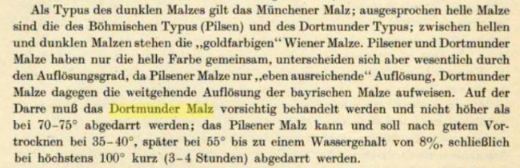
I wish I could remember where I first came across the term "Dortmunder malt" but alas the old grey matter is, well, getting older. However, I did find, not in the newspaper archives of the Austrian National Library I am sure you are relieved to hear, a book called the "Handbuch der Enzymologie, Vol II" on Google Books. On page 1236 of the book there is a fascinating breakdown of the different base malts in use in Germany at the time, I believe the book dates from the 1940s rather than the 1545 Google claims. In this section we get a description of the "dark" Munich malt, the "pale" Bohemian and Dortmunder malts, and the "golden" Vienna malt that is a middle ground between the others.


According to the writer, the fact that Bohemian and Dortmunder malts are pale is the only thing they have in common. He goes on to explain how Pilsner malt is modified "just enough" (major shout here to Andreas Krennmair for helping me with the translation of "Auflösung" meaning "modification" in a malting context) while Dortmunder malt is fully modified just like Bavarian malts. As you probably know, modification with regards to malt refers to:

"the extent to which the endosperm breaks down...releasing nutrients for yeast growth and making the starch available for enzyme degradation during mashing"*

In addition to be more fully modified that Bohemian malt, Dortmunder is also to be treated more gently that Pilsner malt, with the kilning process not reaching temperatures of more than 75°C/167°F. The writer describes the kilning process of Pilsner malt as being "pre-drying at 35-40°, rising to 55° until the water content reaches 8%, then kilning up to 100°", kilning also only takes 3 to 4 hours.


Apparently if you subject Dortmund malt to the same process it would become far too dark. Essentially Dortmunder malt needs to be carefully tended when compared to Pilsner malt so as to stay pale whilst achieving a full modification like Munich malt.

It would appear then that, at least in the 1940s, Dortmunder beer was brewed using specifically Dortmunder malt rather than the modern approach where "Pilsner" malt is the base. However, as early as 1913 Der Böhmische Bierbrauer was referring to "so-called" Dortmunder malt as a "minor type" of base malt, whilst describing it as "lightly kilned". It would seem that it was the use of Dortmunder malt that prevented the style from becoming the dominant German beer.


In an article from 1899 in the brewing journal "Gambrinus Brauerei- und Hopfen- Zeitung", the writer discusses why people were moving away from Dortmunder towards Bohemian beers. The writer confirms again that Dortmunder malt is kilned at low temperatures and thus very pale. He goes on to state that such low kilned malt has an "empty taste", and such a paucity of flavour causes the breweries to stick to brewing a 14° beer, which the writer defines as being "ein alkoholreiches Bier" - an alcohol rich beer - inferring then that Dortmunder was strong because that was it's main redeeming feature. The writer finishes his section on Dortmunder beer by comparing the beer with the Bohemian 10° beers that were "doing so well on the market" by stating they are "good beers, that hold their foam well, and don't taste empty at all".

At the end of the day, the average consumer wanted something that was flavourful, looked good, and wasn't "alkoholreiches", and thus Dortmunder was relegated to an also ran of the pale lager world, with Dortmunder malt eventually dropping out of production altogether it would seem.

* quote from "The Brewer's Handbook" by Ted Goldammer - https://www.beer-brewing.com/beer_brewing/beer_brewing_barley_malts/malt_modification.htm

Thursday, February 9, 2023

1895 - The Year of Pilsener?

It was only within about 50 years of its creation in 1842 that pale lagers from Plzeň were under attack in the learned press of the day. We all know the story of how Josef Groll's golden lager swept continental Europe, inspiring imitations in Munich, Dortmund, Strasbourg, Leuven, Glasgow. You name a major brewing city in Europe in and around 1895 and you likely have a pale lager, vaguely in the style of "pilsner", being brewed, though of course there were hold outs like London, Burton, and Dublin.

Recently though in one of my trawls through the newspaper archive of the Austrian National Library, it really is a fascinating resource that I keep coming back to, I learnt that certain beers being brewed in the recently established German Empire were considered better than the Bohemian original, in particular the "pilsener" lagers of northern Germany and the Dortmunder.


According to one Doctor Wilhelm Windisch, writing in "Wochenschrift für Brauerei", Pilsner and Dortmunder are both "light beers" but of "very different types", and Dr Windisch poses the question "which is the nobler of the two"? Windisch then goes on to sing the praises of the Dortmunder, saying (and here I am relying on the veracity of the quotation in Der Böhmisches Bierbrauer in August 1895 above) that Dortmunder is "always clean". The German here is "es stets blank", "blank" can translate into English as "bare", "shiny", or "pure", though a Czech possibility is the word "čistý", which in English can translate as "clean". Given the context of later in the quote about a yeasty flavour, I think Dr Windisch is talking about the classic clean flavour that we associate with lagers in general.

Dr Windisch goes on that Dortmunder has "a better hop taste than the Pilsener" arguing that in pale lagers from Plzeň "the taste of hop oil is sometimes very strong". His final accusation as to the inferiority of Pilsner, from Plzeň, when compared to Dortmunder is that it has "almost without exception...a peculiar yeasty taste" which he then claims "is not fresh, but a peculiarly old one, like the one imparted to beer by dying or dead yeast". From this he would seem to be claiming that in the Bohemian pilsners of the 1890s you could taste the autolysis of the yeast as it dies.


Moving on from comparing Dortmunder and Bohemian Pilsner, Windisch further extols the virtues of the "Pilsener" style being brewed in Northern Germany, noting that they are "light in colour and...they have a more pronounced hop taste". He points out that this additional hop flavour is due to in part to using more hops in the boil and a slightly different hopping schedule in Northern Germany than in Bohemia. Windisch then goes on to drop the mic, by declaring that Northern German:

"so-called "Pilsener" beers are much more similar to Dortmund beer, and we really didn't need to borrow a beer type from abroad, especially since Dortmund beer has long since acquired an excellent reputation"

leaving us with this question:

"as far as wholesomeness and digestibility are concerned, the question still needs to be decided, whether our light, clear, and not excessively hopped so-called "Pilsener" beer or the Dortmund-style beer isn't even "healthier" than the cloudy, yeasty, strongly hopped Pilsner beer"?


Despite this, Windisch notes that the "importation of Pilsener and other Bohemian beers is steadily increasing and has become very important". As a result of this growing competition from the east,  Munich breweries were forced into action, particularly Spaten and their the recently created helles lager that he notes is "similar to Pilsener beer". So conservative though were Munich drinkers that it had been market tested far from the Bavarian heartlands at the Café Ronacher in Hamburg's Savoy Hotel. As a result of the success of the trial, Spaten started full scale production of their pale lager. The coming of pale lager to Munich, whilst seemingly ignored by the Munich beer press, was declared "notable progress" in the popular press, and in the mind of Windisch himself "a beer-political event of the very first order".


Having quoted Dr Windisch at length, the author of this article in Der Böhmisches Bierbrauer gives short shrift and is quite acerbic in his response claim that:

"you have to get used to the fact that "Pilsner" is making more friends in North Germany because of its excellent properties, is spreading as a result of North German breweries borrowing this popular beer type from Bohemia! The fact that the people of Munich are now also brewing a light beer in the "Pilsner" style doesn't come as a surprise either; already in the 16th Century people set a good example there, in that a brewing method that originated in Bohemia - to produce weisses Weizenbier - was made native in Munich, as can be seen from the brewing regulations of 1616."

Boom from the Bohemian, who signs off as "Ein echter Pilsener". He is basically saying, yes Mr Windisch it is no surprise that people are jumping on the "Pilsener" bandwagon because it is popular, and points out that we have seen this in beer history before, when Bavaria copied the Bohemian "bilé pivo" (white beer/weissbier) and made it is own.

What I found particularly interesting about this little article, which feels like an editorial, was not the history as presented by Dr Windisch, though yes that was fascinating, but rather the response of the "echter Pilsener". Rather than engage with the learned professor on the merits of Bohemian brewed pilsners when compared with those of norther Germany, Dortmund, and Munich he choses the route of rather nationalistic bombast. His argument is essentially, "we're popular and that's why people use the name pilsener", a brewer's "yah boo sucks to you" response basically.

Though putting this in context a little, at this point, if I have understand the other German language stuff I have been reading lately, the definition of what constituted a "pilsner" or "pilsener" in the German Empire, as opposed to the Austro-Hungarian Empire, had not been settled. As late as 1909 the "Böhmische Brauhaus" in Berlin was using the term "Pilsator" for their pale Bohemian style lager. What we are seeing here is the beginning of a battle that in some ways rages on to this day, what exactly even is a "pilsner"?

Wednesday, January 18, 2023

Through a Glass Darkly

According to one Dr Schulze, writing in 1890, "you shouldn't drink beer out of beer glasses". Schulze went on to state that the traditional German bierkrug was far superior as it protects the liquid from the deleterious effects of sunlight. This fact might seem fairly obvious to us here in the first quarter of the 21st century, but in late 19th century central Europe, this was cause for much concern and investigation.

It was in the decades following the creation of Pilsner Urquell, and the subsequent revolution in brewing as from the North Sea to the Black Sea, from the Baltics to the Balkans brewers turned their attention to mimicking Josef Groll's golden lager, that glass became a more common sight on the table of drinking dens across Europe. The industralisation of glassmaking, which resulted in a more affordable vessel, coupled with the sparkling bright transparent nature of the new fangled lagers, made being able to see you beer as you drank all the rage.

However, looks came at a price. If you didn't drink quick enough then the sunlight streaming through your golden pint, then your beer would start to "decompose" and the beer loses its condition "extremely quickly".

Step into the breach then one Wilhelm/Vilem Havlík, master brewer at the Kročehlav brewery near Kladno, about 19 miles/30km from Prague. According to an article in Der Böhmisches Bierbrauer from February 15, 1893, yes I have been browsing around the newspaper archive of the Austrian National Library again, Havlík invented "new, practical beer glasses".

The article claims that a "polish beer glass, in which the rays of light collect at certain points, is the least suitable beer container, since the harmful effects of the light are increased". The article goes on to suggest filling a ceramic krug and a transparent beer glass with beer, leaving them for 15 minutes before tasting. The ceramic is "still fresh and appetising", while the beer in the glass has "lost aroma and sharpness".

If I understand the article correctly, Havlík's glass was entirely opaque, other than for a clear base that would allow the drinker to check the clarity of the beer. The patent submitted by Havlík notes that the glass is entirely lead free and as such replaced the recommendation of a Director Schnitze to drink from gold or silver cups.

A fun element of the design is that these glasses had a "rough, etched plate or strip" upon which the drinker can write their name or some other note whilst at the pub to keep the same glass for the duration of their stay. Finishing off the piece, the editors of Der Böhmisches Bierbrauer hoped that the new glass would soon be available in drinking dens throughout Bohemia.

I couldn't find any definite examples of such glasses as I searching, whether on Ebay or Google, so if anyone knows of any out there it would be fascinating to see. However, it is clear (pun maybe intended), that the idea had very little long term impact as transparent glassware is the norm, though it does also show how little things change across the years, as even in the 1890s people were coming up with new and improved glassware.

Tuesday, March 15, 2022

A Bohemian Porter?

Once upon a time I was sat in a brewpub in Brno. On the wall of the brewpub, called Pegas since you ask, was the following sign:

For those unversed in the Czech language, the sign reads "Original Porter from České Budějovice, from the City Brewery". On the opposite wall was the same sign in German, in which "Měšťanské Pivovaru" was "Bürgerliches Brauhaus Budweis", or the brewery known today as Samson, originally founded in 1795. The idea of Bohemian Porter has kind of intrigued me ever since.

When I lived in Czechia there was basically just one Bohemian Porter in regular existence, the delightful 19° Pardubický Porter, but when I was digging around in Pivety.com, I came across several labels for other Bohemian made porters, such as Třeboňský, Brněnský, and more Budweiser Porter.

There are plenty of other examples that show porter being brewed in Bohemia was most definitely a reality before the descent of the Iron Curtain in 1948. Clearly from the gravities on the labels, porter was a strong dark beer with a gravity of, at least, 19° Plato, which is basically the modern Czech description of a porter.

The thing that often played on my mind was whether the Bohemian Porter of the late 19th/early 20th centuries became the modern tmavé pivo, and I was never convinced. Tmavé is, after all, just a colour descriptor, it doesn't denote the strength of a beer, it's bitterness, or even its point of origin, it is just tells you to expect a dark beer. Even then, it can fall on a colour spectrum from deep red to pitch black, and some lagers marketed as "tmavé" are paler than other breweries' polotmavé, that's amber, beers. It seems as though porter stood apart from the morass of tmavé, with its strength being a key differentiator.


As I have been digging into various newspapers and journals in the Austrian National Library's newspaper archive, I have come back time and again to "Der Böhmische Bierbrauer", the journal of the Brewing Industry Association in the Kingdom of Bohemia. It was here that I found another part of the porter story...a recipe of sorts, and the beginnings of a process. 

So I set about trying to understand what was going on in this, according to the article's author, "well known brewery whose products are highly esteemed and sought after". In the same article, the author discusses "märzenbier" and "kaisersbier" as well.

Anyway, we start with the grist, 2250kg of malt kilned to 76° Réaumur (about 95° C), which thanks to information from Andreas Krennmair would be in the ball park of Munich malt, and 175kg of "Farbmalz". "Farbmalz" literally translates as "colour malt", a phrase in Czech that is still used today - "barevný slad". Farbmalz can also be known as "rostmalz", which is obviously "roasted malt", so we are talking about something similar here to Carafa malts, whether I, II, or III, I really don't know, but that's the ballpark we are playing in. And that's it, a simple grist of 92.8% Munich malt and 7.2% roasted malt.

The grist goes into 48 hectolitres of water, that's 1109 US gallons, or 924 Imperial gallons, a mash then of 1.7 litres of water per kilo of grain. Being an article in the official organ of the Bohemian Brewers' Association, I am going to assume that certain process elements were simply understood and thus not written down. Thankfully though, the author does use the magical incantation of "Dreimaischenmethode", a literal translation of which would be "three mash method", but remember where we are and to whom the author is communicating, and here we have porter being made with a triple decoction mash. We are not told what temperatures are being targeted, but again his audience probably didn't need that level of detail, just do a triple decoction mash, with the first decoction being boiled for 25 minutes, the second for 30, and the third for 20, mashing out at 59° Réaumur (73°C/164.7°F). Oh, and during the third decoction add 52 kilos of hops, assuming here that the hops were added to the decoction while it was boiling, there would have been some isomerisation of the alpha acids to contribute bitterness - but here I am kind of at a loss, so if anyone can explain this better, that would be great.

If I understand the German correctly, the pre-boil gravity was 17.8° Plato, working on the assumption here that "°S" is shorthand for "grad Stammwürze", which post boil came to 22.2°P. With the wort vatted for primary fermentation, it was held at 5.5° R (7°C/44.6°F) for the first 9 days, and then allowed to rise in temperature to 9°R (11°C/51.8°F) for a further 9 days. After 18 days of primary fermentation the finishing gravity was 9.6° P, giving our Bohemian Porter an abv of 7.2% going into the lagering process, which lasted 10 months.

Now, I am not saying that I have an iron clad recipe for porter as being brewed in Bohemia, mainly because I am not the audience for this journal and thus there are gaps in my knowledge, but I think this shows that Porter was understood in Bohemia as a strong, dark, well aged, lager, and was more than just a curiosity. Wonder if I can persuade someone to try making one...

Wednesday, February 23, 2022

Communal Brewing in Bohemia

I really don't have that many things I wish I had done in my ten years living in Prague. I do wish I had been more interested in hiking when I was there as I would love to get up into the mountains that form the borders between Czechia, Austria, Germany, and Poland. Probably my biggest regret, if that is not too strong a word, though is that I never went to Zoigl country.

I am not going to delve deep into the roots of Zoigl, what zoiglbier is or isn't, but it has been on my mind a bit lately because of a single word I came across in one of my jaunts through the Austrian National Library's newspaper archive (yes, again). If you are, though, interested here is an excellent video on Zoigl beer production in Neuhaus bei Windischeschenbach that is worth half an hour of your time. If you want to skip the wort production stuff and see the fermentation and serving arrangements, start from here, and wait for the side pour tap...

The word that leapt from the page as I was reading something completely unrelated in Der Böhmische Bierbrauer was "braucommune", which translates as "brewing commune". Naturally, given Czechia's proximity to Zoigl country over the border in the Oberpfalz, I wondered if what I was seeing here was the remnants of a Zoiglesque communal brewing setup in Bohemia?

Digging further, I discovered that in 1895 there were just 4 "braucommune" breweries operating in Bohemia that produced more than 10,000hl:
  • Asch (Aš)
  • Krumau (Český Krumlov)
  • Kuttenberg (Kutná Hora)
  • Náchod
I also found reference to several other "braucommune" breweries, that presumably had not reached the magic 10,000 hectolitre mark, including
  • Braunau (Broumov)
  • Petschau (Bečov nad Teplou)
  • Brüx (Most)
  • Sebastiansberg (Hora Svatého Šebestiána)
  • Trautenau (Trutnov)
  • Komotau (Chomutov)
  • Teplitz (Teplice)
  • Gottesgab (Boží Dar)
  • Bohdanetsch (Bohdanec)
Try as I might, I could find little more than names and production volumes for such "braucommune" setups. Was I really seeing Bohemian Zoigl or something different? As ever Google gave me a pointer in the right direction when doing a search I came across Braucommune Freistadt, apparently the last remaining "braucommune" in Europe. What then was the difference between a "braucommune" and a communal brewhouse in the Oberpfalz model?

Here I need to give a shout out to Andreas Krennmair for helping me with the meaning behind the words. While the concepts are similar in the sense that brewing rights are invested in houses within a given town, a "braucommune" employs professional brewers and manages distribution and sales on behalf of the braucommune. In the case of Freistadt for example, where the brewery used to give a share of the beer produced to those who lived within the walls of the city, they now pay dividends. If a person decides to sell their house, the dividend remains with the property rather than the person. In Zoigl world, the rights owners have access to the communal brewhouse to make the wort, which is then fermented, and the resulting beer served through their own "zoiglstub'n".

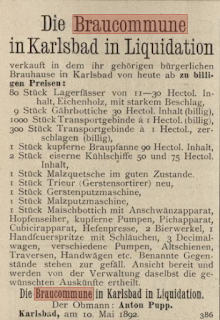
Given this, a "braucommune" was a type of business structure, based on ownership of property within town walls rather than shareholding. As to when the braucommune business structure came to its end in Bohemia, I believe it came during the Communist era of 1948 to 1989 first with nationalisation and then, somewhat ironically, collectivisation. The writing was perhaps on the wall in the latter 19th century as several of these braucommune breweries came up for sale or were placed in liquidation, such as the one in Karlsbad, modern Karlovy Vary, in 1892.


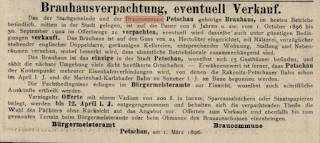
Sometimes it seems as though the braucommune decided to lease the brewery with a view to eventually selling up to a private concern, as was the case in Petschau (Bečov nad Teplou).


Interestingly, the advert above from 1896 touts the fact that this brewery had English malting technology, and that there were 15 taverns in the area as potential outlets. Unrelated, but is there a more perfect word for "hub" than "knotenpunkt"?

Will we ever see a revival in the braucommune concept? I doubt it given the mobility of the modern world, but I have to admit, if a house with rights came on the market in Freistadt...

Tuesday, February 15, 2022

Bohemian Brewing Industry 1898

Again this week we go time travelling into the newspaper archives of the Austrian National Library, and once more we return to Bohemia and the German language publication "Der Böhmische Bierbrauer" in the year 1900.

In the June 15th issue that year, "Der Böhmische Bierbrauer" presented a snapshot of the brewing industry in Bohemia in the year 1898, based on the work of one Dr Bernat, Director of the Prague Brewing School. Now, maybe I am weird, but the numbers and stats presented by Dr Bernat are fascinating. Let's start at the beginning....

Apparently in the year 1898, a total of 8.7 million hectolitres of beer was brewed in Bohemia, which equates to 7.3 million US barrels, or a little less than five Sierra Nevada Brewing Companies, but also less than the modern production of Pilsner Urquell of about 10 million hectolitres. All of that beer was brewed by just 673 breweries, which was 21 brewers fewer than in 1897, when about 8.5 million hectolitres was produced. As such, the average Bohemian brewery in 1898 produced just 12,865 hectolitres, or 10,789 barrels. Production topped out in June, with 808,000 hl brewed, with October being the lowest month, when only 651,000 hl were produced.

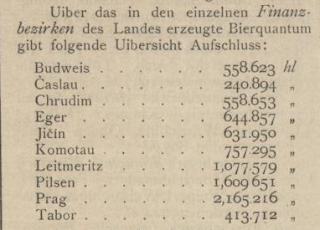
Let's take a quick look at the districts where this beer was being produced

No real surprise that the leading areas were Prague and Plzeň, with about 3.8 million hectolitres brewed between them. Obviously it stood out that Leitmeritz was such a prominent player at the end of the 19th century. Leitmeritz is today known by the Czech name Litoměřice in the north west of modern day Czechia, which includes the Žatec area, perhaps better known in the brewing world as Saaz. Interesting side fact, Saaz in this time period was not just known for the quality of it's hops for brewing, but also for spruce pitch for lining barrels. Perhaps most interesting here though is the case of the Budweis district, which brewed the 3rd lowest amount, but this next picture fills out that story a little...

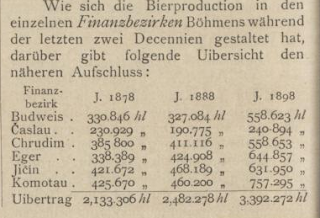
The table above shows the growth, or otherwise, of beer production in several Bohemian regions in 1878, 1888, and then finally in 1898. Clearly there has been major growth in Budweis between 1888 and 1898, and the elephant in the room here is that in 1895 the Czech population of Budweis decided to merge several breweries to compete with the larger, established, and German owned, Bürgerliches Brauerei Budweis. The Czech company would eventually become Budvar, and spuriously lay claim to being the "original Budweiser" despite being 100 years younger than Bürgerliches Brauerei. It seems clear though that beer production in that part of Bohemia had stagnated prior to Budvar being incorporated. It is also clear that brewing between 1888 and 1898 was becoming truly industrialised as production overall increased 36.7% in that decade, compared to 16.4% the decade before, for an impressive 59% increase in just 20 years.

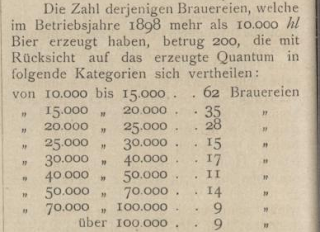
Despite this increase, and the obvious ramping up of industrial production, only 200 of the 673 breweries operating in Bohemia in 1898 brewed more than 10,000 hl, and remember the average was just over 12,000 hl per year. The 200 biggest breweries in 1898 were further broken down as follows:

Just 9 breweries in Bohemia made more than 100,000 hl of beer in 1898. That list contains several names, in brackets, that would be familiar to modern day drinkers, though several a long gone:

  1. Bürgerliches Bräuhaus Pilsen (Pilsner Urquell) - 486,700
  2. Smichov Actiengesellschaft (Staropramen) - 397,000
  3. Actienbrauerei Pilsen (Gambrinus) - 266,800
  4. Protivín - 138,936
  5. Genossenschaft Brauerei Pilsen - 135,100
  6. Maffersdorf (Konrad) - 122,522
  7. Prag-Holešovic (Holešovický měšťanský pivovar) - 112,273
  8. Bürgerliches Brauerei Budweis (Samson) - 109,485
  9. Wittingau (Bohemia Regent) - 109,306
Of the 9 biggest breweries in 1898 Bohemia, 2 are no longer in business. Genossenschaft Brauerei, from what I have found out so far, was a co-operative brewery that at least as late as 1909 was reputed to be a leading import beer in the US, according to the American Beer Review. Holešovický měšťanský pivovar closed down just before I moved to Prague in 1999, with production moved from Holešovice to Staropramen in Smichov.

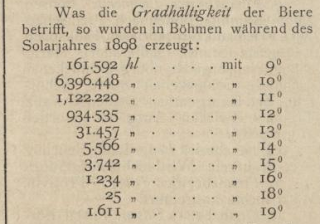
What though was being brewed by these 673 businesses? Well, Dr Bernat has given us a handy breakdown by strength...


99.5% of beer brewed in Bohemia in 1898 had a starting gravity of less than 12° Plato. That is staggering, though not surprising in the slightest really, just desítka accounted for 73.9% of all beer brewed that year. Unfortunately Dr Bernat doesn't go on to tell us what kinds of beer were being produced, but I imagine the majority of beer being made then was a variation on the theme of pale lager.

Wednesday, February 2, 2022

19th Century Bohemian Beer Brewer

It all started by reading Andreas Krennmair's book of homebrew recipes for historic German and Austrian beers. Andreas includes in the book a recipe from 1834 for "Prague Beer" which I am thinking about brewing in the near future. I wanted to get a more contemporaneous handle on "Prague Beer" and so I started digging around in various online archives, like you do. My digging led me once again to the newspaper archives of the Austrian National Library.

It is sometimes easy to forget that for a thousand years Bohemia was very much in the German sphere of influence, whether as part of the Holy Roman Empire until 1806, or as a kingdom within the Austro-Hungarian Empire up to the end of World War 1. In the mountains and marches of much of western Bohemia there was, for centuries, a large German majority. I don't want to get into the fraught, complicated politics of Bohemia, but rather to point out that it makes sense to go looking for information about the Bohemian brewing world in the Austrian National Library.

The first publication I stumbled upon was "Der Böhmische Bierbrauer", a brewing trade journal that was published in Prague from 1874 to 1916. At the height of World War 1 it was renamed "Der Österreiche Bierbrauer", having relocated to Vienna, after a year of just being "Der Bierbrauer" and being published jointly in Prague and Vienna. In the few issues that I browsed through, I didn't find any descriptions of "Prague Beer" but that is mainly because I starting delving into the ads section of the journal.

Adverts are fascinating pieces of social history and tell us more about the reality of what was going on in a society than lengthy technical treatises about brewing processes and the like. Take, for example, this advert from the January 1st 1891 issue.

A rough translation would be:

"Best clarifying agent! American isinglass, made from thornback ray (ray skin)

Imported directly, only prime quality, cheapest offered to brewers and dealers"

I find it fascinating that there was a business in 1891 selling Isinglass finings, imported from America, to breweries in Bohemia. The address of said business, "Tuchmachergasse 9", would show up time and time again in adverts from this journal, so naturally I looked up a period map to find out where it was...and it is just a few doors down from Pivovarská Nalévárna on modern day Soukenická.

Talking about brewing businesses on streets I know well, I discovered that on the same street as my last apartment in Prague was a malting company:

Leopold Schmied was a malt manufacturer at an address that is today the address of the Autoklub České Republiký. It is fun to think that less than a five minute walk from where I lived, malt was being made. A dark malt for Munich beer, a Bavarian style black malt to be used with the dark Patentmalz for Bock. The pale Patentmalz made for full bodied beers with good foam retention apparently, and there was roast malt for brown beer, porter, and so on and so forth. Hmm...malt being sold for specifically for porter brewing in late 19th century Bohemia? There's a whole world of intrigue right there, what was Bohemian Porter, bottom fermented like Baltic Porter or top fermented as U Fleků's legendary dark beer still was at this time? Schmied could also provide you with caramel malt to meet all your brewing colour and flavour needs. Being locating right opposite a major railway station, they had logistics right on their doorstep - fun fact, the railway station opposite Leopold Schmied Malzfabrik was not the hauptbahnhof of the day, that was the station known today as Masarykovo Nádraží. Today's Hlavní Nádraží was named Franz Josef Station until 1919.

Talking about railway stations, they are the natural place for a brewery to pick up the seed yeast they need to turn lovely sweet wort into even lovelier beer, but who would be selling seed yeast in 19th century Bohemia?

Bürgerliches Brauhaus in Pilsen obviously, though these days they are better known as Pilsner Urquell. For just a single Krone, you could purchase a kilogram (2.2lb), of "excellent and pure" seed yeast. What you didn't get for your money though was packaging and delivery from the railway station in Plzeň, which if I have the right station is this somewhat ornate pile.

I am sure that there will be far more to come as I trawl my way through the digitised newspapers available through the Austrian National Library. I am focusing on the adverts for the time being as they give a sense of the reality of the Bohemian brewing industry at the time, the products available, the names in the business, and where such brewing adjacent businesses were located.

Some Closing Thoughts

On Friday afternoon, with work concerns disappearing into the rear view mirror, and a little time to go until I had to pick up the twins fro...