
If you've been keeping abreast of my mini-series about Schilling Beer Company in New Hampshire, you will hopefully recall that this is their magnificent Malý 8° lager, had on tap at the brewery's tasting room in Littleton. What I didn't mention in that particular post was the method of dispense, and fairly obviously, this particular beer was poured using a Lukr tap, also known as a side pour tap, sometimes also known as a slow pour tap. Whatever you want to call it, this was poured from a tap that is currently all the rage amongst the lager brewing and drinking community in the craft beer world, and is often touted as being the "traditional" method in Czechia.
I still remember the first time I saw a Lukr tap in the wild back in Czechia. It was around 2009 and Mrs V and I had gone to Purkmistr, a brewery and hotel on the outskirts of Plzeň, for a long weekend. Said tap was, for whatever reason, in the room that the hotel used for serving breakfast. I don't recall if they were in use in the restaurant or bar, but I noted them because they were so different from the taps I had seen in pretty much every pub I went to at the time. Almost every pub I frequented had standard taps like those at Pivovarský klub or U Slovanské lipy...


A tap system that bore an uncanny similarity to the one I had seen in Purkmistr, clearly there was something here...oh I didn't mention these illustrations yet:

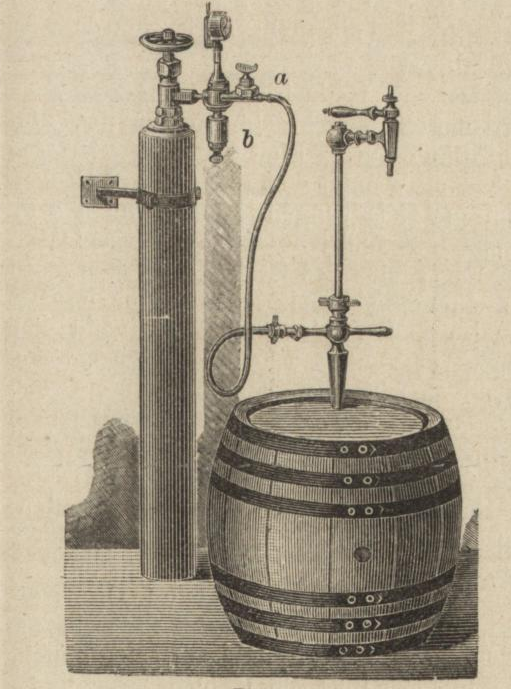

Each of these illustrations came from an edition of Der Böhmische Bierbrauer which contained an article about the new innovation for pouring beer, attaching a CO2 tank to the barrel that would push the beer to the tap. The article had the glorious title of "The Practical Use of Carbonic Acid for Serving Beer" and appeared in Der Böhmische Bierbrauer in 1894. Before the use of CO2, it was traditional for beer to be poured either via gravity or pulled through the line by a hand pump.
Intrigued, I dug further, finding images of such historic side pour taps in use in Germany in the 1930s - sorry folks I am not paying $20 a piece for a stock images of beer being poured in Mannheim at a radish festival, so have a link instead. Eventually I came across the Historische Bierzapf-Säulen website and learnt that the idea for using CO2 to dispense beer from a tap was patented in 1877 by a high school teacher and chemist Wilhelm Carl Raydt, originally from Lingen in modern day Lower Saxony. The new method of pouring beer apparently took off in northern Germany and the industrial cities, but met resistance in traditional Bavaria, which for many decades stuck with the anstich method of tapping beer.
The Historische Bierzapf-Säulen site is a beer history nerd's wet dream. The oldest illustration on the site that shows a side pour tap in use is from the 1880s, and purports to show the Berlin pub "In der Katschemme". There is even a Pilsner Urquell pub in Hamburg in one of the pictures from 1900. The guy behind the website, who clearly has a love of historical beer taps, and the beautifully decorative towers that were once part and parcel of taprooms in central Europe is also the owner of Storchenbräu in Pfaffenhausen, about 100km/62 miles west of Munich.
From what I can ascertain, side pour taps were in use in Germany until the 1960s, and if film evidence from the former Czechoslovakia is correct, there also, being replaced by the more modern flow control taps we are used to seeing in central European pubs today. Though they did seem to still be in use in at least one Zoigl pub in around 2012, and judging by the design of the tap, it is not a Lukr made tap.

Central Europe, broadly modern day Germany, Austria, Poland, Czechia, Slovakia, and Hungary, is full of stories like this, where there are parallel foods, drinks, and ways of doing things that each group of people claim as "traditional". Of course, until the First World War, most of the region lay within either the German Empire or the Austro-Hungarian Empire, so such commonality is to be expected. To give a small example, recently Mrs V and I went to dinner with some friends. The husband is Serbian, the wife is German - weird fun fact, they met in Lavka in Prague, and lived there for a period that overlapped with Mrs V and I, though we only met them here in Virginia. Dinner that night was a traditional Serbian meal called "podvarak", basically pork shoulder slow cooked in the oven on a bed of sauerkraut. The Czech national dish is "vepřo-knedlo-zelo", slow roasted pork shoulder, dumplings, and cabbage. In Germany there is "sauerkraut und Schwein", erm....slow cooked pork with sauerkraut, often served with potato dumplings. Where modern borders create breaks and barriers, reality is a continuity of shared history and experience.
To come back then to the side pour tap, what we are seeing is a revival of a central European way of doing things that was lost in the rush to modernity that was the 1960s. The uniqueness of the Lukr tap is in an innovation within the tap itself, which I can find no evidence for in the old texts, a filter screen that in layman's terms, turns the tap into a shower head, much like the sparkler does on a beer engine, thus creating the voluminous wet foam that the tap is rightly renowned for.


