Showing posts with label beer culture. Show all posts

Wednesday, February 26, 2025

Singing The Pub's Praises

I never imagined that I would stumble across a song whilst digging through the online version of Der Böhmische Bierbrauer, but low and behold that's exactly what I found.

I was just searching for any information in the journal about pubs and drinking establisments as opposed to the beer brewing industry, so my search term was "kneipe". Weirdly, one of my core memories of learning German as a kid is being 13 years old and asking the teacher what the German for "pub" was, and nearly 37 years later it is stuck in my brain.

The song though is called "Lob der Kneipe", or "Praise of the Pub" and should be sung to the tune of "Das war der Zwerg Perkeö ..." or "Ich weiss nicht, was soll es bedeuten." I think the tune is the same regardless of the name, at least to my ears, and so here is an example...

Ah but the lyrics, the lyrics...

And here they are in English...

The pub is my life,
The pub is my downfall;
Can there be anything more beautiful
In this valley of misery?
Yes, I live in the pub
As a human being and as a student,
And I strive for the pub
Until my blessed end.

When the beer foams in the glasses
Brown and light,
How divine it dreams are.
Time passes so quickly!
You drink and slurp and drink
One glass after another empty,
You wave happily to the bartender
Over and over again.

And songs ring out happily,
Full of youthful joy,
The soul wants to struggle
From the oppressed breast.
Clouds of smoke drift
Through the sacred space,
And sparks of speech fly.
For me, only vain foam!

But when the witching hour
starts to strike,
the table closes
for the happiest of feasts.
How wonderful is such a stay
with unadulterated liquid!
It cannot be described
such an excess of happiness.

Let us raise our glasses
therefore full of enthusiasm:
The pub should live.
It keeps us all young!
Booze, that is the real thing.
The element of life,
from the cradle to the grave,
to a blessed end!
Obviously, speaking only for myself here, but what a lovely song...

Wednesday, November 29, 2023

In Praise of...Czech Beer Snacks

The very first post of 2023 on here was "Year of Czech...Snacks", in which I held forth on the notion that if 2023 was to be the "Year of Czech Beer" then I really hoped that we would also see more elements of Czech beer culture come to the fore. With just a few weeks until the end of the year, I can honestly say that I have not really seen a noticeable increase in the number of Czech style lagers available in this part of the world. The cynical side of me kind of wonders though if "America", when it comes to beer trends, is largely limited to the West Coast, Colorado, and New England. Czech beer styles really haven't swept the nation in any meaningful way, and I say that with a tinge of regret, for obvious reasons, and a tinge of relief for equally obvious reasons if you know me at all.

Anyway, unless you have been under a rock recently, you will know that I spent a few days back in Czechia a couple of weeks ago. As you can tell from the last pair of posts, I drank a lot of seriously good beer, and there are several places and beers that I simply haven't mentioned. Drinking tankové Svijany in a pub in Malá Strana was a delight, as was Plzeňský Prazdroj at Pod Petřínem, all of which happened before midday. While it is true that Czechs make the best beers in the world, sorry everyone else, they also have the kind of pub culture that resonates most with me - admittedly my decade living in the city sorely colours that, but for a deeply shy person (I know some of you will be stunned by that admission), Czech pub culture is a safe space lacking the forced bonhomie of much of the modern Anglophonic world.

Essential to such a pub culture are snacks, small bites of something to mop up the booze that is going down in prodigious amounts. Sure, many tap rooms and bars over here do snacks, but a side of fries or a pile of tortilla chips with cheese just don't do much for me.

On the Friday afternoon, I got to introduce Dave and Chris to the place that is, for me, the epitome of a proper Czech pub. A place that doesn't have a bank of taps serving dozens of beers from breweries of varying quality, there were only 3 beers on tap that day. A place that doesn't have garish lighting, modern fixtures and fittings, or a sign in English, or even a menu in English. A space with just the bar and about 6 tables total, I have said this many times, but if I had the building skills to do so, I could replicate it pretty closely in one half of my garage. I am referring, of course, to Hostomická nelevarna (sorry Evan for drawing more attention to it), the brewery tap for Pivovar Hostomice, and a bastion of Czech pub culture in an ever more westernised (read generic) experience in Prague.

As Chris and I were starting our journeys home the next day, we were planning to only have a few pints before relatively early nights. Well, that was the plan, but it went out the window. The only picture I took while we were there was this one.

Despite the mug of desítka in the foreground, that was not the focal point of the picture, rather the three plates and basket between it and the glass in the background. When the munchies hit, we looked at the board of available snacks and just decided to get one of each of the options, knowing that they all came with bread. And, so we had nakládaný hermelín, utopenec, and škvarková pomazánka, with classic Šumavský chleb to spread all the unctuous goodness onto. I am not going to go into detail about how to make the snacks, I did that in the post from January, though since being back I realise that Mrs V and I sorely need to make more of the first two, and I really need to get on with making my own škvarková pomazánka.

While this is the only picture of snacks that I bothered to take, we had similar morsels in several of the places we went to, always accompanied by dense, chewy Czech bread. At Únětice we had a delicious game pâté, and at Pivovarský klub a magnificent duck liver pâté and more škvarková pomazánka. All of this delightful food got me thinking about what makes a good pub snack?

Let's start with the basics, it can't be fiddly. Food that you have to mess about with is a pain in the prdel in general, but when it is accompanying good beer and fine conversation, it is even more important that it be easy to eat. When I think specifically about Czech pub snacks, grease is the word. Nakládaný hermelín, a piquantly spiced wheel of soft cheese, somewhat akin to Brie or Camenbert, is marinaded in oil, and served with a pool of said highly flavoured oil. To eat it, you smoosh the cheese, oil, onions, and any of the spice paste that came along with it into an unctuous goo to be spread on a slice of the dense bread. While not marinaded in oil, the škvarková pomazánka being made with lard and crispy bits of unrendered meat is likewise a study in greasiness, again spread on a slab of rye bread.

The more I think about it though, I think the key is actually the bread. Now, I will happily own the fact that I am a big fan of Czech bread. I love that it isn't some fluffy, light, airy nonsense, but rather dense, chewy, and it sticks to your ribs. Sure, you can buy seeded rye bread here in the US, and while it may taste similar, it doesn't hold a candle to Czech rye bread. The tight crumb is ideal for spreading whatever cheese or meat based snack it is that you want with your beer. Another superb traditional Czech pub snack is some form of topinky, basically fried bread, sometimes with a topping like a cheese paste, or with cloves of garlic to be rubbed across the crispy bread.

I feel as though I could wax lyrical about Czech pub grub ad nauseum, but for the sake of my grumbling stomach I will stop, and work out some plans to make more versions of my own.

Wednesday, February 9, 2022

Life in Czech Vienna

When I lived in Czechia, the website expats.cz provided a useful and occasionally fun way to garner inside information on living in that foreign land about which, at first, I knew nothing. Once upon a time, the site had a message board which was split into themes like "Accommodations", "Life in CZ", and the ever popular "Miscellaneous" - possibly not exact titles, but you get the drift. 

It was not uncommon to see grizzled old hands rolling their cyber-eyes at the latest newly minted TEFL teacher/poet/novelist looking for a place to get a distinctly foreign product to make their new life in central Europe more akin to their home country. I know of people, and I am not exaggerating here, who whenever friends visited from the UK had them bring British milk and bread. It was just as often on the boards to see comments along the lines of "if you don't like it go home" as the 9 millionth newbie complained about Czech service.

Prague, being an international hub, was home to all manner of ethno-pubs, butchers doing "proper" bacon and sausages (which were superb by the way), places to buy Wychwood ales, and places to get cheese from across Europe. There were even a couple of Marks and Spencer stores. Fun fact there was an M&S in Prague when I first arrived in 1999, it was out at Černý Most and didn't have a food hall, ergo, it sucked.

These message boards popped into my mind as I was bimbling around the scanned newspapers of the Austrian National Library, in particular the weekly "Česká Vídeň", which from what I can see was published from 1902 to 1914, but scans only exist from 1907 to 1909. "Česká Vídeň" translates as "Czech Vienna" and obviously thus served the sizeable Czech community in the capital of the then Austro-Hungarian Empire. Another fun fact, Vienna was home to the second largest Czech community in the world in the early 20th century, the largest being Prague. Estimates range from 10-30% of the Viennese population in 1900 being Czech, and even today it is not uncommon for Austrians to have distinctly Czech family names.

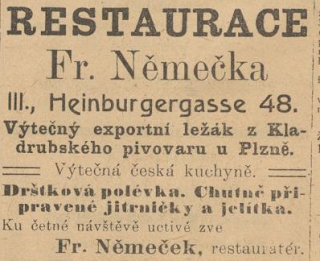
Restaurants are, I guess by nature, the perfect venue for expat communities to gather in and feel a little bit "normal" or at home in their foreign domicile. As such, it was restaurant ads that caught my eye most, for example...


At Restaurace Fr. Němečka, or František Němeček's Restaurant you could get all manner of Bohemian treats, while enjoying the irony of your host being a Mr Frank German. Mr Němeček naturally sold "delicious export lager" from Plzeň, but not from Pilsner Urquell, rather from the Kladrubský Pivovar which was based in a one time Benedictine monastery. On the food front, his menu featured such "delicious Czech cuisine" staples as tripe soup, liver sausage, and blood sausage - other than the tripe soup, you bet this Scotsman would have been there, jitrnice and jelítka are some of my favourite Czech foods. Mr Němeček, being a most congenial host, naturally invites you to visit.

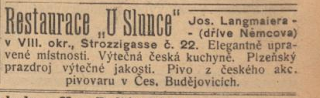
If you were looking though for a choice of beers made in Bohemia, you could always try Strozzigasse 22 and Restaurace U Slunce.

Pitching up "At the Sun" Restaurant, you would be welcomed to an elegantly decorated venue by Mrs Langmaiera (née Němcova), who as well as serving delicious Czech cuisine (is there any other kind?), can offer you a choice between Pilsner Urquell, "of excellent quality" and beer from the brewery known today as Budvar.

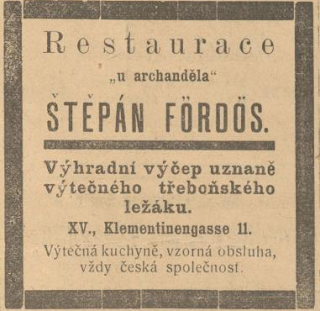
Not keen on making a decision between Pilsner Urquell and Budvar? Then perhaps you want to to visit the divine "Restaurace u archanděla" on Klementinengasse, where your host is a Mr Štěpán Fördős.

I am no expert on these things, but the family name "Fördős" looks distinctly Hungarian to me. A reminder that Vienna was capital to a multi-ethic empire, and that despite the prattlings of nationalists everywhere, none of us are pure anything other than human. At the Archangel is, if my Czech isn't entirely letting me down, the exclusive Vienna tap room for the renowned lagers from Třebon, also know as Wittingau and likely the brewery owned by the noble Schwarzenberg family, known today as Bohemia Regent. Of course, just like most of the restaurants whose ads I saw, the Archangel promises excellent food, though the "exemplary service" was new, as was a phrase I saw pop up time and time again..."vždy česká společnost".

"Vždy česká společnost" translates literally as "always Czech company", which I have to admit had me scratching my head at what it meant. The word "společnost" does indeed mean company in the sense of a corporation or business, so was the advertiser claiming to be an "always Czech owned company"? The more ads I read though, the more it became apparent that "společnost" did indeed mean company, but in the sense of "community" or "fellowship". These restaurants, like expat hangouts since time immemorial were offering Czechs in Vienna a Czech environment in which to feel at home. Pretty much each and every restaurant ad I saw in "Česká Vídeň" mentioned the beer being poured, and also that they had Czech language magazines available. Rarely did an advert mention any of the dishes being prepared in the kitchen though.

Restaurants were, for Czechs in Vienna, a place to drink Czech beer, read news in Czech, meet fellow Czechs, and eat Czech food, places to have a sense of home away from home. Multiculturalism is nothing new, people have always migrated for better lives, more opportunity, or even just for plain old adventure. I wonder if there were folks in these restaurants who told Honza, having just got of the train and adjusting to life in a modern, chaotic metropolis that if he didn't like it, he should just go home? Probably, but at least there was "vždy česká společnost" to make him feel that he belonged, and another glass full of whatever Bohemian beer was on tap.

Tuesday, April 16, 2019

Cleveland in dem Haus

Last week I was in Cleveland, Ohio, for a conference. Having admitted in several posts that I am a terrible beer tourist, I have determined that whenever I am away on a business trip I am going to try and change that narrative. Naturally I had done some research on Cleveland and had a list of breweries whose wares I at least wanted to try, time can often be at a premium on these conference trips and so I usually find a well regarded pub with a decent local selection so I can at least try a few new things.

Then I saw the magic words "Hofbräuhaus Cleveland" and knew without a shadow of any doubt that if time allowed then I would be going. Inspired by the thought of Bavarian style booze and food, I checked Google Maps and discovered it was 0.4 miles from my hotel...yeah, you know I was going there. Thus it was having landed in a much colder than Virginia Cleveland, and spent the afternoon getting set up for the conference exhibition, I took a stroll and allowed my mind to wander back to central Europe...


It being a Wednesday night, the Hofbräuhaus was not exactly busy and so I strode past the classic bench tables of a bierhalle, headed straight for my favourite place to drink, the bar itself.


Behind the bar stands the heartbeat of any brewpub, the coppers, and in this case actually copper, or at least copper clad, shining brightly. I was actually thrilled when I saw them, I knew their beers would be brewed in the US rather than shipped from Germany, but for some reason I hadn't expected them to be brewed in house. The thought of fresh, brewed in situ, Hofbräuhaus lagers filled my heart with joy. Yeah, I am a sucker for pretty much all beer and food related Teutonic things, I would say "German" but let's not leave out the Austrians shall we?


When in Rome and all that jazz, I started out with a half litre (yes!!) of the Hofbräuhaus Original...


Original is a Helles that is clean, crisp, with a nice noble hop bite and enough malt body to make it wonderfully easy drinking without dissipating into wateriness. It was a lovely beer with which to stare in bafflement at the food menu - how exactly does an avowed teutonophile decide between schnitzel and wurst? With a half litre of dunkel perhaps?


As I said it was cold in Cleveland, about 30°F when I arrived and there it had stayed in anticipation of warmer times, and so the dunkel just seemed more like cold weather drinking. This was lovely, rich, spicy, gently warming, touches of cocoa, tobacco, and that light cinnamon thing that you get with German hops. With a decision made on the food front, jägerschnitzel, another half litre was duly ordered as I had found my beery muse for the night.

I am fairly sure that Hofbräuhaus Cleveland will not win many friends among the punks and illuminati of the craft beer world, but for those of us who love a well made, classic, German style lager, it is a great place and one that if ever life takes me to Cleveland again will be due another visit.

Thinking about it in light of the news that Stone had sold their Berlin brewery to BrewDog, maybe the problem was craft beer's attitude to Germany rather than Germany's attitude to craft beer, after all Bavaria basically invented "traditional ingredients". Perhaps in the beer drinking heartlands of the world, there is less demand for beers "with a twist", and perhaps craft beer largely fails to understand that for the normal German drinker something like a helles, pilsner, or dunkel is as good as they want it to get?

And who is to say they are wrong? Not this guy, that's for sure.

Friday, December 28, 2012

Fuggled Review of the Year - Blogs

I am making a slight change for my review of this year's best blogs. Rather than being best in Virginia, the US and the World, it will be the best from North America, UK/Ireland and the World, mainly because the blogs I read are pretty evenly split between the three categories. The regional top blogs in my world this year are:
  • North America - A Good Beer Blog
  • UK/Ireland - Boak and Bailey's Beer Blog
  • Rest of the World - Beer Culture


Whether it's researching Albany Ale or hosting an annual photography competition, Alan's blog is always an interesting read and often rather enlightening.


Boak and Bailey have always been interesting, and they are wonderful pub crawl company into the bargain, but this year they really seem to have 'upped their game'. Lots of fascinating posts about the milieu that eventually led to the creation of CAMRA as well as an ode to the working man's club have raised many a smile for me and brought back a fair few memories...


There are very, very few people in the beer world that I look up to, whose friendship I value and whose opinions I regard in the very highest of terms, one such person is Evan Rail. Evan doesn't perhaps blog as often as some of us, but each and every post this year has been worth reading, absorbing and sharing with friends, colleagues and others who love beer. The only downer is that I haven't shared a pint with him in Pivovarský klub for far too damned long now.

Difficult though it is to single out one blog from some very excellent writers, but it must be done. Earlier this year the winner wrote a series of posts about the origins of Pilsner Urquell which I consider to be essential reading for anyone with an interest in beer history, as such the winner is:
  • Evan Rail - Beer Culture
If you have never read Beer Culture, head on over and then go buy his extended essays on Amazon, Why Beer Matters and In Praise of Hangovers.

Wednesday, February 15, 2012

Understanding Beer

Language fascinates me. When I was at college I learnt a bit about linguistics, semiotics, semantics and a clutch of other language related subjects as part of our hermeneutics course - don't worry I won't be wondering how to use the hermeneutical circle as proposed by Liberation Theologian Juan Luis Segundo.

One of the areas we looked at that I found particularly interesting was the development of words and how we interpret them, or more specifically how do we interpret the meaning of words within their historical context and how much of that context is it necessary to know and understand. There are two basic approaches here, synchronic analysis and diachronic analysis. The former looks at language only at a single point in time, usually in the present, while the latter is more concerned with the development of language over a period of time.


"What the hell does all this have to do with beer?" I hear you mumbling. Well, there has been a fair bit of chatter in the old blogosphere about how we understand beer styles and whether or not the styles as described by either the Brewers Association or the BJCP are valid or correct, especially what constitutes a "proper" version of a beer? In my reading of various blogs there are two main schools thought, which for want of a better phrase I will call stylistic synchronism and stylistic diachronism; the former saying that what is important is beer styles as we understand them in 2012 and the latter interested in how beer styles have evolved through time to reach this point. As I am sure you can imagine, I consider myself more of a diachronist, given my interest in the historical development of beer, and the fact I have no problem with the International Homebrew Project recipe being called a "mild" even though it smashes present convention squarely in the balls.

From this wondering about how we understand a given style arises a further question, having understood the numbers, how do we reach the soul of the beer we brew? The obvious answer is to drink examples of the style we are trying to brew. But is it enough for me to buy and drink all the available Czech lagers at Beer Run in order to understand the Bohemian Pilsner "style"? Personally I would say "absolutely not", simply because Pilsner Urquell in bottles here, while a decent beer, is nowhere near as good as tankove, or kegged for that matter, Pilsner Urquell in Plzeň. Given that the creation myths that surround many modern beer styles are located within particular geographical areas, spending a decent amount of time in those places is, I think, important. Beers such as "Pilsner", London Porter and Saison are so intertwined with the context from which they arose that simply brewing by the numbers is akin to reproducing the Mona Lisa from a photograph.


We quite often talk about the "context" of drinking a particular beer, but what about the "context" which gave birth to the beer we are drinking? Again for want of a better phrase, we should talk about the "humanity of beer" as it reflects the people and milieu of its creation as much as the agricultural ingredients that make up its tangible elements.

Wednesday, June 29, 2011

The Truth of Session Culture Is Out There

There is a bar not more than 7 minutes from my flat, well, a grill that has a draft beer selection, but still, it is well within walking distance. I have to confess though that I have never gone to said bar and grill, even though I have driven by it many a time on the way to Beer Run or Court Square Tavern, or just going to the same strip mall to get Chinese take away. All I know about this bar is the name, The Lazy Parrot, it's reputation and the fact that it is opening a barbecue area in the near future. I guess they must be doing something right then.

I was mulling this over the other day when in the middle of a twitterlogue about session beer - you know the kind of thing, what is the appropriate abv level for session beer in the USA (for the record, I agree with Lew Bryson that 4.5% is acceptable, but then I am a cultural traitor extraordinaire). Suddenly it hit me, taking Lew's definition of session beer, that the USA has a vibrant, thriving session beer culture, it's just that the self-appointed arbiters of taste chose to ignore it because it doesn't fit with their narrative.

More than 50% of beer sold in the US is "light lager", along the lines of Bud Light, Miller Lite and Coors Light, all three of which have an abv of 4.2%, just 0.2% shy of Pilsner Urquell's 4.4% but streets away in terms of bitterness. Clearly then, there is a market for session beer, there are drinkers out there who want a low alcohol brew which they can enjoy several of in the pub before heading home.

This is not to suggest that I am about to start drinking mass produced light lager on a regular basis, but it does point to a fact which seems to get lost in all the macho posturing of much of the craft beer world - people like to drink beer, in pubs, with friends over a period of time. I would suggest however that if craft beer is to truly worry the big boys, then perhaps with the ever growing awareness and acceptance of craft beer, it is time to take the fight to their doorstep. Sam Adams Light is an interesting step in that direction and at 4.1% abv is ideally set to challenge the more established light lager brands (and in my opinion a darned sight tastier and I will be doing my utmost to convert my father-in-law to it). By the way, I am not convinced that the big boys are worried, after all everyone has their price and the big boys have the money to buy independent breweries.

This also got me thinking about how easily we generalise, assuming that our experiences and preferences are the norm and can thus be extrapolated out to all of the society within which we live. Coming back to the comment about there being no market for low strength beer in America, the figures clearly show otherwise. I have more time for a brewery that says something along the lines of "that's not the market we are targetting", but to claim the absence of a market at all is to misunderstand the reality of the market as a whole.

Call it what you will, I am happy with the term session beer for sub 4.5% beers, the fact remains that demand is out there for lower than average strength beers, which people want to sit in the pub and drink with their friends over a longer period of time. Clearly the likes of Samuel Adams and Devils Backbone are listening, and responding with tasty beers that are low in alcohol and insanely drinkable (if you are in the area get down to Devils Backbone and try the Ale of Fergus while it lasts), here's hoping for more to catch on.

Some Closing Thoughts

On Friday afternoon, with work concerns disappearing into the rear view mirror, and a little time to go until I had to pick up the twins fro...