Showing posts with label czech food. Show all posts

Wednesday, November 29, 2023

In Praise of...Czech Beer Snacks

The very first post of 2023 on here was "Year of Czech...Snacks", in which I held forth on the notion that if 2023 was to be the "Year of Czech Beer" then I really hoped that we would also see more elements of Czech beer culture come to the fore. With just a few weeks until the end of the year, I can honestly say that I have not really seen a noticeable increase in the number of Czech style lagers available in this part of the world. The cynical side of me kind of wonders though if "America", when it comes to beer trends, is largely limited to the West Coast, Colorado, and New England. Czech beer styles really haven't swept the nation in any meaningful way, and I say that with a tinge of regret, for obvious reasons, and a tinge of relief for equally obvious reasons if you know me at all.

Anyway, unless you have been under a rock recently, you will know that I spent a few days back in Czechia a couple of weeks ago. As you can tell from the last pair of posts, I drank a lot of seriously good beer, and there are several places and beers that I simply haven't mentioned. Drinking tankové Svijany in a pub in Malá Strana was a delight, as was Plzeňský Prazdroj at Pod Petřínem, all of which happened before midday. While it is true that Czechs make the best beers in the world, sorry everyone else, they also have the kind of pub culture that resonates most with me - admittedly my decade living in the city sorely colours that, but for a deeply shy person (I know some of you will be stunned by that admission), Czech pub culture is a safe space lacking the forced bonhomie of much of the modern Anglophonic world.

Essential to such a pub culture are snacks, small bites of something to mop up the booze that is going down in prodigious amounts. Sure, many tap rooms and bars over here do snacks, but a side of fries or a pile of tortilla chips with cheese just don't do much for me.

On the Friday afternoon, I got to introduce Dave and Chris to the place that is, for me, the epitome of a proper Czech pub. A place that doesn't have a bank of taps serving dozens of beers from breweries of varying quality, there were only 3 beers on tap that day. A place that doesn't have garish lighting, modern fixtures and fittings, or a sign in English, or even a menu in English. A space with just the bar and about 6 tables total, I have said this many times, but if I had the building skills to do so, I could replicate it pretty closely in one half of my garage. I am referring, of course, to Hostomická nelevarna (sorry Evan for drawing more attention to it), the brewery tap for Pivovar Hostomice, and a bastion of Czech pub culture in an ever more westernised (read generic) experience in Prague.

As Chris and I were starting our journeys home the next day, we were planning to only have a few pints before relatively early nights. Well, that was the plan, but it went out the window. The only picture I took while we were there was this one.

Despite the mug of desítka in the foreground, that was not the focal point of the picture, rather the three plates and basket between it and the glass in the background. When the munchies hit, we looked at the board of available snacks and just decided to get one of each of the options, knowing that they all came with bread. And, so we had nakládaný hermelín, utopenec, and škvarková pomazánka, with classic Šumavský chleb to spread all the unctuous goodness onto. I am not going to go into detail about how to make the snacks, I did that in the post from January, though since being back I realise that Mrs V and I sorely need to make more of the first two, and I really need to get on with making my own škvarková pomazánka.

While this is the only picture of snacks that I bothered to take, we had similar morsels in several of the places we went to, always accompanied by dense, chewy Czech bread. At Únětice we had a delicious game pâté, and at Pivovarský klub a magnificent duck liver pâté and more škvarková pomazánka. All of this delightful food got me thinking about what makes a good pub snack?

Let's start with the basics, it can't be fiddly. Food that you have to mess about with is a pain in the prdel in general, but when it is accompanying good beer and fine conversation, it is even more important that it be easy to eat. When I think specifically about Czech pub snacks, grease is the word. Nakládaný hermelín, a piquantly spiced wheel of soft cheese, somewhat akin to Brie or Camenbert, is marinaded in oil, and served with a pool of said highly flavoured oil. To eat it, you smoosh the cheese, oil, onions, and any of the spice paste that came along with it into an unctuous goo to be spread on a slice of the dense bread. While not marinaded in oil, the škvarková pomazánka being made with lard and crispy bits of unrendered meat is likewise a study in greasiness, again spread on a slab of rye bread.

The more I think about it though, I think the key is actually the bread. Now, I will happily own the fact that I am a big fan of Czech bread. I love that it isn't some fluffy, light, airy nonsense, but rather dense, chewy, and it sticks to your ribs. Sure, you can buy seeded rye bread here in the US, and while it may taste similar, it doesn't hold a candle to Czech rye bread. The tight crumb is ideal for spreading whatever cheese or meat based snack it is that you want with your beer. Another superb traditional Czech pub snack is some form of topinky, basically fried bread, sometimes with a topping like a cheese paste, or with cloves of garlic to be rubbed across the crispy bread.

I feel as though I could wax lyrical about Czech pub grub ad nauseum, but for the sake of my grumbling stomach I will stop, and work out some plans to make more versions of my own.

Tuesday, January 24, 2023

What a Pickle

A couple of weeks ago I wrote about some of my favourite Czech pub snacks, which left me in something of an nostalgic reverie. When Mrs V and I lived in Prague our Sunday tradition was to take a number 6, 8, or 26 tram from Masarykovo nádraží to Strossmayerovo náměstí and from there a number 17 to Trojská. Once at Trojská we would walk along the river, practically to the zoo and then cross the river Vltava into the expansive Stromovka park, once the hunting grounds of toffs. Having walked through Stromovka we would be near Letenské náměstí and would often have brunch at a restaurant called Fraktal before continuing our walk through the park at Letna, then down the hill, across Čechův most, and into Prague's Old Town to find a pub to sit in and fritter away the afternoon.

As a result of both the reverie and my post, I decided I needed to make some utopenci again. As I mentioned in the post, "utopenec" (singular) translates as "drowned man" in Czech, a name that allegedly comes from a Bohemian story about a pub owner and miller. The legend goes that in the town of Beroun, coincidentally one of Mrs V and I's favourite day trips from Prague for their ceramic festival, there once lived a man by the name of Šamánek, whose boozer was well regarded for the quality of the pickled sausages it served. One day, our friend Šamánek was making repairs to the waterwheel that powered his mill and had the misfortune of falling into the water and drowning. Henceforth the pickled sausages sold at his pub were called, rather darkly, after his misfortune to become a drowned man.

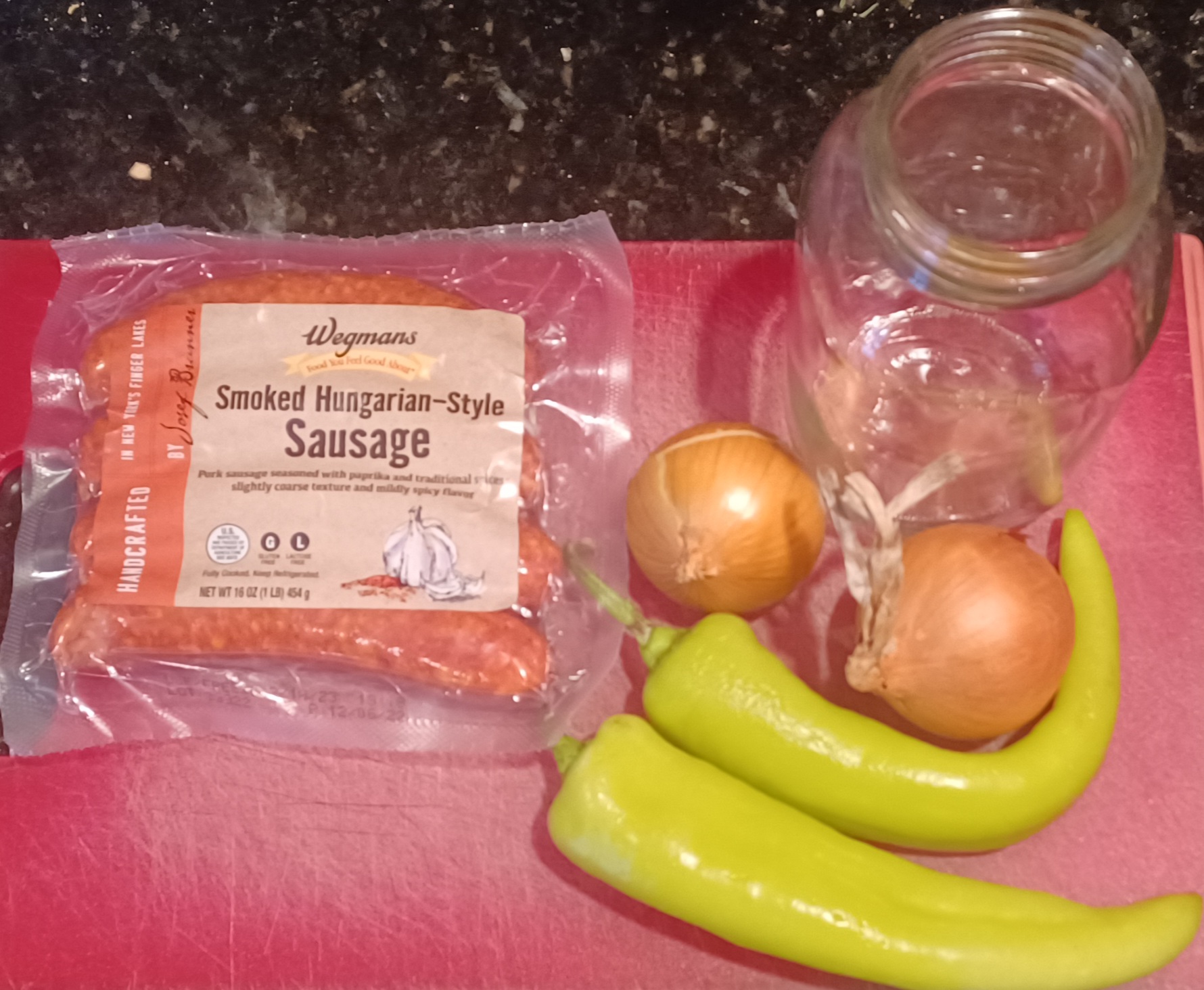
Several friends asked if I could share with them how to make utopenci (plural), and so when I got round to making a new batch at the weekend, I figured I'd take some pictures and put it all here. So...for the recipe you will need:

  • 1 packet of spicy smoked sausage
  • 2 medium onions
  • 2 Hungarian wax peppers
  • 2 cups white vinegar
  • 2 cups water
  • 0.5 teaspoon salt
  • 1 tablespoon sugar
  • 0.5 teaspoon allspice berries
  • 0.5 teaspoon black peppercorns
  • 4 or 5 bay leaves

The traditional Czech sausage used in utopenci is called a špekáček (singular), which is a short, fat smoked sausage that is a mix of beef and pork. The Wegman's Smoked Hungarian style sausage below is the closest I have found to špekáčky (plural).

Before dealing with the sausages themselves though, we need to make the brine. In a smallish pot, mix the vinegar, water, salt, sugar, and spices then bring to the boil. Boil hard for 3 minutes, remove the pot from the heat, and let the brine cool. You don't want to pour boiling brine over the sausages, we are pickling not cooking them remember.

While the brine is cooling, prepare the sausages and vegetables. I cut one end off the sausages purely so they fit better in the type of jar I generally use. Finely slice the onions and peppers.

Next up split the sausages lengthwise without cutting all the way through to the other side and stuff them with slices of onion and pepper.

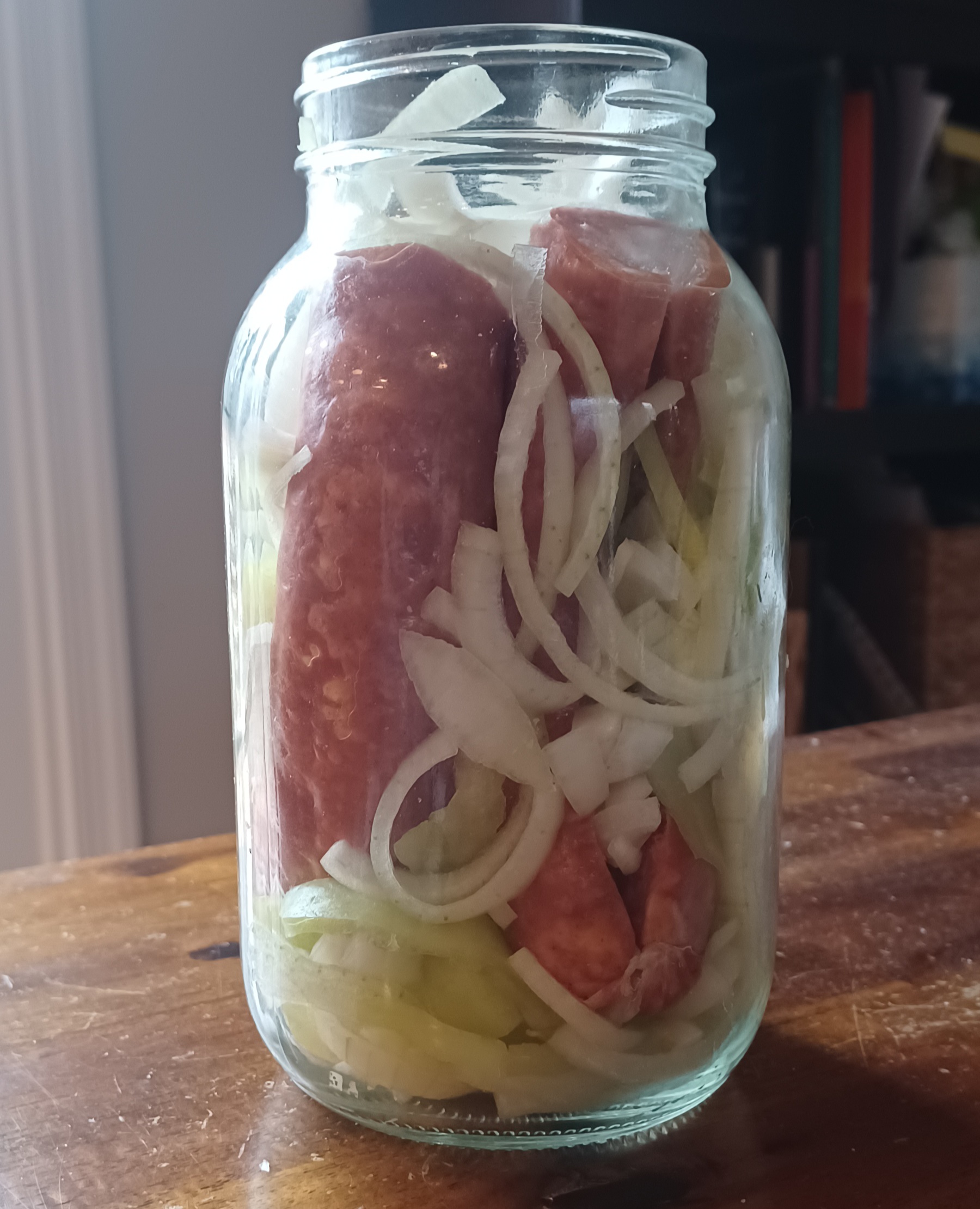
Once the brine is lukewarm, it is time to fill your jar with more sliced onions and peppers, and add the stuffed sausages so that you have a pretty well packed jar.

Before pouring the brine into the jar, I take a spoon to remove the allspice, peppercorns, and bay leaves, which I then add to the jar so they can macerate further and add more flavour. Gently pour in the brine to cover the sausages completely, using a chopstick or similar to allow the spices to penetrate further into the jar. Once full, tap the jar on the counter surface a few times to get rid of any air pockets.

Pop a lid on the jar and put it into the fridge to forget about for at least 10 days, though 2 weeks is my preferred minimum.

When it is time to eat them, just pull out a sausage, some of the veggies, which will have pickled nicely as well, and serve with a dollop of mustard, a couple of slices of seeded rye bread, and a half litre of some properly made Bohemian style pilsner, Pilsner Urquell would do the trick nicely.

Note: there is another theory as to the origin of the name, but it is less prosaic and hence, sadly, more likely, simply that the floating sausages look like drowned men. Meh, I prefer the story of Šamánek.

Wednesday, January 4, 2023

Year of Czech...Snacks

I wish I could remember where I read it, I thought it might be Vinepair, but I can't find the article there. Apparently 2023 is to be the "year of Czech beer" in the context of the writer discussing Schilling's very respectable polotmavý ležák, Augustin.

That phrase "year of Czech beer" had me conflicted however. On the one hand, yes I would love to see more traditional Bohemian style beers, whether světlé, polotmavé, or tmavé, at whatever strength category is in order, lehké (8° or less), výčepní (8°-10°), ležák (11°-12°), speciální (13°+), or porter if it's dark and over 18°. On the other hand, I dread the market being swamped with second rate brews, trading on the popularity/trendiness of Czech beer, a pale lager hopped with Saaz does not a Bohemian pilsner make, neither yet does adding a slug of Carafa to your "pilsner" recipe make a tmavé.

Inevitably, along with screeds about how Czech beer is the IT beer of 2023 will come the "hanger-on" content around what foods pair with what beers, how the Lukr tap is "traditional" (retro-revival is far more accurate), and the mythological dumping of beer by the good citizens of Pilsen that is claimed to be the catalyst for the advent of Pilsner Urquell.

What I would love to see though in all the inevitable content, is an appreciation of broader Czech pub culture and the kind of things you are likely to see or get in a Czech boozer - preferably one outside of Prague 1, 2, and the posh bits of 3. In particular it would thrill my heart to walk into a brewpub that is showcasing a triple decoction světlý ležák, hopped to the nines with Saaz, open fermented, extensive horizontal lagering, and be able to order an "utopenec" or "drowned man". 

Utopenci (plural here, hence change in spelling) are pickled sausages, served with a slice or two of rye bread, some of the onions from the pickling liquor, and a good dollop of mustard. They were one of my absolute favourite bar snacks when I lived in Czechia, usually fished out of a great jar behind the bar, and served with little ceremony. In my unhumble opinion you need to get out of Prague altogether to find truly great utopenci, from memory the ones I had in Velké Hamry were superb. In a fit of ostalgia (not a typo) last year I decided to make my own...

The method itself is pure simplicity, split some spicy sausages, in this case Hungarian style smoked paprika sausages from Wegmans, slice a couple of onions and Hungarian wax peppers, layering them in a clean container with an airtight lid. For the brine I made a mixture of white vinegar, salt, a tiny bit of sugar, along with a bay leaf, a few allspice berries, and some black peppercorns, boiled it for a few minutes then let it cool to blood temperature. Once the brine had cooled, pour it over the sausages, onions, and peppers, and seal up your container, then put it in the fridge for a couple of weeks to mature. Some recipes include thinly sliced chili peppers, but I didn't have any, so I didn't use them. The great thing about peasant snacks is recipes are wonderfully flexible depending on what is in your cupboard.

Another gastronomic treasure to be found in many a Czech pub is nakládaný hermelín, which really means "marinated heremlín", "hermelín" is a soft cheese in the mold of brie. Evan Rail best described it in his article for Vinepair as "a type of gooey, marinated soft cheese that serves as a popular beer snack in the atmospheric beer halls of Prague". Again, this is something that Mrs V and I make fairly often, even though, as the article notes, here in central Virginia we have to replace the hermelín with brie.


As you can see from the picture, the brie is split in half, and a paste of garlic and paprika, add a little cayenne if you like a touch of heat, is smeared on the revealed cheese. The halves are then put back together and stacked in a sterile glass jar with onions and wax peppers, lots of onions - I think we used 4 large ones in this batch. Added to jar are a couple of bay leaves, some allspice berries, and black peppercorns - are you seeing a flavour theme here yet? The jar is then filled with oil, the blandest, most neutral oil you can find, and left to sit in the fridge for 10 days to 2 weeks. What comes out of the jar is an unctuous, pungent cheese that spreads easily on a slab of rye bread, best enjoyed with a half litre of whatever style of Bohemian beer is your fancy that day.

Bread...the staff of life, and Czech bread, chleb, in particular is something I loved. The standard loaf in Czechia is a dense, brown rye bread, that sticks to your ribs, and goes with absolutely everything. I never understood expats who didn't like it, and I even knew one who had his friends from the UK bring British bread over when they came to visit. Anyway, Czech bread looks kind of like this version I baked last year:


Another of my favourite pub snacks in Czechia is half a loaf of this kind of bread, sliced most of the way through, served warm, and with a pot of škvarková pomazánka, basically an egg, gherkin, and mustard spread that includes "škvarký" - the cooked, unrenderable bits left over from making lard from belly pork. This video shows the process far better than I can explain it, suffice to say it is fecking delicious, spread on the warm bread...I need to make more lard soon...

As I said earlier, if I were to walk into a taproom showcasing Czech beers and any of these snack were also available, I'd be in heaven. The best foods to pair with Czech beer are Czech foods, they go hand in hand so perfectly.

For The Keepsake of It

Usually, when Mrs V and I drive back to central Virginia from South Carolina we stop at Olde Mecklenburg Brewing in Charlotte, mainly to swa...