Showing posts with label austrian national library. Show all posts

Monday, January 8, 2024

Rauchbier Revival?

Tis January, so 2 things must be true, I am taking the month off the booze, and I am diving into the Austrian National Library's online newspaper archives looking at the sometimes weird, but often wonderful world of brewing in Central Europe prior to World War 1.

I really don't take a structured approach to my, ahem, "research", usually preferring to just to enter a keyword or phrase, select the publication I want to look at, and start scanning through images. Just a side note, I find these kind of publications so enlightening about the brewing, and broader, world at the time, as opposed to reading technical brewing treatises. In particular I love trade ads in journals like Der Böhmisches Bierbrauer, Gambrinus Brauerei und Hopfen Zeitung, or Saazer Hopfenzeitung und Lokaler Anzeiger as they give you a picture of the ingredients, machinery, and assorted allied products being made and sold in Central Europe.

Anyway, purely on a whim, I decided to see what I would get if I typed "rauch" into the advanced search, pre-filtering to Der Böhmisches Bierbrauer. There were 115 results returned, and so I decided to sort further by searching on "rauchbier" specifically, which gave me this single result from October 26th 1909:


The headline in bold there declares there is a "Re-emergence of "self-malting"", going on, quoting an article from Bamberg in the "Allgemeine Anzeige für Brauer und Mälzer" which, assuming the translation is reasonable accurate goes on to say:
"The depressed situation of the small breweries is now leading them to return to the old arrangement of malting themselves. Over the years, people have gotten used to getting the malt ready from the malt factory. Today's cheap (?) barley price offers the hand for a return to the old system and so the old Bavarian smoked beer will soon appear again. Whether this will prove successful remains to be seen in the future."

If this report is correct, smaller breweries in Bavaria were going back to malting their own grains because the cost of the raw materials was sufficiently low to make this economical again, rather than buying their malt from the likes of Weyermann, whose maltings is massive pile right next to the railway station in Bamberg.

What jumped out most to me though was that the relative low cost of barley could lead to the return of "the old Bavarian smoked beer". This raises the question then, did rauchbier die out in Bavaria in the latter 19th century and only revive when breweries starting taking back the ability to make their own malt, as, for example, Schlenkerla continue to do so to this day?

Another question this raises is, were malting companies such as Weyermann not providing rauchmalz and thus the beer died out? Was there customer demand for rauchbier to the extent that any other malting company at the time was providing rauchmalz?

As ever, more questions than answers at this point, but if we can take this report at face value, it looks possible that rauchbier as we know it today could so easily have gone the way of grodziskie, broyhan, and Braunschweiger mumme, but for the alleged fact that barley was cheap in the years running up to World War 1.

Wednesday, February 15, 2023

The Dortmund Question

My last post was ostensibly about how Bohemian brewers felt about North German breweries co-opting the name "pilsener" to describe their pale lagers. The article from Der Böhmischer Bierbrauer that I reference in the post includes several references to quotes by Professor Wilhelm Windisch, one time chief of the VLB in Berlin, where he praises the qualities of Dortmund beer, whilst musing why German brewers felt it necessary to co-opt a foreign brew.

We all kind of know the general outline of history when it comes to pale lager, Josef Groll creates Pilsner Urquell in 1842, which is just a hair paler than Anton Dreher's Vienna Lager, and thus kicks off a pan-continental craze for pale bottom fermented beers. By the end of the 19th century, the list of "styles" that have come about as a result of Groll's introduction of English malting technology to Central Europe included Helles, Biere d'Alsace, North German Pilsner, Polish Mocne, and of course Dortmunder. All of the styles followed the same basic template, pale malt and the local hops, from Strisselspalt in Alsace, though Hallertau and Tettnang in Germany, up to Poland's Lublin.

In our hop centric minds in the early 21st century, we make the assumption that the main driver of differentiation in all these beers was the presence of local hops, relegating malt to essentially the role of hop delivery system. However the role of malt in the development of beer styles seems to get somewhat overlooked, as if all pale central European beers can be brewed with pilsner malt and whatever hops are appropriate. Historically that seems not to have been the case.

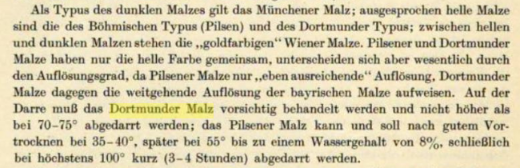
I wish I could remember where I first came across the term "Dortmunder malt" but alas the old grey matter is, well, getting older. However, I did find, not in the newspaper archives of the Austrian National Library I am sure you are relieved to hear, a book called the "Handbuch der Enzymologie, Vol II" on Google Books. On page 1236 of the book there is a fascinating breakdown of the different base malts in use in Germany at the time, I believe the book dates from the 1940s rather than the 1545 Google claims. In this section we get a description of the "dark" Munich malt, the "pale" Bohemian and Dortmunder malts, and the "golden" Vienna malt that is a middle ground between the others.


According to the writer, the fact that Bohemian and Dortmunder malts are pale is the only thing they have in common. He goes on to explain how Pilsner malt is modified "just enough" (major shout here to Andreas Krennmair for helping me with the translation of "Auflösung" meaning "modification" in a malting context) while Dortmunder malt is fully modified just like Bavarian malts. As you probably know, modification with regards to malt refers to:

"the extent to which the endosperm breaks down...releasing nutrients for yeast growth and making the starch available for enzyme degradation during mashing"*

In addition to be more fully modified that Bohemian malt, Dortmunder is also to be treated more gently that Pilsner malt, with the kilning process not reaching temperatures of more than 75°C/167°F. The writer describes the kilning process of Pilsner malt as being "pre-drying at 35-40°, rising to 55° until the water content reaches 8%, then kilning up to 100°", kilning also only takes 3 to 4 hours.


Apparently if you subject Dortmund malt to the same process it would become far too dark. Essentially Dortmunder malt needs to be carefully tended when compared to Pilsner malt so as to stay pale whilst achieving a full modification like Munich malt.

It would appear then that, at least in the 1940s, Dortmunder beer was brewed using specifically Dortmunder malt rather than the modern approach where "Pilsner" malt is the base. However, as early as 1913 Der Böhmische Bierbrauer was referring to "so-called" Dortmunder malt as a "minor type" of base malt, whilst describing it as "lightly kilned". It would seem that it was the use of Dortmunder malt that prevented the style from becoming the dominant German beer.


In an article from 1899 in the brewing journal "Gambrinus Brauerei- und Hopfen- Zeitung", the writer discusses why people were moving away from Dortmunder towards Bohemian beers. The writer confirms again that Dortmunder malt is kilned at low temperatures and thus very pale. He goes on to state that such low kilned malt has an "empty taste", and such a paucity of flavour causes the breweries to stick to brewing a 14° beer, which the writer defines as being "ein alkoholreiches Bier" - an alcohol rich beer - inferring then that Dortmunder was strong because that was it's main redeeming feature. The writer finishes his section on Dortmunder beer by comparing the beer with the Bohemian 10° beers that were "doing so well on the market" by stating they are "good beers, that hold their foam well, and don't taste empty at all".

At the end of the day, the average consumer wanted something that was flavourful, looked good, and wasn't "alkoholreiches", and thus Dortmunder was relegated to an also ran of the pale lager world, with Dortmunder malt eventually dropping out of production altogether it would seem.

* quote from "The Brewer's Handbook" by Ted Goldammer - https://www.beer-brewing.com/beer_brewing/beer_brewing_barley_malts/malt_modification.htm

Thursday, February 9, 2023

1895 - The Year of Pilsener?

It was only within about 50 years of its creation in 1842 that pale lagers from Plzeň were under attack in the learned press of the day. We all know the story of how Josef Groll's golden lager swept continental Europe, inspiring imitations in Munich, Dortmund, Strasbourg, Leuven, Glasgow. You name a major brewing city in Europe in and around 1895 and you likely have a pale lager, vaguely in the style of "pilsner", being brewed, though of course there were hold outs like London, Burton, and Dublin.

Recently though in one of my trawls through the newspaper archive of the Austrian National Library, it really is a fascinating resource that I keep coming back to, I learnt that certain beers being brewed in the recently established German Empire were considered better than the Bohemian original, in particular the "pilsener" lagers of northern Germany and the Dortmunder.


According to one Doctor Wilhelm Windisch, writing in "Wochenschrift für Brauerei", Pilsner and Dortmunder are both "light beers" but of "very different types", and Dr Windisch poses the question "which is the nobler of the two"? Windisch then goes on to sing the praises of the Dortmunder, saying (and here I am relying on the veracity of the quotation in Der Böhmisches Bierbrauer in August 1895 above) that Dortmunder is "always clean". The German here is "es stets blank", "blank" can translate into English as "bare", "shiny", or "pure", though a Czech possibility is the word "čistý", which in English can translate as "clean". Given the context of later in the quote about a yeasty flavour, I think Dr Windisch is talking about the classic clean flavour that we associate with lagers in general.

Dr Windisch goes on that Dortmunder has "a better hop taste than the Pilsener" arguing that in pale lagers from Plzeň "the taste of hop oil is sometimes very strong". His final accusation as to the inferiority of Pilsner, from Plzeň, when compared to Dortmunder is that it has "almost without exception...a peculiar yeasty taste" which he then claims "is not fresh, but a peculiarly old one, like the one imparted to beer by dying or dead yeast". From this he would seem to be claiming that in the Bohemian pilsners of the 1890s you could taste the autolysis of the yeast as it dies.


Moving on from comparing Dortmunder and Bohemian Pilsner, Windisch further extols the virtues of the "Pilsener" style being brewed in Northern Germany, noting that they are "light in colour and...they have a more pronounced hop taste". He points out that this additional hop flavour is due to in part to using more hops in the boil and a slightly different hopping schedule in Northern Germany than in Bohemia. Windisch then goes on to drop the mic, by declaring that Northern German:

"so-called "Pilsener" beers are much more similar to Dortmund beer, and we really didn't need to borrow a beer type from abroad, especially since Dortmund beer has long since acquired an excellent reputation"

leaving us with this question:

"as far as wholesomeness and digestibility are concerned, the question still needs to be decided, whether our light, clear, and not excessively hopped so-called "Pilsener" beer or the Dortmund-style beer isn't even "healthier" than the cloudy, yeasty, strongly hopped Pilsner beer"?


Despite this, Windisch notes that the "importation of Pilsener and other Bohemian beers is steadily increasing and has become very important". As a result of this growing competition from the east,  Munich breweries were forced into action, particularly Spaten and their the recently created helles lager that he notes is "similar to Pilsener beer". So conservative though were Munich drinkers that it had been market tested far from the Bavarian heartlands at the Café Ronacher in Hamburg's Savoy Hotel. As a result of the success of the trial, Spaten started full scale production of their pale lager. The coming of pale lager to Munich, whilst seemingly ignored by the Munich beer press, was declared "notable progress" in the popular press, and in the mind of Windisch himself "a beer-political event of the very first order".


Having quoted Dr Windisch at length, the author of this article in Der Böhmisches Bierbrauer gives short shrift and is quite acerbic in his response claim that:

"you have to get used to the fact that "Pilsner" is making more friends in North Germany because of its excellent properties, is spreading as a result of North German breweries borrowing this popular beer type from Bohemia! The fact that the people of Munich are now also brewing a light beer in the "Pilsner" style doesn't come as a surprise either; already in the 16th Century people set a good example there, in that a brewing method that originated in Bohemia - to produce weisses Weizenbier - was made native in Munich, as can be seen from the brewing regulations of 1616."

Boom from the Bohemian, who signs off as "Ein echter Pilsener". He is basically saying, yes Mr Windisch it is no surprise that people are jumping on the "Pilsener" bandwagon because it is popular, and points out that we have seen this in beer history before, when Bavaria copied the Bohemian "bilé pivo" (white beer/weissbier) and made it is own.

What I found particularly interesting about this little article, which feels like an editorial, was not the history as presented by Dr Windisch, though yes that was fascinating, but rather the response of the "echter Pilsener". Rather than engage with the learned professor on the merits of Bohemian brewed pilsners when compared with those of norther Germany, Dortmund, and Munich he choses the route of rather nationalistic bombast. His argument is essentially, "we're popular and that's why people use the name pilsener", a brewer's "yah boo sucks to you" response basically.

Though putting this in context a little, at this point, if I have understand the other German language stuff I have been reading lately, the definition of what constituted a "pilsner" or "pilsener" in the German Empire, as opposed to the Austro-Hungarian Empire, had not been settled. As late as 1909 the "Böhmische Brauhaus" in Berlin was using the term "Pilsator" for their pale Bohemian style lager. What we are seeing here is the beginning of a battle that in some ways rages on to this day, what exactly even is a "pilsner"?

Tuesday, February 15, 2022

Bohemian Brewing Industry 1898

Again this week we go time travelling into the newspaper archives of the Austrian National Library, and once more we return to Bohemia and the German language publication "Der Böhmische Bierbrauer" in the year 1900.

In the June 15th issue that year, "Der Böhmische Bierbrauer" presented a snapshot of the brewing industry in Bohemia in the year 1898, based on the work of one Dr Bernat, Director of the Prague Brewing School. Now, maybe I am weird, but the numbers and stats presented by Dr Bernat are fascinating. Let's start at the beginning....

Apparently in the year 1898, a total of 8.7 million hectolitres of beer was brewed in Bohemia, which equates to 7.3 million US barrels, or a little less than five Sierra Nevada Brewing Companies, but also less than the modern production of Pilsner Urquell of about 10 million hectolitres. All of that beer was brewed by just 673 breweries, which was 21 brewers fewer than in 1897, when about 8.5 million hectolitres was produced. As such, the average Bohemian brewery in 1898 produced just 12,865 hectolitres, or 10,789 barrels. Production topped out in June, with 808,000 hl brewed, with October being the lowest month, when only 651,000 hl were produced.

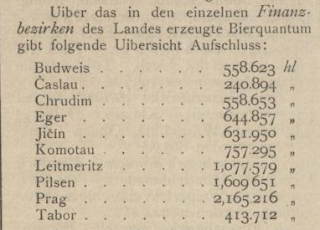
Let's take a quick look at the districts where this beer was being produced

No real surprise that the leading areas were Prague and Plzeň, with about 3.8 million hectolitres brewed between them. Obviously it stood out that Leitmeritz was such a prominent player at the end of the 19th century. Leitmeritz is today known by the Czech name Litoměřice in the north west of modern day Czechia, which includes the Žatec area, perhaps better known in the brewing world as Saaz. Interesting side fact, Saaz in this time period was not just known for the quality of it's hops for brewing, but also for spruce pitch for lining barrels. Perhaps most interesting here though is the case of the Budweis district, which brewed the 3rd lowest amount, but this next picture fills out that story a little...

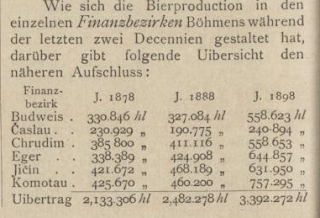
The table above shows the growth, or otherwise, of beer production in several Bohemian regions in 1878, 1888, and then finally in 1898. Clearly there has been major growth in Budweis between 1888 and 1898, and the elephant in the room here is that in 1895 the Czech population of Budweis decided to merge several breweries to compete with the larger, established, and German owned, Bürgerliches Brauerei Budweis. The Czech company would eventually become Budvar, and spuriously lay claim to being the "original Budweiser" despite being 100 years younger than Bürgerliches Brauerei. It seems clear though that beer production in that part of Bohemia had stagnated prior to Budvar being incorporated. It is also clear that brewing between 1888 and 1898 was becoming truly industrialised as production overall increased 36.7% in that decade, compared to 16.4% the decade before, for an impressive 59% increase in just 20 years.

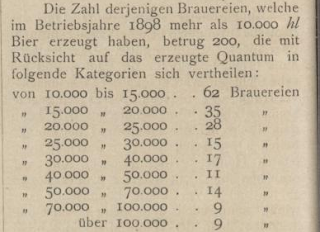
Despite this increase, and the obvious ramping up of industrial production, only 200 of the 673 breweries operating in Bohemia in 1898 brewed more than 10,000 hl, and remember the average was just over 12,000 hl per year. The 200 biggest breweries in 1898 were further broken down as follows:

Just 9 breweries in Bohemia made more than 100,000 hl of beer in 1898. That list contains several names, in brackets, that would be familiar to modern day drinkers, though several a long gone:

  1. Bürgerliches Bräuhaus Pilsen (Pilsner Urquell) - 486,700
  2. Smichov Actiengesellschaft (Staropramen) - 397,000
  3. Actienbrauerei Pilsen (Gambrinus) - 266,800
  4. Protivín - 138,936
  5. Genossenschaft Brauerei Pilsen - 135,100
  6. Maffersdorf (Konrad) - 122,522
  7. Prag-Holešovic (Holešovický měšťanský pivovar) - 112,273
  8. Bürgerliches Brauerei Budweis (Samson) - 109,485
  9. Wittingau (Bohemia Regent) - 109,306
Of the 9 biggest breweries in 1898 Bohemia, 2 are no longer in business. Genossenschaft Brauerei, from what I have found out so far, was a co-operative brewery that at least as late as 1909 was reputed to be a leading import beer in the US, according to the American Beer Review. Holešovický měšťanský pivovar closed down just before I moved to Prague in 1999, with production moved from Holešovice to Staropramen in Smichov.

What though was being brewed by these 673 businesses? Well, Dr Bernat has given us a handy breakdown by strength...


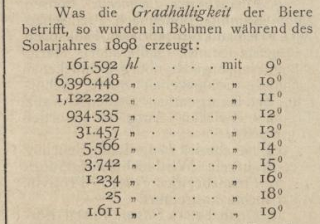
99.5% of beer brewed in Bohemia in 1898 had a starting gravity of less than 12° Plato. That is staggering, though not surprising in the slightest really, just desítka accounted for 73.9% of all beer brewed that year. Unfortunately Dr Bernat doesn't go on to tell us what kinds of beer were being produced, but I imagine the majority of beer being made then was a variation on the theme of pale lager.

Wednesday, February 9, 2022

Life in Czech Vienna

When I lived in Czechia, the website expats.cz provided a useful and occasionally fun way to garner inside information on living in that foreign land about which, at first, I knew nothing. Once upon a time, the site had a message board which was split into themes like "Accommodations", "Life in CZ", and the ever popular "Miscellaneous" - possibly not exact titles, but you get the drift. 

It was not uncommon to see grizzled old hands rolling their cyber-eyes at the latest newly minted TEFL teacher/poet/novelist looking for a place to get a distinctly foreign product to make their new life in central Europe more akin to their home country. I know of people, and I am not exaggerating here, who whenever friends visited from the UK had them bring British milk and bread. It was just as often on the boards to see comments along the lines of "if you don't like it go home" as the 9 millionth newbie complained about Czech service.

Prague, being an international hub, was home to all manner of ethno-pubs, butchers doing "proper" bacon and sausages (which were superb by the way), places to buy Wychwood ales, and places to get cheese from across Europe. There were even a couple of Marks and Spencer stores. Fun fact there was an M&S in Prague when I first arrived in 1999, it was out at Černý Most and didn't have a food hall, ergo, it sucked.

These message boards popped into my mind as I was bimbling around the scanned newspapers of the Austrian National Library, in particular the weekly "Česká Vídeň", which from what I can see was published from 1902 to 1914, but scans only exist from 1907 to 1909. "Česká Vídeň" translates as "Czech Vienna" and obviously thus served the sizeable Czech community in the capital of the then Austro-Hungarian Empire. Another fun fact, Vienna was home to the second largest Czech community in the world in the early 20th century, the largest being Prague. Estimates range from 10-30% of the Viennese population in 1900 being Czech, and even today it is not uncommon for Austrians to have distinctly Czech family names.

Restaurants are, I guess by nature, the perfect venue for expat communities to gather in and feel a little bit "normal" or at home in their foreign domicile. As such, it was restaurant ads that caught my eye most, for example...


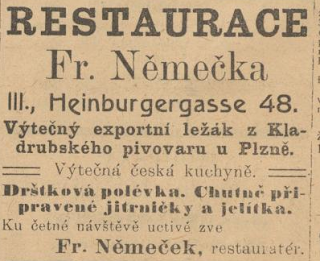
At Restaurace Fr. Němečka, or František Němeček's Restaurant you could get all manner of Bohemian treats, while enjoying the irony of your host being a Mr Frank German. Mr Němeček naturally sold "delicious export lager" from Plzeň, but not from Pilsner Urquell, rather from the Kladrubský Pivovar which was based in a one time Benedictine monastery. On the food front, his menu featured such "delicious Czech cuisine" staples as tripe soup, liver sausage, and blood sausage - other than the tripe soup, you bet this Scotsman would have been there, jitrnice and jelítka are some of my favourite Czech foods. Mr Němeček, being a most congenial host, naturally invites you to visit.

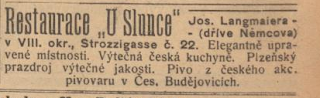
If you were looking though for a choice of beers made in Bohemia, you could always try Strozzigasse 22 and Restaurace U Slunce.

Pitching up "At the Sun" Restaurant, you would be welcomed to an elegantly decorated venue by Mrs Langmaiera (née Němcova), who as well as serving delicious Czech cuisine (is there any other kind?), can offer you a choice between Pilsner Urquell, "of excellent quality" and beer from the brewery known today as Budvar.

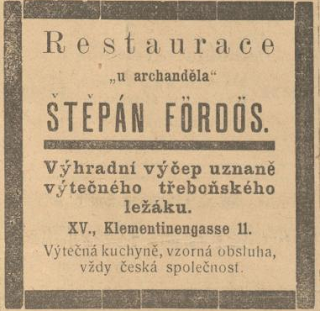
Not keen on making a decision between Pilsner Urquell and Budvar? Then perhaps you want to to visit the divine "Restaurace u archanděla" on Klementinengasse, where your host is a Mr Štěpán Fördős.

I am no expert on these things, but the family name "Fördős" looks distinctly Hungarian to me. A reminder that Vienna was capital to a multi-ethic empire, and that despite the prattlings of nationalists everywhere, none of us are pure anything other than human. At the Archangel is, if my Czech isn't entirely letting me down, the exclusive Vienna tap room for the renowned lagers from Třebon, also know as Wittingau and likely the brewery owned by the noble Schwarzenberg family, known today as Bohemia Regent. Of course, just like most of the restaurants whose ads I saw, the Archangel promises excellent food, though the "exemplary service" was new, as was a phrase I saw pop up time and time again..."vždy česká společnost".

"Vždy česká společnost" translates literally as "always Czech company", which I have to admit had me scratching my head at what it meant. The word "společnost" does indeed mean company in the sense of a corporation or business, so was the advertiser claiming to be an "always Czech owned company"? The more ads I read though, the more it became apparent that "společnost" did indeed mean company, but in the sense of "community" or "fellowship". These restaurants, like expat hangouts since time immemorial were offering Czechs in Vienna a Czech environment in which to feel at home. Pretty much each and every restaurant ad I saw in "Česká Vídeň" mentioned the beer being poured, and also that they had Czech language magazines available. Rarely did an advert mention any of the dishes being prepared in the kitchen though.

Restaurants were, for Czechs in Vienna, a place to drink Czech beer, read news in Czech, meet fellow Czechs, and eat Czech food, places to have a sense of home away from home. Multiculturalism is nothing new, people have always migrated for better lives, more opportunity, or even just for plain old adventure. I wonder if there were folks in these restaurants who told Honza, having just got of the train and adjusting to life in a modern, chaotic metropolis that if he didn't like it, he should just go home? Probably, but at least there was "vždy česká společnost" to make him feel that he belonged, and another glass full of whatever Bohemian beer was on tap.

Wednesday, February 2, 2022

19th Century Bohemian Beer Brewer

It all started by reading Andreas Krennmair's book of homebrew recipes for historic German and Austrian beers. Andreas includes in the book a recipe from 1834 for "Prague Beer" which I am thinking about brewing in the near future. I wanted to get a more contemporaneous handle on "Prague Beer" and so I started digging around in various online archives, like you do. My digging led me once again to the newspaper archives of the Austrian National Library.

It is sometimes easy to forget that for a thousand years Bohemia was very much in the German sphere of influence, whether as part of the Holy Roman Empire until 1806, or as a kingdom within the Austro-Hungarian Empire up to the end of World War 1. In the mountains and marches of much of western Bohemia there was, for centuries, a large German majority. I don't want to get into the fraught, complicated politics of Bohemia, but rather to point out that it makes sense to go looking for information about the Bohemian brewing world in the Austrian National Library.

The first publication I stumbled upon was "Der Böhmische Bierbrauer", a brewing trade journal that was published in Prague from 1874 to 1916. At the height of World War 1 it was renamed "Der Österreiche Bierbrauer", having relocated to Vienna, after a year of just being "Der Bierbrauer" and being published jointly in Prague and Vienna. In the few issues that I browsed through, I didn't find any descriptions of "Prague Beer" but that is mainly because I starting delving into the ads section of the journal.

Adverts are fascinating pieces of social history and tell us more about the reality of what was going on in a society than lengthy technical treatises about brewing processes and the like. Take, for example, this advert from the January 1st 1891 issue.

A rough translation would be:

"Best clarifying agent! American isinglass, made from thornback ray (ray skin)

Imported directly, only prime quality, cheapest offered to brewers and dealers"

I find it fascinating that there was a business in 1891 selling Isinglass finings, imported from America, to breweries in Bohemia. The address of said business, "Tuchmachergasse 9", would show up time and time again in adverts from this journal, so naturally I looked up a period map to find out where it was...and it is just a few doors down from Pivovarská Nalévárna on modern day Soukenická.

Talking about brewing businesses on streets I know well, I discovered that on the same street as my last apartment in Prague was a malting company:

Leopold Schmied was a malt manufacturer at an address that is today the address of the Autoklub České Republiký. It is fun to think that less than a five minute walk from where I lived, malt was being made. A dark malt for Munich beer, a Bavarian style black malt to be used with the dark Patentmalz for Bock. The pale Patentmalz made for full bodied beers with good foam retention apparently, and there was roast malt for brown beer, porter, and so on and so forth. Hmm...malt being sold for specifically for porter brewing in late 19th century Bohemia? There's a whole world of intrigue right there, what was Bohemian Porter, bottom fermented like Baltic Porter or top fermented as U Fleků's legendary dark beer still was at this time? Schmied could also provide you with caramel malt to meet all your brewing colour and flavour needs. Being locating right opposite a major railway station, they had logistics right on their doorstep - fun fact, the railway station opposite Leopold Schmied Malzfabrik was not the hauptbahnhof of the day, that was the station known today as Masarykovo Nádraží. Today's Hlavní Nádraží was named Franz Josef Station until 1919.

Talking about railway stations, they are the natural place for a brewery to pick up the seed yeast they need to turn lovely sweet wort into even lovelier beer, but who would be selling seed yeast in 19th century Bohemia?

Bürgerliches Brauhaus in Pilsen obviously, though these days they are better known as Pilsner Urquell. For just a single Krone, you could purchase a kilogram (2.2lb), of "excellent and pure" seed yeast. What you didn't get for your money though was packaging and delivery from the railway station in Plzeň, which if I have the right station is this somewhat ornate pile.

I am sure that there will be far more to come as I trawl my way through the digitised newspapers available through the Austrian National Library. I am focusing on the adverts for the time being as they give a sense of the reality of the Bohemian brewing industry at the time, the products available, the names in the business, and where such brewing adjacent businesses were located.

Skoro Doma

Having arrived in Denver on a Saturday afternoon, clearly these posts are not in any particular chronological order, I got myself unpacked a...