Showing posts with label bohemia. Show all posts

Wednesday, July 9, 2025

What The Schnitt?

Yesterday I introduced you to our friend Mr Bílek, shoemaker and fundraiser for Czech national causes extraordinaire, yet he was far from alone in his endeavours, as I discovered in the German language daily "Znaimer Tagblatt" from January 1900.


Znaim is the German name for the modern city of Znojmo in Moravia (minor aside, I always find typing "Moravia" rather than "Morava" weird) and if ethnic maps of the late 19th and early 20th century are accurate the city, and its attendant region, was predominantly German rather than Czech. The history of Bohemia and Moravia within the context of the wider Austro-Hungarian Empire is delightfully complex and multi-ethnic, and I don't want to get into that fun here. However, what is clear is that Czechs and Germans living in Bohemia and Moravia used each other to prod and cajole their fellow citizens into ever greater demonstrations of national fervour.

According to this story, the fund raising undertaken by the likes of Mr Bílek at U Fleků had raised a total of 26,614 Florins in the 20 years since 1880. One thing that I find fascinating is all the different names for the same basic currency throughout the Empire. If the 14,000 Złoty raised by our shoemaker friend was about $90,000 then over the course of 20 years, the proud Czechs of U Fleků raised about $170,000/£126,000/€146,000 for various Czech national associations, specifically the Czech School Association, Czech Association in North Moravia, and the Sokol, a gymnastics association.

And so this success makes the "Deutsche Blatt" ask the question "and what are we Germans doing?". Seemingly there were a pair of Moravian "Bunds", one in the North and one in the South, for whom an annual contribution of a mere 20 Kroner or even a single Krone respectively was, perhaps hyperbolically, considered "already too much".

The writer continues to berate their fellow German Austrians that a single "schnitt" fewer every day wouldn't be so bad and that the savings would build up to a sizeable fund for civic associations tied to the ethnically German population of the Empire. And here we have again an example of the cross pollination of cultures that was Bohemia and Moravia in the 19th century, evidenced today through the use of a transliteration of "schnitt" into Czech, "šnyt" as the name for effectively a half pour of beer and lots of foam. "Schnitt", if you know your German means "cut", because it is a cut down pour of beer, that is "better than nothing", at least according to Bohumil Hrabal, or was it Karel Čapek, when he wasn't inventing the word "robot"?

Anyway, clearly the writer in the Znaimer Tagblatt thinks Czechs are more effective as patriots, reminding his audience with his closing line "organising festivals and dancing for national purposes is far from fulfilling one's duty".

Wednesday, March 2, 2022

Beyond Definition

Last week, I tweeted the following as the final piece in a thread about how we refer to Czech pale lagers:

This train of thought, combined with something I read in Der Böhmische Bierbrauer about the fact 10° beers were by far the most commonly produced in 1890s Bohemia, got me wondering what exactly is a 10° beer, other than having a starting gravity of 10° Plato?

According to Czech beer law, there are 4 types of beer:

  • Stolní pivo or 'table beer', up to 6° Plato OG
  • Výčepní pivo or 'tap beer' between 7° to 10°
  • Ležák or 'lager' 11° and 12°
  • Speciální pivo or 'special beer' 13° and higher
There is nothing in the law about what colour a particular type of beer needs to be, how many IBUs are expected, and all that other stuff you get with style guidelines. I was reminded of this while I was digging around the old interwebs looking for other information about particular historical breweries when I came across a site about Czech breweries before the Communist takeover in 1948, and what a trove of information that turned out to be.

All the label images that follow are from Pivety, and there is a shit ton more there if you are interested in early 20th century Czechoslovak beer advertising materials.

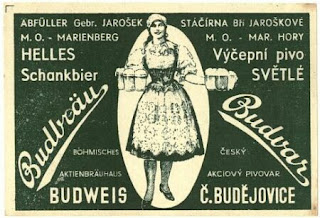
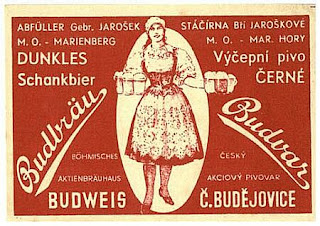
For example, once upon time, Budvar brewed a pair of 10° výčepní beers, one pale and one dark:


As you can see, the labels are in both German and Czech with exactly the same information on both. It is interesting that the dark lager version, the red one for those with no German or Czech, uses the Czech word "černé", which means "black" as opposed to "tmavé", which is more properly the translation of "dunkles". While I was not surprised to find a dark lager lurking in Budvar's history, I was marginally shocked when I saw this label:


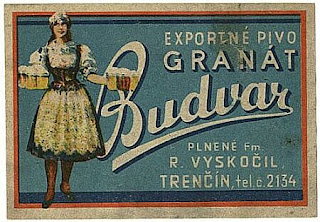
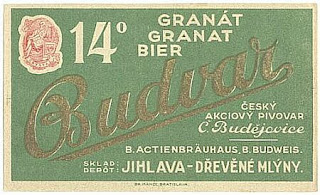
The label is for Budvar's "Granát Export Beer". The "granát" bit is pretty easy to suss out. We are talking "polotmavý", or "half-dark", usually a reddish lager that in terms of colour sits between pale and dark. Such beers often use the moniker "granát" in reference to the garnet gemstones that Bohemia is famous for. I had not seen the term "exportné pivo" though before, and through digging in this label archive, I am pretty confident that we are looking at a 12° Plato polotmavý ležák to use modern parlance. At some point though, Budvar's Granát was a 14° lager, whether it got stronger or weaker, I don't know.


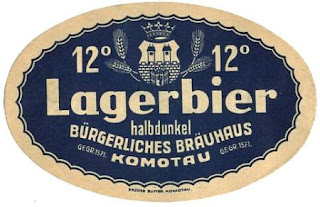
Perhaps the most startling label I have come across so far, was for the Bürgerliches Bräuhaus Komotau, which I referenced in my last post as being at one point in its history registered as a "braucommune". This label shows that at some point the notion of a beer sitting between pale and black on the colour spectrum was known to both the German and Czech speaking communities of Bohemia.


"Halbdunkel" is simply "polotmavý" in German, it was not a term I had seen or heard in relation to German beer before. Seeing it there on the label made me wonder if I could find references to "halbdunkel" in Austrian and German archival sources, but more about that some other time.

This all though does point to the truth that beer is a product of culture, and to understand a people's beer means understanding it in relation to their lived culture. As such, making a 14° pale lager and calling it a světlý ležák when it is more properly a světlý speciál just shows, in my opinion, a lazy disrespect to Bohemian brewing culture and history. Defining "tmavé" as beginning at 11° Plato, when the reality of history shows there have been výčepní beers that are dark is likewise presenting a slanted view of history.

I have argued elsewhere that tradition is an important part of being a craft brewery, but when reaching for someone else's tradition, brewers should seek firstly to be faithful and produce a beer, and label it, something that a person from that tradition would recognise. 

Many years ago, a Czech friend's father was given a bottle of Lagunitas Pils, allegedly brewed in the Czech tradition, and spat it out in disgust. Having taken a large mouthful from a bottle of Port City Downright Pilsner, his response was "tohle je České pivo", "this is Czech beer".

Wednesday, February 23, 2022

Communal Brewing in Bohemia

I really don't have that many things I wish I had done in my ten years living in Prague. I do wish I had been more interested in hiking when I was there as I would love to get up into the mountains that form the borders between Czechia, Austria, Germany, and Poland. Probably my biggest regret, if that is not too strong a word, though is that I never went to Zoigl country.

I am not going to delve deep into the roots of Zoigl, what zoiglbier is or isn't, but it has been on my mind a bit lately because of a single word I came across in one of my jaunts through the Austrian National Library's newspaper archive (yes, again). If you are, though, interested here is an excellent video on Zoigl beer production in Neuhaus bei Windischeschenbach that is worth half an hour of your time. If you want to skip the wort production stuff and see the fermentation and serving arrangements, start from here, and wait for the side pour tap...

The word that leapt from the page as I was reading something completely unrelated in Der Böhmische Bierbrauer was "braucommune", which translates as "brewing commune". Naturally, given Czechia's proximity to Zoigl country over the border in the Oberpfalz, I wondered if what I was seeing here was the remnants of a Zoiglesque communal brewing setup in Bohemia?

Digging further, I discovered that in 1895 there were just 4 "braucommune" breweries operating in Bohemia that produced more than 10,000hl:
  • Asch (Aš)
  • Krumau (Český Krumlov)
  • Kuttenberg (Kutná Hora)
  • Náchod
I also found reference to several other "braucommune" breweries, that presumably had not reached the magic 10,000 hectolitre mark, including
  • Braunau (Broumov)
  • Petschau (Bečov nad Teplou)
  • Brüx (Most)
  • Sebastiansberg (Hora Svatého Šebestiána)
  • Trautenau (Trutnov)
  • Komotau (Chomutov)
  • Teplitz (Teplice)
  • Gottesgab (Boží Dar)
  • Bohdanetsch (Bohdanec)
Try as I might, I could find little more than names and production volumes for such "braucommune" setups. Was I really seeing Bohemian Zoigl or something different? As ever Google gave me a pointer in the right direction when doing a search I came across Braucommune Freistadt, apparently the last remaining "braucommune" in Europe. What then was the difference between a "braucommune" and a communal brewhouse in the Oberpfalz model?

Here I need to give a shout out to Andreas Krennmair for helping me with the meaning behind the words. While the concepts are similar in the sense that brewing rights are invested in houses within a given town, a "braucommune" employs professional brewers and manages distribution and sales on behalf of the braucommune. In the case of Freistadt for example, where the brewery used to give a share of the beer produced to those who lived within the walls of the city, they now pay dividends. If a person decides to sell their house, the dividend remains with the property rather than the person. In Zoigl world, the rights owners have access to the communal brewhouse to make the wort, which is then fermented, and the resulting beer served through their own "zoiglstub'n".

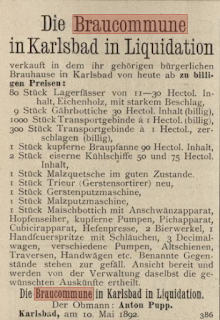
Given this, a "braucommune" was a type of business structure, based on ownership of property within town walls rather than shareholding. As to when the braucommune business structure came to its end in Bohemia, I believe it came during the Communist era of 1948 to 1989 first with nationalisation and then, somewhat ironically, collectivisation. The writing was perhaps on the wall in the latter 19th century as several of these braucommune breweries came up for sale or were placed in liquidation, such as the one in Karlsbad, modern Karlovy Vary, in 1892.


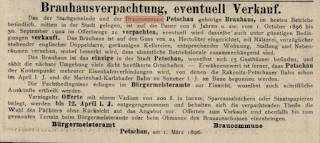
Sometimes it seems as though the braucommune decided to lease the brewery with a view to eventually selling up to a private concern, as was the case in Petschau (Bečov nad Teplou).


Interestingly, the advert above from 1896 touts the fact that this brewery had English malting technology, and that there were 15 taverns in the area as potential outlets. Unrelated, but is there a more perfect word for "hub" than "knotenpunkt"?

Will we ever see a revival in the braucommune concept? I doubt it given the mobility of the modern world, but I have to admit, if a house with rights came on the market in Freistadt...

Friday, July 6, 2018

#TheSession 137: Mitteleuropäisches Bilé Pivo


This month's Session is being hosted by Roger at "Roger's Beers...and Other Drinks", and the theme as stated is:
German Wheat Beers. I would like to clarify for myself the similarities and dissimilarities of weissbeers, kristall weizen, weizen, hefeweizen, etc. I’d love to read about the distinctions all you brewers and beer researchers know about regarding the various “styles” of weissbeer, experiences in brewing and drinking the beer, it’s history. Yeah, whatever you’d like to say about German wheat beers will be great.

I wish I could remember what my first weissbier actually was, though I well remember the occasion. I was at college in Birmingham, West Midlands not Alabama, and it was the British equivalent of spring break. There was a small coterie of folks at the college I went to who didn't go home for the week of spring break due to distance. The Outer Hebrides being a 24 journey home meant I stayed in Brum, my best mate Cristi is from Timisoara in Romania, so he didn't go home either. Being at theological college and training for ministry, we were officially discouraged from partaking in the devil's brew, but most of us would have the occasional pint at weekends, oh and I could tell you about a reasonably well known evangelist who was on the idiot box post college absolutely pissed as a fart one afternoon. Anyway Cristi and I had decided we would go to a concert during the break. The Mutton Birds were playing at the Flapper and Firkin and before the gig we wandered into a different pub on the canal, got a couple of pints and sat at a table outside, next to said canal. As I said, I had a pint of weissbier, it being 1998 it was probably Schöfferhofer or something, all I really remember was thinking it was rank to my untrained mind. I had half a mind to pour it into the canal, but it looked polluted enough as it was. I wouldn't touch wheat again until I was living in Prague.


Fast forward about 8 years to 2006, a group of my mates and I were in Pivovarský klub before heading to our regular haunt to watch the footie and one of them is raving about this German wheat beer that they had available, lo and behold the very same Schöfferhofer comes to the table. On a spur of the moment I decided to get one as well, just to see if my tastes had changed, fully expecting to hate it. My tastes had indeed changed in the intervening 8 years and so I had a couple more. The next time Mrs V and I went to Pivovarský klub I tried the Primátor Weizen and I liked it a lot, maybe more than the Schöfferhofer, I was getting a taste for wheat beers. On a trip up to Berlin in 2008 I had a pint or two of Memminger for breakfast, weizen was now a confirmed part of my drinking life.


Something that I was not aware of though as weizens took an increasing share of my drinking habits was the existence in the Czech Republic of "bilé pivo", which translates into English, in common with "weissbier" and "witbier", as "white beer". Apparently "bilé pivo" in Bohemia predates weizen in Bavaria and most historians of beer believe that "bilé pivo" migrated from the former to the latter before falling out of favour in its homeland, so much so that great Czech brewer František Ondřej Poupě is famously quoted as saying "wheat is for cakes, oats for horses, and barley for beer". Today weizen is making a comeback in the Czech lands, both under the modern Germanic name and the older Czech term.


All this thinking about Central European Wheat Beers got me thinking about my need to get back on the homebrew trail, twins inevitably take up the majority of free time that used to be used for brewing, and as soon as time allows I think I will brew another batch of my own "bilé pivo", which I call Böhmerwald, the German name for Šumava on the Czech/German border, which in a nod to the Bohemian origins of the weissbier style is hopped 100% with Saaz and is a lovely later summer thirst quencher.

Some Closing Thoughts

On Friday afternoon, with work concerns disappearing into the rear view mirror, and a little time to go until I had to pick up the twins fro...