Showing posts with label bohemian brewing industry. Show all posts

Sunday, January 25, 2026

Lost Breweries of Egerland

Along the north western edges of modern day Czechia lie the Ore Mountains, known in Czech as Krušné hory, and in German as Erzgebirge. The mountains themselves straddle the border between Czechia and Germany, and as the name makes patently obvious mining was for centuries the primary industry.  It is actually from the town of Jáchymov that we get the word "dollar" as a name for many currencies, though obviously from it's German name Joachimsthal - the silver that was mined here was minted into the standard coin for trade throughout Europe, the Joachimsthaler, which was shortened to just "taler", and eventually became "dollar". For centuries the mountains and their hinterland to the east formed a region known as Egerland, known in Czech as Chebsko.

As early as the 11th century, German speakers were invited to Bohemia to work the mines that generated some of the most industrialised areas of the Austro-Hungarian empire, with glass works, lace making, and textiles also prevalent. Where you have industry you have workers in need of a pint, and so you have breweries to meet that need. All of which brings me to the year 1913, when one "F. Zodel", the business manager of the Eger Chamber of Commerce wrote an article for Der Böhmische Bierbrauer, giving an update on the state of brewing the Eger region. Eger is today called Cheb, and lies almost as far west as you can go in modern Czechia.

In the article, Mr (I assume) Zodel lists the brewing totals for the extant breweries in the region for the 1911/1912 season, though the German word is "kampagne", which sounds so much more workmanlike. The list consists of 37 breweries, all of whom produced over 10,000 hectolitres/8400 barrels of beer that season:

These 37 breweries produced nearly 1.3 million hectolitres/1.1 barrels. Being something of a nerd, I know, shocking, right? I decided to plot the towns these breweries were in, yay for Google Maps!

As you can see, a decent sized local brewery could be found throughout the Ore Mountains in 1913. The red pins are towns where the brewery had closed down the year before the season being reported upon, and the eagle eyed amongst you will probably spot the couple of green pins, those are breweries mentioned in the list that are still operating, Žatecký Pivovar, and Pivovar Chodovar. Unfortunately, Zodel's report doesn't list the 53 other breweries in the area that produced an additional 200,000 hectolitres/167,000 barrels, or the 8 breweries with a production of less than 1000 hectolitres/840 barrels. Imagine that map, with nearly 100 breweries on it. 100 breweries in an area of just short of 1000km2/390 square miles, and between them a production total in the 1911/12 season of 1.5 million hectolitres/1.3 million barrels.

While this all sounds impressive, the 1911/1912 season was 2.3% less than the 1910/1911 season, mainly as a result of 6 breweries closing down, caused apparently by a cold and rainy summer and the impacts on the barley harvest, as well as increased prices for hops. Zodel notes that the breweries in his district were sourcing most of their ingredients from the region itself, making it a truly local beer culture.

However, as Zodel looks to the upcoming brewing season, he strikes a downbeat note, claiming that it "is highly probable that a further significant decline in beer production will occur in the current operating season", citing the ongoing war in the Balkans, a shortage of ready cash, and the rising cost of living, claiming that any "restriction in the lifestyle of the working class and the middle class consequently leads first and foremost to a decrease in beer consumption". Sounds all too familiar really.

While his report doesn't give specifics as to what kinds of beer were being produced in Egerland, Zodel does mention that the cost of a hectolitre of "draft beer (schankbier) or the so-called double beer (Doppelbier)" is about 16 Crowns, though he doesn't mention the price of a half litre of such beer in the pubs.

In modern Czechia, the area we are looking at is mostly part of the Karlovy Vary district, which had as of 2024 a population just under 300,000 people, compared to one of 470,000 in 1910 though it peaked in 1930 at over half a million. The area that today has just a handful of breweries, and as I noted earlier it appears only 2 of the companies mentioned by Mr Zodel in 1913 are still extant, once had a large, local, beer culture. 

Yet, today, in many of the towns and villages of modern Chebsko, I am sure you are more likely to find Gambrinus on tap than you are Chodovar, and I find that deeply sad.

Wednesday, January 18, 2023

Through a Glass Darkly

According to one Dr Schulze, writing in 1890, "you shouldn't drink beer out of beer glasses". Schulze went on to state that the traditional German bierkrug was far superior as it protects the liquid from the deleterious effects of sunlight. This fact might seem fairly obvious to us here in the first quarter of the 21st century, but in late 19th century central Europe, this was cause for much concern and investigation.

It was in the decades following the creation of Pilsner Urquell, and the subsequent revolution in brewing as from the North Sea to the Black Sea, from the Baltics to the Balkans brewers turned their attention to mimicking Josef Groll's golden lager, that glass became a more common sight on the table of drinking dens across Europe. The industralisation of glassmaking, which resulted in a more affordable vessel, coupled with the sparkling bright transparent nature of the new fangled lagers, made being able to see you beer as you drank all the rage.

However, looks came at a price. If you didn't drink quick enough then the sunlight streaming through your golden pint, then your beer would start to "decompose" and the beer loses its condition "extremely quickly".

Step into the breach then one Wilhelm/Vilem Havlík, master brewer at the Kročehlav brewery near Kladno, about 19 miles/30km from Prague. According to an article in Der Böhmisches Bierbrauer from February 15, 1893, yes I have been browsing around the newspaper archive of the Austrian National Library again, Havlík invented "new, practical beer glasses".

The article claims that a "polish beer glass, in which the rays of light collect at certain points, is the least suitable beer container, since the harmful effects of the light are increased". The article goes on to suggest filling a ceramic krug and a transparent beer glass with beer, leaving them for 15 minutes before tasting. The ceramic is "still fresh and appetising", while the beer in the glass has "lost aroma and sharpness".

If I understand the article correctly, Havlík's glass was entirely opaque, other than for a clear base that would allow the drinker to check the clarity of the beer. The patent submitted by Havlík notes that the glass is entirely lead free and as such replaced the recommendation of a Director Schnitze to drink from gold or silver cups.

A fun element of the design is that these glasses had a "rough, etched plate or strip" upon which the drinker can write their name or some other note whilst at the pub to keep the same glass for the duration of their stay. Finishing off the piece, the editors of Der Böhmisches Bierbrauer hoped that the new glass would soon be available in drinking dens throughout Bohemia.

I couldn't find any definite examples of such glasses as I searching, whether on Ebay or Google, so if anyone knows of any out there it would be fascinating to see. However, it is clear (pun maybe intended), that the idea had very little long term impact as transparent glassware is the norm, though it does also show how little things change across the years, as even in the 1890s people were coming up with new and improved glassware.

Tuesday, March 15, 2022

A Bohemian Porter?

Once upon a time I was sat in a brewpub in Brno. On the wall of the brewpub, called Pegas since you ask, was the following sign:

For those unversed in the Czech language, the sign reads "Original Porter from České Budějovice, from the City Brewery". On the opposite wall was the same sign in German, in which "Měšťanské Pivovaru" was "Bürgerliches Brauhaus Budweis", or the brewery known today as Samson, originally founded in 1795. The idea of Bohemian Porter has kind of intrigued me ever since.

When I lived in Czechia there was basically just one Bohemian Porter in regular existence, the delightful 19° Pardubický Porter, but when I was digging around in Pivety.com, I came across several labels for other Bohemian made porters, such as Třeboňský, Brněnský, and more Budweiser Porter.

There are plenty of other examples that show porter being brewed in Bohemia was most definitely a reality before the descent of the Iron Curtain in 1948. Clearly from the gravities on the labels, porter was a strong dark beer with a gravity of, at least, 19° Plato, which is basically the modern Czech description of a porter.

The thing that often played on my mind was whether the Bohemian Porter of the late 19th/early 20th centuries became the modern tmavé pivo, and I was never convinced. Tmavé is, after all, just a colour descriptor, it doesn't denote the strength of a beer, it's bitterness, or even its point of origin, it is just tells you to expect a dark beer. Even then, it can fall on a colour spectrum from deep red to pitch black, and some lagers marketed as "tmavé" are paler than other breweries' polotmavé, that's amber, beers. It seems as though porter stood apart from the morass of tmavé, with its strength being a key differentiator.


As I have been digging into various newspapers and journals in the Austrian National Library's newspaper archive, I have come back time and again to "Der Böhmische Bierbrauer", the journal of the Brewing Industry Association in the Kingdom of Bohemia. It was here that I found another part of the porter story...a recipe of sorts, and the beginnings of a process. 

So I set about trying to understand what was going on in this, according to the article's author, "well known brewery whose products are highly esteemed and sought after". In the same article, the author discusses "märzenbier" and "kaisersbier" as well.

Anyway, we start with the grist, 2250kg of malt kilned to 76° Réaumur (about 95° C), which thanks to information from Andreas Krennmair would be in the ball park of Munich malt, and 175kg of "Farbmalz". "Farbmalz" literally translates as "colour malt", a phrase in Czech that is still used today - "barevný slad". Farbmalz can also be known as "rostmalz", which is obviously "roasted malt", so we are talking about something similar here to Carafa malts, whether I, II, or III, I really don't know, but that's the ballpark we are playing in. And that's it, a simple grist of 92.8% Munich malt and 7.2% roasted malt.

The grist goes into 48 hectolitres of water, that's 1109 US gallons, or 924 Imperial gallons, a mash then of 1.7 litres of water per kilo of grain. Being an article in the official organ of the Bohemian Brewers' Association, I am going to assume that certain process elements were simply understood and thus not written down. Thankfully though, the author does use the magical incantation of "Dreimaischenmethode", a literal translation of which would be "three mash method", but remember where we are and to whom the author is communicating, and here we have porter being made with a triple decoction mash. We are not told what temperatures are being targeted, but again his audience probably didn't need that level of detail, just do a triple decoction mash, with the first decoction being boiled for 25 minutes, the second for 30, and the third for 20, mashing out at 59° Réaumur (73°C/164.7°F). Oh, and during the third decoction add 52 kilos of hops, assuming here that the hops were added to the decoction while it was boiling, there would have been some isomerisation of the alpha acids to contribute bitterness - but here I am kind of at a loss, so if anyone can explain this better, that would be great.

If I understand the German correctly, the pre-boil gravity was 17.8° Plato, working on the assumption here that "°S" is shorthand for "grad Stammwürze", which post boil came to 22.2°P. With the wort vatted for primary fermentation, it was held at 5.5° R (7°C/44.6°F) for the first 9 days, and then allowed to rise in temperature to 9°R (11°C/51.8°F) for a further 9 days. After 18 days of primary fermentation the finishing gravity was 9.6° P, giving our Bohemian Porter an abv of 7.2% going into the lagering process, which lasted 10 months.

Now, I am not saying that I have an iron clad recipe for porter as being brewed in Bohemia, mainly because I am not the audience for this journal and thus there are gaps in my knowledge, but I think this shows that Porter was understood in Bohemia as a strong, dark, well aged, lager, and was more than just a curiosity. Wonder if I can persuade someone to try making one...

Wednesday, March 2, 2022

Beyond Definition

Last week, I tweeted the following as the final piece in a thread about how we refer to Czech pale lagers:

This train of thought, combined with something I read in Der Böhmische Bierbrauer about the fact 10° beers were by far the most commonly produced in 1890s Bohemia, got me wondering what exactly is a 10° beer, other than having a starting gravity of 10° Plato?

According to Czech beer law, there are 4 types of beer:

  • Stolní pivo or 'table beer', up to 6° Plato OG
  • Výčepní pivo or 'tap beer' between 7° to 10°
  • Ležák or 'lager' 11° and 12°
  • Speciální pivo or 'special beer' 13° and higher
There is nothing in the law about what colour a particular type of beer needs to be, how many IBUs are expected, and all that other stuff you get with style guidelines. I was reminded of this while I was digging around the old interwebs looking for other information about particular historical breweries when I came across a site about Czech breweries before the Communist takeover in 1948, and what a trove of information that turned out to be.

All the label images that follow are from Pivety, and there is a shit ton more there if you are interested in early 20th century Czechoslovak beer advertising materials.

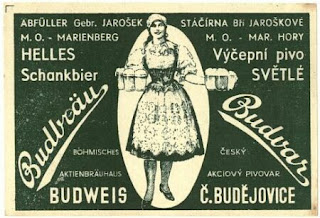
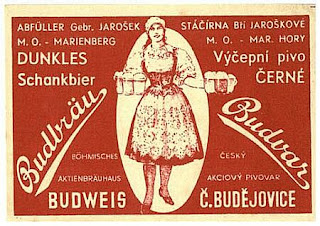
For example, once upon time, Budvar brewed a pair of 10° výčepní beers, one pale and one dark:


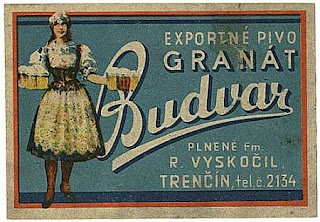
As you can see, the labels are in both German and Czech with exactly the same information on both. It is interesting that the dark lager version, the red one for those with no German or Czech, uses the Czech word "černé", which means "black" as opposed to "tmavé", which is more properly the translation of "dunkles". While I was not surprised to find a dark lager lurking in Budvar's history, I was marginally shocked when I saw this label:


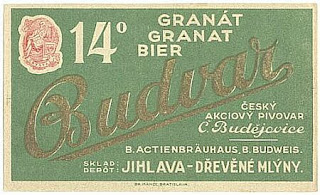
The label is for Budvar's "Granát Export Beer". The "granát" bit is pretty easy to suss out. We are talking "polotmavý", or "half-dark", usually a reddish lager that in terms of colour sits between pale and dark. Such beers often use the moniker "granát" in reference to the garnet gemstones that Bohemia is famous for. I had not seen the term "exportné pivo" though before, and through digging in this label archive, I am pretty confident that we are looking at a 12° Plato polotmavý ležák to use modern parlance. At some point though, Budvar's Granát was a 14° lager, whether it got stronger or weaker, I don't know.


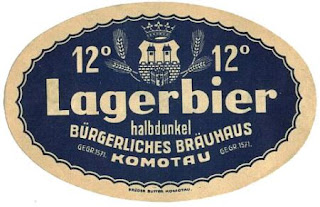
Perhaps the most startling label I have come across so far, was for the Bürgerliches Bräuhaus Komotau, which I referenced in my last post as being at one point in its history registered as a "braucommune". This label shows that at some point the notion of a beer sitting between pale and black on the colour spectrum was known to both the German and Czech speaking communities of Bohemia.


"Halbdunkel" is simply "polotmavý" in German, it was not a term I had seen or heard in relation to German beer before. Seeing it there on the label made me wonder if I could find references to "halbdunkel" in Austrian and German archival sources, but more about that some other time.

This all though does point to the truth that beer is a product of culture, and to understand a people's beer means understanding it in relation to their lived culture. As such, making a 14° pale lager and calling it a světlý ležák when it is more properly a světlý speciál just shows, in my opinion, a lazy disrespect to Bohemian brewing culture and history. Defining "tmavé" as beginning at 11° Plato, when the reality of history shows there have been výčepní beers that are dark is likewise presenting a slanted view of history.

I have argued elsewhere that tradition is an important part of being a craft brewery, but when reaching for someone else's tradition, brewers should seek firstly to be faithful and produce a beer, and label it, something that a person from that tradition would recognise. 

Many years ago, a Czech friend's father was given a bottle of Lagunitas Pils, allegedly brewed in the Czech tradition, and spat it out in disgust. Having taken a large mouthful from a bottle of Port City Downright Pilsner, his response was "tohle je České pivo", "this is Czech beer".

Wednesday, February 2, 2022

19th Century Bohemian Beer Brewer

It all started by reading Andreas Krennmair's book of homebrew recipes for historic German and Austrian beers. Andreas includes in the book a recipe from 1834 for "Prague Beer" which I am thinking about brewing in the near future. I wanted to get a more contemporaneous handle on "Prague Beer" and so I started digging around in various online archives, like you do. My digging led me once again to the newspaper archives of the Austrian National Library.

It is sometimes easy to forget that for a thousand years Bohemia was very much in the German sphere of influence, whether as part of the Holy Roman Empire until 1806, or as a kingdom within the Austro-Hungarian Empire up to the end of World War 1. In the mountains and marches of much of western Bohemia there was, for centuries, a large German majority. I don't want to get into the fraught, complicated politics of Bohemia, but rather to point out that it makes sense to go looking for information about the Bohemian brewing world in the Austrian National Library.

The first publication I stumbled upon was "Der Böhmische Bierbrauer", a brewing trade journal that was published in Prague from 1874 to 1916. At the height of World War 1 it was renamed "Der Österreiche Bierbrauer", having relocated to Vienna, after a year of just being "Der Bierbrauer" and being published jointly in Prague and Vienna. In the few issues that I browsed through, I didn't find any descriptions of "Prague Beer" but that is mainly because I starting delving into the ads section of the journal.

Adverts are fascinating pieces of social history and tell us more about the reality of what was going on in a society than lengthy technical treatises about brewing processes and the like. Take, for example, this advert from the January 1st 1891 issue.

A rough translation would be:

"Best clarifying agent! American isinglass, made from thornback ray (ray skin)

Imported directly, only prime quality, cheapest offered to brewers and dealers"

I find it fascinating that there was a business in 1891 selling Isinglass finings, imported from America, to breweries in Bohemia. The address of said business, "Tuchmachergasse 9", would show up time and time again in adverts from this journal, so naturally I looked up a period map to find out where it was...and it is just a few doors down from Pivovarská Nalévárna on modern day Soukenická.

Talking about brewing businesses on streets I know well, I discovered that on the same street as my last apartment in Prague was a malting company:

Leopold Schmied was a malt manufacturer at an address that is today the address of the Autoklub České Republiký. It is fun to think that less than a five minute walk from where I lived, malt was being made. A dark malt for Munich beer, a Bavarian style black malt to be used with the dark Patentmalz for Bock. The pale Patentmalz made for full bodied beers with good foam retention apparently, and there was roast malt for brown beer, porter, and so on and so forth. Hmm...malt being sold for specifically for porter brewing in late 19th century Bohemia? There's a whole world of intrigue right there, what was Bohemian Porter, bottom fermented like Baltic Porter or top fermented as U Fleků's legendary dark beer still was at this time? Schmied could also provide you with caramel malt to meet all your brewing colour and flavour needs. Being locating right opposite a major railway station, they had logistics right on their doorstep - fun fact, the railway station opposite Leopold Schmied Malzfabrik was not the hauptbahnhof of the day, that was the station known today as Masarykovo Nádraží. Today's Hlavní Nádraží was named Franz Josef Station until 1919.

Talking about railway stations, they are the natural place for a brewery to pick up the seed yeast they need to turn lovely sweet wort into even lovelier beer, but who would be selling seed yeast in 19th century Bohemia?

Bürgerliches Brauhaus in Pilsen obviously, though these days they are better known as Pilsner Urquell. For just a single Krone, you could purchase a kilogram (2.2lb), of "excellent and pure" seed yeast. What you didn't get for your money though was packaging and delivery from the railway station in Plzeň, which if I have the right station is this somewhat ornate pile.

I am sure that there will be far more to come as I trawl my way through the digitised newspapers available through the Austrian National Library. I am focusing on the adverts for the time being as they give a sense of the reality of the Bohemian brewing industry at the time, the products available, the names in the business, and where such brewing adjacent businesses were located.

Skoro Doma

Having arrived in Denver on a Saturday afternoon, clearly these posts are not in any particular chronological order, I got myself unpacked a...