Wednesday, November 1, 2023

My House, My Rules

A couple of weeks back I wrote a post about the concept of a "house beer", in which I ask the question:

"which of your brews is the one that is the highest expression of you as a brewer, of the business that is your brewery? Which one would you stake your entire reputation on?"

Having put that question out there into the interwebs, several friends have asked me which of my various beers that I brew would I consider my "house beer"?

Obviously, here I am talking about my homebrew rather than any of the recipes I have provided to professional brewers. As such, while I love Morana to bits, my tmavé that was first brewed in 2010 with Devils Backbone and coincidently again this week, I would not call it my house beer as I haven't brewed my own version of it in over a decade. The same could be said of Session/Bitter 42, a best bitter that I did with Three Notch'd Brewing, and hasn't seen the light of their brewpub for nearly 4 years now.

However, in terms of the style of my house beer, it is a best bitter, for the very simple reason that any kind of bitter, other than overly heavy stabs at ESB (seriously American brewers stop making them all grain and use some invert sugar to lighten the load and enhance drinkability), is rarer than a speckled hen's tooth. I do have an ordinary bitter recipe that I will brew from time to time, but it is my best bitter that I probably brew more than anything else, at least 4 times a year, or about a third of all my brewing projects.

The recipe does have similarities with Session/Bitter 42 in that I don't use any crystal malts at all, my single specialty malt is a biscuit malt, the Three Notch'd version uses Briess Victory malt. I moved away from Victory for my version as I prefer the sweeter character of biscuit to the toastier notes in Victory, it rounds out the beer for me. In terms of base malt, I have also moved away from using one of the "traditional" British pale malts (fun fact, Golden Promise long ago stopped being Scotland's barley of choice, the most common these days for malting and brewing is a variety called Laureate). My base malt of choice is Murphy & Rude English Pale Malt, which is a tad bit darker than their standard pale malt, but still uses Virginia grown barley. I have made it my goal to use exclusively Murphy & Rude malt where possible, and I feel that using seriously fresh malt has made my beer several steps better than previously.

The grist then for my house best bitter then is:

  • 88% Murphy & Rude English Pale malt
  • 12% Murphy & Rude Biscuit malt
Hops is one part of this recipe that I change pretty often, purely on a whim. The classic version though uses East Kent Goldings to get about 40 IBUs, a little bit lower than the 42 IBU that goes into Session/Bitter 42. The targeted number of IBUs at each addition is pretty much set in stone regardless of the hop variety in use:
  • 25 IBU for 60 minutes
  • 10 IBU for 15 minutes
  • 5 IBU for 5 minutes
When it comes to yeast choice, I will happily admit that I use one particular strain far more than any other whether I am brewing my brown ale, stout, or best bitter. I love the reliability and character of SafAle S-04, the very subtle floral and fruity esters play nicely with the malt in particular. Oh and it flocculates superbly, leaving me with a lovely clear beer without having to fine my brews with isinglass or gelatin.

The water just comes straight out of my well.

Assuming everything goes to plan when I brew my best bitter, which I don't really have a name for beyond [hop variety] Best Bitter, I end up with something like this in the glass.


Can't be bad, eh?

Thursday, October 26, 2023

What Price a Pint?

Yesterday, the following image popped up in my various socials:


Said image was accompanied by the following text:
"Starting today all pints will be $3.50. Share, spread the word, and show us some love so we can keep it going for the full month… or forever, should the response be undeniable; either way, this is the price that pilsners should be. Come and take advantage!"

Three things immediately sprang to mind, firstly that is a damned fine looking pint, secondly, I don't think I have ever paid $3.50 for a pint of beer in my 14 years living in Virginia, and thirdly bravo to Tabol Brewing!

Tabol Brewing are based in Richmond, and given that I very rarely go that way I have yet to actually get to their taproom, where all pints are now $3.50. I have, however, had a few of their beers in cans, on tap at Beer Run, or in the case of my favourite beer of late summer/autumn their collaboration Franconia inspired vollbier with Selvedge Brewing. Everything I have had from them has been superb, and the vollbier, Tabolcloth, is very much a contender for the Fuggled beer of the year.

A while back, I wrote a post about what the price of a pint would be if we followed the pricing restrictions of Reinheitsgebot as well as the ingredients, and unless my maths is entirely atrocious (eminently possible), based on the average daily wages of a manual labourer in Virginia and it's purchasing power compared to 16th century equivalents, Tabol's new price point is pretty close.

I reached out to Travis at Tabol to share the post I mention above, and while he admitted that he could "proffer zero opinions with regard to the maths of the various European currencies" he did tell me his reasoning behind the change:

"my cans are sold, to-go, at $3.50 a piece in their 4 packs and more expensive packaging. I figured I could cut my pint prices in half, and still be making as good or better profit than my to-go sales in cans".

I have long muttered under my breath about the price of a pint at a brewery's taproom, especially when you consider the number of markups removed from the brewery to drinker process when you buy a pint in the taproom. To see a brewery actually take action on behalf of the consumer then is both refreshing and in my opinion absolutely fantastic.

Travis continued:

"I'd like the working man's beverage to be affordable. I just want to know it it's enticing enough to drop the price. Instead of seeking hype and notoriety for a brand, maybe my traditional style lagers should be more traditional in price? If we can make it work".

I am pretty sure this move it going to stir the pot in craft brewing circles in Virginia, especially given the number of breweries where they are changing $7 and upwards for a pint at their taproom. I am sure that Travis and the Tabol team have considered all the economic implications around the change, and to be perfectly honest I desperately want them to succeed, even though I am unlikely to get to Richmond any time soon and take advantage of $3.50 pints of superb lagers.

I also love the fact that Tabol don't shy away from the fact that beer is the everyman drink rather than a niche product for the upper middle classes. I realise every brewery is different, and for many where their primary outlet is a brewpub, dropping prices so dramatically might not be possible given the added overheads of being a restaurant. But where a brewery's taproom is exactly that, a place to drink a brewery's beer, in situ, as fresh as fresh could possibly be, without the additional logistical steps that drive up the price, then cheaper than draft or packaged retail should be the norm. If this move drives down the cost of a beer, that is a good thing in my world. After all, isn't that one of the supposed benefits of increased competition? 

We have shit loads of breweries now, so why are prices not coming down in line with the alleged economic orthodoxy that increased competition is good for consumers?

Tuesday, October 17, 2023

House Rules?

Blimey, it's been a while since I posted, these things happen from time to time, you know how it is...

Anyway, a few weekends ago I was touring cideries as research for a book I am writing about the cider industry in Virginia, scheduled for release next year. One of the places I visited, with my long time collaborator, photographer, and all round good bloke, Mark, was Troddenvale Cider.

Troddenvale Cider is located on the historic Oakley Farm, owned and run by husband and wife duo, Will and Cornelia. The farm is set in some of the most glorious countryside that we have in Virginia, deep in Bath County, among the valleys and mountains that form the Blue Ridge. To say I reveled in the drive from Lexington to Warm Springs would have been an understatement.

Coming from a wine background, Will and Cornelia approach cider from the viewpoint of it being the highest expression of the fruit that they press, and as such they are insanely patient as their pressings ferment and age in wooden barrels for months, and even years at a time. Their orchard, just a few years old but already producing apples for the press, contains several French and Spanish cider apple varieties as well as many of the American standards.

Their tasting room, and to be honest that term is simply insufficient for the delightful space where they serve their ciders, it really reminded me far more of a country pub, is a charming space that if we didn't have an appointment in Monterey, Virginia to get to, I could have happily sat in all day drinking their stunning cider. When time allows I will be taking Mrs V over the mountains for a tip.

While it is true that the single varietal made from Dolgo Crab Apples that is in the picture above was an absolute revelation - puckeringly dry, intensely fruity, with aromas of strawberry and cranberry, and it goes absolutely stonkingly with a West Country farmhouse cheddar (shock, horror, right?), I have been thinking about the "House Cider" since that trip.

More specifically I have been thinking about something Will said about their House Cider. Given their oenological background, Will lamented that the term "house" has come to mean the most basic wine on offer, something almost cheap and cheerful, but decidedly not excellent. His aim with House Cider is to be the exact opposite, to be the very best that Troddenvale puts out, and it is a magnificent cider, easily up there with the best being made in Virginia today, no I didn't take notes, I was too busy enjoying it.

This got me thinking about the concept of "house" products when it comes to beer. We quite often use the term "house beer" in homebrewing circles to refer to something that we brew regularly, but I don't recall a brewery, at least not in my neck of the woods, hanging their entire reputation as a brewery on a single "house" beer. Is it perhaps that modern beer drinkers are constantly on the hunt for the new, or is it a case of fear of missing out by not pushing every possible style out the door in case the crowds choose to go somewhere else?

I feel as though the concept of a "house beer" is distinct from flagship beers in the sense that flagships are often based on commercial decisions. Plenty of breweries come out the door with their flagship beers and as commercial reality bites they often change. Flagships are more often than not just the best selling beers a brewery offers.

Quite often in interviews with brewers, and I have done this myself, we ask the question "what is your favourite beer that you brew?" Invariably there follows some umming and ahhing, mutterings of chosen your favourite child, before a beer is chosen. Perhaps a better question would be "what is you house beer?" as in, which of your brews is the one that is the highest expression of you as a brewer, of the business that is your brewery? Which one would you stake your entire reputation on?

Tuesday, August 8, 2023

Taking Up the Alworth #MyDreamBrewery Baton

We've all done it I am sure, dreamt about what our ideal brewery or pub would look like. I have done it many times, whether sat in a taproom with a drink or sat at a desk letting the mind wander, I may even have written about it once or twice in various media. Jeff Alworth over at Beervana wrote a great post a few days ago about his dream brewery, which in a stunning turn of events turned into a dream pub - his dream after all. The thing with dreams, even the nighttime type, is that they evolve and change with new inputs from our waking lives, and so while I recognise much of my dream pub in 2016, I have an additional 7 years of lived experience to integrate.

In keeping with Jeff's post, I am not going to attempt to name my pub, though in the various business plans I have written over the years (yes, I have got to the point of writing business plans several times) there have been names, but they all seem cheesy to me now.

Location

Given this is, now, my dream I find that as I grow steadily older, the grey in my beard is migrating beyond just my chin, I have a deep longing to "go home". That's not to say that I am unhappy in central Virginia, far from it, I love living here and it would genuinely grieve me to leave behind the couple of acres of land that I have planted fruit trees on. However, my family holiday to Iceland earlier this summer reminded me of the deeper magic. I am not Icelandic, obviously, but I am a child of the North Atlantic. I grew up mostly in the Hebrides, my ancestry is overwhelmingly from the coastal communities that ring the North Sea, and this summer again I remembered just how much that world resonates with me. I am not talking here about being a beach bum, I hate sand with a passion, but being by the North Atlantic for an extended period of time again just made me feel reconnected in a way that is hard to explain.

One afternoon in Iceland we were sat at the local cafe, watching the twins play among the rocks and pools of the inlet, much like my little brother and I did when we were their age, when a group of Icelandic women joined us at our table as we had space and they needed it - I love that aspect of European social life. We got speaking with them, Mrs V about knitting, me about mythology and the shared worldview of Northern Atlantic people - one where we don't see a barrier in the ocean but a highway, we share stories, the names may be different but the themes are common, much like the stories of the Carpathian Mountains as they wend their way through Central Europe.

So my dream pub would be by the North Atlantic ocean, whether clinging to a vík or sitting just off the machair, the ocean is an all pervading presence, the smell of the sea permeating everything, the cry of sea birds echoing, low clouds scuttling across the gun metal sea, both broody in its darkness, and enervating in its lightness.

As to the building itself, the apostate in me loves the simple architecture of churches, whether presbyterian of some degree of freeness, continuity, or associatedness (IYKYK) or Lutheran. Simple, solid, battered by storms, defiant, a comfort, seemingly hewn from the very rock of the islands themselves, reminders of the great halls of old. My pub is a place of community, a place where all are welcome, and welcomed, my pub is not truly mine, it is the community's, I am the custodian.

This will no doubt come to the horror of many, but kids will be fine, assuming that they have parents who are responsible and considerate of the place they are in. In my experience the problem is rarely the children but invariably the parents deciding to use the pub as a nursery with booze for the adults. So, your kids will be welcome, they are part of the community after all, and how will they learn how to behave in a pub if they are excluded? However, you will be asked to leave if you are not managing them well, and if it becomes a regular thing, you will be asked to only come without them in future.

In the 2016 post on this theme, I mentioned that I would want my pub to have rooms so that people could find a place that suits them. Given my great hall style architecture though, discrete spaces would be created through furniture and furnishings rather than walls. You will be able to find a place to hide as much as a place to be seen. I also mentioned that the day's newspapers would be available, which is something I would maintain, but expand to have a wall of books available for reading, many of my favourite drinking sessions have involved me losing myself in a book. I would hand pick many of the authors on the shelves, Seamus Heaney, Tolkien, Neil Gaiman, Umberto Eco, Iain Banks, there would be non-fiction as well as novels, poetry, and sagas.

There will be no television.

Did I mention the fireplace? It will be large, and when the weather requires it will be roaring, fed a steady stream of wood and peat - you will have to love the smell of peat smoke to really enjoy the place in winter when the North Atlantic roils and crashes on the rocks. I imagine the Scottish deerhound of my dreams (he'd be called Wulver) stretched out on the stone hearth.

The Offer

This is my pub, so what will be on the taps? In common with the last time I pondered on my dream pub, I will not be having a bank of dozens of taps lined up on the wall. For a long time now I have thought that the optimum number of taps is 6, pure coincidence I am sure that 6 taps is how many there are at Pivovarský klub...

Of those 6 taps I would be keeping 4 within defined characteristics, not given over to any particular brewery, my pub is resolutely a free house. The remaining pair of taps would be split between a seasonal style and whatever special one-offs I feel like putting on. With this being a pub in dreamland, there are no dumbass three tier distribution systems in play, I can buy directly from the brewery, oh and the notion of tariffs and import customs have been consigned to the dung heap of history, so I can get exactly what I want, when I want it.

My pub is primarily a session pub, a fact reflected in the 4 regular taps, with strong beers being reserved for seasonals, specialties, or the range of bottled beers. Tap 1 is pale lagers with starting gravities below 14°, so an ABV of 5.5% or less. Tap 2 is for bitter, regardless of colour or strength, so a rotating tap of ordinary, best, and extra special. Tap 3 again sticks to an ABV below 5.5%, but this time features amber, red, or brown beers, top or bottom fermented, it will have the most range, sometimes with Vienna lager, sometimes mild, sometimes Oud Bruin. The 4th tap is for the truly dark beers, and here the ABV ceiling is a bit higher at 6.5%, get ready for tmavé pivo, American porter, Export Stout, night cap beers.

My bottle cellar would be well stocked in the rarer and stronger beers, Fullers Vintage Ale would feature, as would North Coast Old Stock Ale, Samichlaus, and Sierra Nevada's Narwahl. It would be fun to find a local brewery to contract specialty brews specifically for the pub, my current fascination, as a result of an article by Lars Marius Garshol, is Danish skibsøl, or "ship's beer", a low gravity smoked beer that was an essential part of the daily ration in the 19th century Danish navy. 

Cider would also feature, though here I get particularly snooty as my preferences in cider veer very strongly to the traditional. I would keep a healthy stock of Albemarle Ciderworks, Big Fish Cider, and Castle Hill Cider products in the cellar. Cider has long been my summer booze of choice, going back to my early drinking days when I wanted something lighter and more refreshing than beer. Traditional, artisanal, cider and perry will always find a place in my offerings, and in the case of Albemarle Ciderworks, I would be buying as much of their Harrison and Dabinett blend as I can lay hands upon.

This will likely sound contradictory given the stated aim of tap 1 and the previous paragraph, but my pub will always give precedence to local products, not just those made locally, but those using local inputs in their creations. If I were able to source a great pilsner, made with locally grown barley that was malted locally, and then hopped with locally grown hops, then I will have that on tap regularly as supporting fellow local businesses would be important to me.

It is in this spirit that I would be sourcing food for the pub. My interest is in booze, I have no ambition to own and run a restaurant, but brought in pub grub, sure. Fun fact, my first ever paying job was making hot water crust pie shells for the bakery in the village I lived in. Said cases were filled with minced lamb to form the traditional Scottish meat pie, but also chicken curry, and the ever popular sausage, beans, and mash. Assuming such a place was within striking distance of the pub, I'd be selling a range of hot water crust pies, sausage rolls, and pasties. I might consider a daily pot of soup or stew, bringing in fresh bread from the bakery as well. You might see a bit of a theme here, I like simple hearty food, nothing fancy with juliennes of this or gastriques of that, peasant food. I once had this daft notion that a peasant focused restaurant called "The Hearty Peasant" would be fun, but then remembered I have no ambition to run a restaurant.

My hope is that my pub would be a place of solace, a place of joy, a place of intellectual stimulation, a place of discovery, a place where people of good faith find community. And in the heart of it all, you will find me, behind the bar serving great beer.

* Yes that is me in the last picture, my youngest son was messing with my phone in a restaurant in Arnarstapi, Iceland while I was lost in thought. I think he has a good eye for one so wee.

Thursday, August 3, 2023

Flying Through Columbia

You can tell the end of July is approaching in VelkyAl world because I am invariably in Columbia, South Carolina, on the way back from a beach week in Florida. Rather than drive 12 hours to central Virginia, Mrs V and I take a few days at the in-laws' place, and this year I decided to be like a beer tourist and actually get round to a few taprooms rather than just picking up cans of local stuff at Bottles. 

Being at the in-laws' place also gives us built in babysitters so Mrs V and I can engage in shocking behaviour like having a few hours social life sans enfants. So we went to Savage Craft Ale Works on Saturday night. We had originally planned to go there way back in spring when we were last here, I don't remember why we changed our minds, but I was glad to finally get out to the fantastically renovated space in West Columbia.

Looking up their website before we headed out, I saw those wonderful, magical words that mean so much in my world, yes you know the ones "German pilsner", and then looking at the name of it "Purge Under Pilsner" a bell began to ring. It struck me that purely by change I had picked up a four pack of their pilsner at Bottles, largely because the can mentions decoction mashing. Yes, I am predictable, I know.


Given that I was out on one of the rare occasions my wife and I manage to get away for some adult time, I wasn't taking details notes, but Purge Under Pilsner is a lovely German style pils. Nicely bitter, good cereal malt character, and a clean finish that is long as midsummers in Iceland, just the kind of beer I love. I tried their American style pale ale too, and it hit all the right notes. Maybe next time I am in Columbia I'd get round and try more of their range, but suffice to say that Savage Craft is a welcome addition to the city's improving beer scene.

Notes were however very much part of my plan for the following afternoon. While Mrs V and the twins swam in the pool, I ventured off to hunt out some of the taprooms of Columbia's breweries that I hadn't visited before. I mentioned I am a terrible beer tourist, right?

First up on my list of places to go to was Hunter Gatherer, a brewery I have written about before, and one I have a very large soft spot for. Their brewpub, aka "the Alehouse", in the centre of Columbia is one of my favourite places to drink, it has the perfect old school craft brewpub vibe, but I had not got to their production brewery before.

The newer venue is known as the Hangar, and is, somewhat unsurprisingly, located in an old airport hangar. Known as the Curtiss-Wright Hangar, the building was erected in 1929 as part of Columbia's original airport, known in the area as Owens Field. Finding myself a seat at the bar, I ordered my first flight of the day...


The four beers I chose were:
  • Lager 29 - 5% copper lager
  • Golden Ale - 4.5% blonde ale
  • Pale Ale - 4.7% English Pale Ale
  • ESB - 5.2% Extra Special Bitter
Rather than bore you all to tears with my tasting notes, I will say that all four beers were very good, clearly well made by proficient brewers, and I would happily drink any of them, but in plumping for a pint I went for the Pale Ale. At 4.7% it really is in the best bitter world, but US drinkers seem to have an aversion to the concept of "bitter" and hence you end up with English Pale Ale, Pub Ale, or some other moniker that avoids the concept of bitterness. Pouring a dark gold, with flashes of orange, and a decent white head, it actually looks somewhat like Timothy Taylor Landlord or Harviestoun Bitter & Twisted. The aroma was mostly cookie dough, laced with spicy hops and a hint of stone fruits in the background. Tastewise, the cookie dough became more like digestive biscuits (is there a better biccy in the world?), and again the spicy English hops shone through, and the light stone fruit flavours were present as well. It's a really nice beer, and if I hadn't been planning to get to at least a couple more breweries, I'd have done my usual and thrown the plan out the window.

The next brewery on my list was River Rat, another brewery whose products I have had and enjoyed either in Columbia itself or brought back home to central Virginia - indeed they have made the Fuggled Review of the Year a couple of times. It was stinkingly hot on Sunday in South Carolina, so I was very relieved to find a parking place completely shaded by trees, even after a mere 5 minute drive from Hunter Gatherer. Again I found myself a seat at the bar and ordered a flight, this time a set of 6 rather than 4, oh and my second pint of water for the afternoon - hydration is important folks.


Included in my wheel of beer this time were:
  • Luminescent Lager - 4% American Light Lager
  • Dry Hopped Pilsner - 4.9 American Pilsner
  • Broad River Red Ale - 5.3% American Amber
  • American Kölsch Story - 5% Kölsch
  • Hazelnut Brown Ale - 5.4% Brown
  • My Morning Stout - 6% Stout
This time round my selections were much more of a mixed bag. Nothing was terrible, or to be honest even bad, but the first four in my flight left me underwhelmed. The Luminescent was thin and watery, and I get that American Light lagers are, in the words of the old joke, like making love in a canoe, but experience has taught me they really do not have to be. I have had some wonderful light lagers brewed with corn in the last year or so, whether at Black Narrows in Virginia or TRVE Brewing in Denver. I felt the pilsner had a rough, vegetal bitterness that did nothing for me, and the Kölsch and Red were decent. However, the Hazelnut Brown Ale was a delight, maybe it had been sitting in the heat for just long enough to reach cellar temperature, but the lovely nutty character coupled with a subtle, earthy hop note was delightful, even at 95° Fahrenheit. The stout was also very nice, striking the ideal balance of milk chocolate, unsweetened cocoa, and espresso. I decided not to have a pint of anything, being a vaguely responsible human being from time to time, and I had one more brewery that I wanted to get to, but it was shut. I am clearly illiterate as I had checked Google before heading out and missed the fact that "Opens at 2pm" means something entirely different when you remember to read the "on Monday" part of the sentence.

So I went to Steel Hands Brewing instead, winding my way from West Columbia to Cayce, over some railway tracks, down by a steel mill, and parking in the the glaring sun. There was a band just winding up their set as I arrived, major kudos to them for playing outside in that heat. Before the baking heat could weld the soles of my sandals to the pavement I made my way inside and ordered my third and final flight of the day.


My choices for this particular foursome were:
  • Lager - 4.7% pale lager
  • Run for the Pils - 5% German style Pilsner
  • German Amber Lager - 5.3% Düsseldorf Altbier
  • Dunkel - 5.5% Munich Dunkel
Fun fact, I had been led to believe at River Rat that Steel Hands was the kind of brewery I am not wildly fond of, specialising in beers with lots of silly shit chucked in. To be frank I am glad that I applied a hermeneutic of suspicion and checked out their website to confirm I could get some brews in styles I am a fan of. All four of my chosen samples were well executed examples of the styles, which is saying something for altbier in particular as US breweries have a tendency to use crystal malts for sweetness rather than Munich and it just tastes wrong. Given the flight was just a foursome rather than 6 I decided to have one last pint before heading back to the family, and plumped for the Dunkel.


It pours lightish brown, with some red highlights, definitely paler than many a dunkel I have had in the US, but well within the norms in Germany. The nose was slightly toasty with a bit of unsweetened cocoa, and a pleasant herbal hop aroma. As you would expect with a Munich style dunkel, the taste was dominated by that lovely bready character that you get with German malts, lightly toasty and with a subtle earthiness rounding everything off nicely. All in all it was a fine way to round of an afternoon brewery hopping.

I had been hoping that Bierkeller Columbia would be open in time for my annual late summer sojourn in Columbia, but alas it was not to be. They will hopefully be fully operational by the time I next head south for Thanksgiving. 

When I think back to my early days of living in the US, Columbia was something of a good beer desert, so it is fantastic to see it improving, even if my go-to pub from those days is no more, and a couple of breweries have also gone under. A metropolitan area the size of Columbia, with a population of nearly 900,000 should be well able to support a good beer scene, and with these four breweries, and Columbia Craft, already operating, there is definitely a far greater choice of locally brewed beer than in 2009, and that makes me one happy camper.

Wednesday, July 26, 2023

Top Ten Virginia Beers - 2023

It's been quite the jet-set month has July. At the beginning of the month, plus a couple of days at the end of June, my family and I traipsed our way up to and around Iceland for 10 days (quite possibly the best holiday I have ever had) and now we are down in central Florida. While my wife and kids have fun on the beach, I am working so as not to completely use up all my holiday time, still I can't complain as the view from the window is one of a couple of palm trees and the Atlantic ocean.


As usual at this time of year, I like to take a pause and decide on what have been the ten best beers from Virginia that I have drunk in the last 12 months. The list is entirely subjective, and likely doesn't feature hype breweries making hazies, bastardised sours with fake fruit flavor syrups, or pastry stouts simply because I don't enjoy that shit. This is, after all, the Fuggled Top Ten Virginia Beers, purely subjective, entirely my opinion, and I make no apologies for that. 

With that said, let's dive into my Virginian drinking highlights...

  1. Port City Brewing - Franconian Kellerbier (5.0%). - for the fourth year in a row, Franconian Kellerbier is either top of the list or second, though for 2023 it returns to the number 1 slot. Each spring I look forward to its release, and as ever I bought a couple of cases once it was available. The beer itself has a delightful rusticity that I find delightful, especially when I am sat on my deck dealing with the first harvests from my gardens, often shelling peas. If I had a single complaint about Franconian Kellerbier it would be that it isn't part of the permanent lineup, but I guess we all need things to look forward to in life.
  2. Wheatland Spring Brewing - Found Artifacts (4.8%). - the number 1 beer in my 2022 list, I have enjoyed Found Artifacts several times in the last 12 months and it would have taken top spot again this year but for Port City. I love the work that John and the folks at Wheatland Spring are doing up in Northern Virginia, especially as a brewery growing the vast majority of the ingredients they use. Despite being an unfiltered beer, Found Artifacts showcases the very real benefits of extended lagering to produce a pale lager of such poise and balance that I would defy any central European friend of mine not to think it superb.
  3. Devils Backbone Brewing - Yourn 10°. - I have said this many times, but Devils Backbone are still one of the best breweries in Virginia, full stop, end of story, I don't give a shit about your big beer business bogeyman arguments. Jason makes incredible beer, and his recent Czech inspired 10° pale lager was right up there with the very best beers that he has put out in 15 years on the brewing deck behind the bar at Basecamp. Decocted, fermented in an open fermenter, and then given extensive lagering in their horizontal lager tanks, Yourn is brewed with so much fidelity to its Czech inspiration that drinking it is like being transported back to rural Czechia, drinking in the villages, in the heartland of Czech beer culture, and there is not an ounce of hyperbole in that statement.
  4. Port City Brewing - Porter (7.2%). - let me be honest with you, I probably only drink Port City Porter a couple of times a year, usually in the depths of winter, and if the weather is being favourably unfavourable, next to a roaring log fire, yet most years it makes my list of the 10 best Virginia brewed beers. Port City Porter is, in my unhumble opinion, one of the best porters being brewed in the world today, let alonge just Virginia or even the US. A complex beast dripping with unsweetened cocoa, espresso, and even an umaminess that reminds me of traditionally made soy sauce (forget your mass produced sachets from your local Chinese restaurant), all in a beguiling package that makes it too easy to forget that it is pretty hefty at 7.2%, not a session beer, but certainly a delight.
  5. Black Narrows Brewing - How Bout It (4.2%). - A new brewery to the list, and a new kind of beer in some ways. I have never been a big fan of corn in my beer, I find it lends an oily, slick, sweetness that I just find disagreeable, the same could be said about bourbon. But, malt the corn and you get a very different beast, the sweetness dissipates and what is left in it's wake is a very subtle nuttiness, kind of like an almond. Now, put that malted corn in the hands of a true artisanal brewer like Josh Chapman up on Chincoteague Island and what you get is an American Light Lager that is quite frankly, fecking awesome. I love the story behind the beer, so much so I wrote an article about it for Pellicle, and I love the beer too
  6. Decipher Brewing - 80/-. - Unhumble opinion time again. Most American brewed "Scottish" ales are shit, a riotous mess of crystal, chocolate, and black malts that would never see the light of the mash tun actually in Scotland, and we haven't even got around to talking about the use of peat malt (we don't, so feck off with your "traditional peated flavor" bullshit). Decipher though get it right, and get it right with aplomb. The star here is drinkability, a Scottish export is not supposed to be sweet, it is supposed to have balance, be something that lubricates the social setting, that looks glorious in the glass, and the Burtons get it. Now, I have to admit to a touch of bias, because anyone that is willing to do something daft like put an 80/- on a Lukr tap to try and replicate the old Scottish Aitken font because some loony Scotsman in Virginia suggests it must be a top bloke. It helps that they make such cracking beer too.
  7. Reason Beer - Barrel Aged Inexorable Stout. - assuming that you have cleaned up the spillage from you choking on your drink at the presence of barrel aged stout weighing in at 10.5% making it onto this list, let me tell you story. Mrs V plays the fiddle, and once a month or so, her teacher invites her to take part in an Irish music session at a local restaurant/pub. If we can find a babysitter to look after the twins, I will tag along and allow myself a couple of hours of reading with a pint. Usually I drink whatever the best lager they have available is, but on this particular Sunday I fancied the porter on the menu. The barmaid told me that they were out of the porter, but that they had a stout, so in the absence of strength denoting adjectives I agreed. Along came this beast, and I thought to myself, why not, just the one. Just the one is all it took to remind me that done well, barrel aging an imperial stout can lead to a great drinking experience. A definite slow sipper rather than my regular chugging session beers, I sat with my book, a brew that unlocked more dimensions than a dungeon master as it warmed, revealing cocoa, chocolate, coffee, vanilla, and a whole melange of tastes, all to the soundtrack of excellent folk tunes.
  8. Devils Backbone - Alt Bier (5.8%). - I've been a fan of the altbier style of beer since having a half litre of Schumacher Alt at an arts festival in Berlin. Dry, bitter, intensely hoppy, and with all the sweetness you expect of central European malts (i.e. not the fecking syrupy mess of crystal malt), bundled into a very pintable package, it is a woefully undervalued style in the US. Thank goodness then for Jason and his love of central European beers, and his commitment to making them as authentically as possible, with open fermentation and horizontal lagering. Also thank goodness for Jason sending me texts to let me know when Alt Bier is on tap - come on marketing people of breweries everywhere, keep your websites and social media up to date with what is on tap. A couple of time this year we've made the 60 minute drive to Basecamp purely on the basis that Alt Bier was on tap, and both times I have sat there drinking great beer and being immensely happy that Devils Backbone is one of my local breweries.
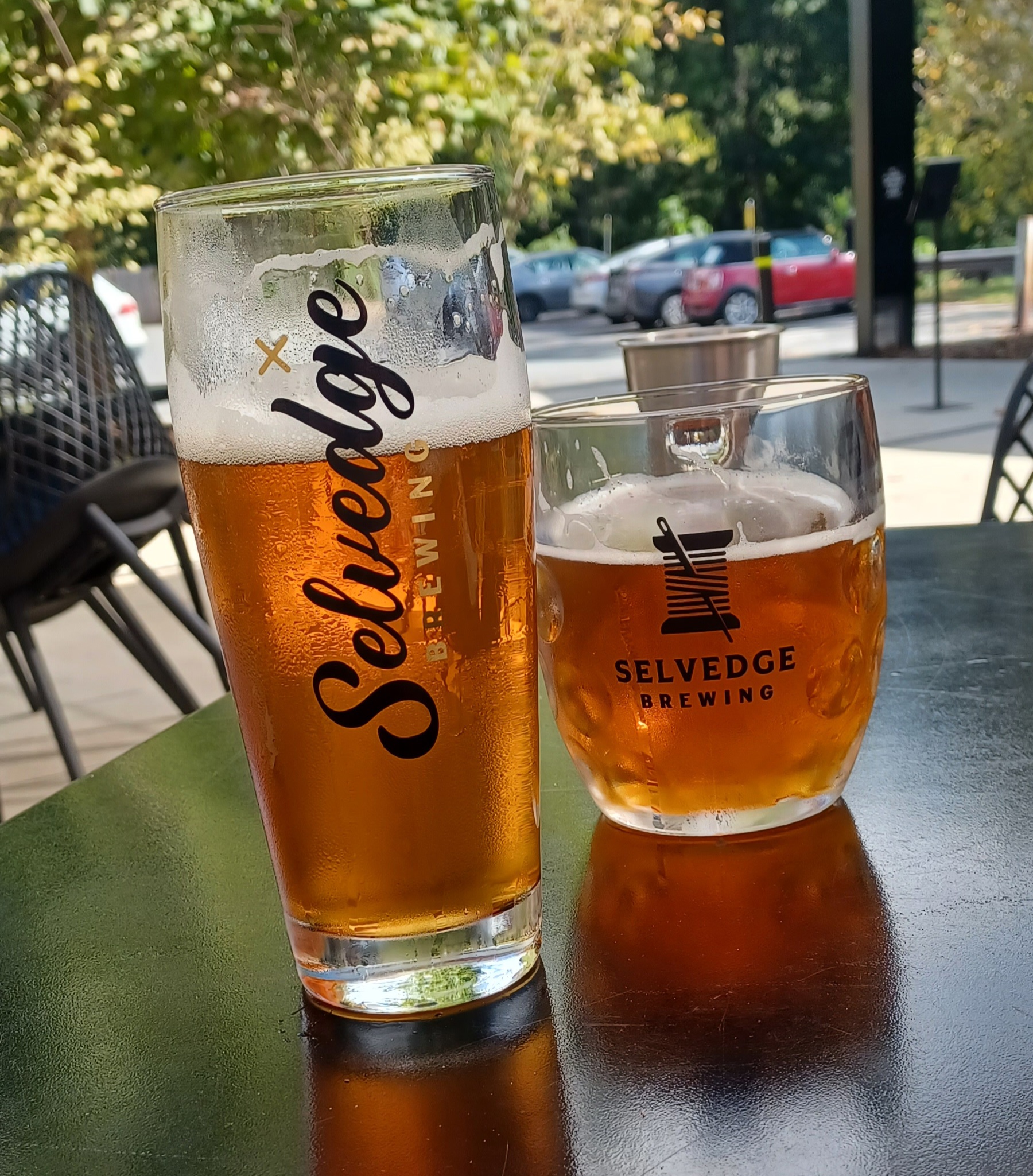
  9. Selvedge Brewing - Tweed (5.3%). - once upon a time there was a Munich dunkel style lager brewed in Charlottesville that I absolutely adored, then the brewery making it changed brewer, and the dunkel was no more. A good dunkel is a rare beast, a cracking one with a fascinating yeast strain that elevates the malts is worth chasing. Selvedge are a new brewery to this list, and I have really only started going there in the last 12 months, since they hired a former Champion Brewing brewer who started making the kind of beers I love - you know the drill, bottom fermented, extensively lagered, no silly shit. Tweed is very much a classic Munich dunkel, but with the added wrinkle of using the TUM-35 yeast strain, which originated in Franconia and was thought lost until re-discovered in a yeast bank archive. Perhaps it is purely a figment of my imagination but used in a dunkel, TUM-35 adds a character somewhat like rustic country style rye bread that you find in Central Europe, a basket of which accompanies practically every meal, add to that the crusty bread of Munich malts, and the subtle Nutella of something like Carafa, Tweed is a glass full of comfort and cheer, and I am already looking forward to its return.
  10. Patch Brewing - CU Later Copper Ale (4.4%). - every now and again you have to disagree with the brewer of a beer. If you look at Patch's Untappd page for this beer, it is listed as an Extra Special Bitter, though purely on strength I would argue it is closer to a Best Bitter, but that is not my quibble. My quibble, which is purely semantic I am sure, is that CU Later is an excellent example of a mild ale - though of course if there is one beer style likely to cause more confusion among many than the notion of "bitter" being a good thing (bollocks to Keystone Light and their anti-bitterness marketing) is the very existence of Mild. While CU Later does tread a fine line between a mild and the kind of best bitter you find in London and the South East, it is definitely in the excellent, moreish, I need another pint of this camp. During December, I found several excuses to wander by the brewery, it's only 7 miles up the road, and have a few pints with mates, it's what beer is really all about after all.

Tuesday, June 13, 2023

Terroir: Bollocks for All?

Matt at Pellicle stirred things up a bit yesterday with his post titled "There is No Such Thing as Terroir in Beer". There followed a raft of commentary on Twitter, which I got engaged in as a result of retweeting the article:

This got me thinking more about the concept of terroir in general and so I figured I'd do a little research and put my thoughts down in a blog post.

The first thing I wanted to make sure of was that I had a proper understanding of "terroir", what it is, what it isn't, and for that I turned to the world of wine, in particular this video by Konstantin Baum:

In the video, Konstantin lays out 2 competing visions of "terroir", the "naturalist" approach that focuses purely on the impacts of the soil, geology, and climate on the fruit, and the "culturalist" approach that also includes the impact of human activity on the wine. As Konstantin points out the "naturalistic" approach "is misleading in its mythic simplicity, vineyards are not naturally occurring, they are cultured land, managed by people".

I also discovered that UNESCO actually has a definition of "terroir" as being:

"a living and innovative space, where groups of people draw on their heritage to construct viable and sustainable development."

I think it is clear then that the naturalist approach to terroir is unhelpful as it diminishes the key inputs of humans in the creation of wine. I love the phrase Konstantin uses in his video, that the naturalist approach almost has a vision that "the wine makes itself, or flows out of a crack in the soil like a miracle wine fountain".

It is true that grapes will ferment in nature, as they overripen and the sugars turn to alcohol - ever wondered why wasps are more aggressive in the autumn? It's because they are pissed on fermenting fruit. However, simply fermenting fruit does not make wine, cider, or perry, if that were the case there would be no need for wine makers, cider makers, or perry makers.

So much of what I learnt about the culturalist approach to terroir actually chimes deeply with me with regard to the segment of craft brewing that I find myself drawn to, and it clarifies some of my thoughts around the problem of "local" beer. I have basically got to the point that I can no longer think of a factory that makes beer in a given location, whilst importing grain from Canada, hops from Germany, yeast strains from the UK, and removing all the mineral distinctions from their water as a "local" brewery. This is not to say that I won't drink their beer, or that I don't like them as a brewery, but they are no more special to me than a brewery making similar beers in North Carolina, California, or Germany. Surely there must be more to local than just location?

In this sense, what Matt says in his article is true. Terroir for industrial brewing is bollocks, and when I say industrial I mean it in the sense that the beer is made in a factory with a globalised supply chain that could, if the owners so desired, be picked up and plonked somewhere on the other side of the planet and make the exact same beer.

However, that is not true for all beer. 

Here in Virginia we have a distinction made in the brewing laws for a business that functions as a "farm brewery". A farm brewery is required to grow a minimum portion of their ingredients on their own land. It is a very pre-Industrial Revolution model, and one that I find deeply appealing. Just up the road from me is Lickinghole Creek Brewing, I think they were the first farm brewery in Virginia, and they grow a substantial amount of their ingredients on their 305 acre farm. Given the culturalist approach, I would argue that for Lickinghole Creek, and other farm breweries, and breweries that source the vast majority of their ingredients from their locality, the concept of terroir is most definitely not bollocks.

I think this comes back to the parting of the ways I wrote about a few weeks ago, where you have "craft" brewing as an expression of modernity (or post-modernity if they are self-consciously cool), industrial lite you could say, and then you have "artisanal" brewing which roots itself in a sense of place and tradition, where terroir is very real, and cherished.

Looking Back and Forward

If you've been following along recently, you'll know that several weeks ago I spent 9 days in the United Kingdom, split pretty evenl...