Friday, March 11, 2022

Of Bohemia and Bavaria, with a Taste of Austria

It is sometimes difficult to imagine more iconic beer, specifically lager, brewing regions of the world than Bohemia and Bavaria. Likewise difficult to imagine is a more iconic type of lager from Bohemia and Bavaria than the pilsner. Further, is there a more recognisably Austrian family than the Von Trapps?

Von Trapp Brewing up in Vermont currently have a special release of their Bavarian Style Pilsner, so I figured I'd take the opportunity to do a little side by side tasting of that and their core Bohemian Pilsner...first up, Bavaria.

  • Sight - golden, beautifully clear, good inch of white foam that persists nicely
  • Smell - floral hops, lightly toasted grain, lemon oil, graham crackers
  • Taste - rustic, crusty, bread, some lemony bitterness, very subtle spiciness in the finish
  • Sweet - 2/5
  • Bitter - 3/5

An absolutely lovely beer, and more than justifying the fact that I bought a couple of cases when it finally made its way to Beer Run. It was this beer I had in mind when I tweeted something along the lines of the best beers those that you can drink a few ounces of to write your tasting notes, and then just sit back and enjoy the beer, making the occasional note as thoughts come to you. It has a really nicely rounded mouthfeel that complements the medium body perfectly. The lemony hop bite in the finish is just perfection in my mind, and the finish is not overly dry, but definitely clean and sharp. There are times I wish this were a core part of the Von Trapp range, not in the sense that it should replace any of their other wonderful beers, but be added to them.

Onwards them to Bohemia.

  • Sight - paler than the Bavarian, dark straw, 3/4" of white persistent foam
  • Smell - spicy hops, some herbal notes, nice note of fresh hay, slightly grainy
  • Taste - crackers, sweet grass, really solid hop bitterness, almost pithy
  • Sweet - 2.5/5
  • Bitter - 3/5
Using the method of working out starting gravity in Plato by multiplying abv by 2.5, this is a 13.5° Plato lager, making it under Czech classification a světlý speciál. It is perhaps a tad strong for an all nighter, but it hits every flavour and character note absolutely spot on, which can almost trick you into drinking way more of it than is perhaps wise. Sure, the use of Perle is not really "traditional" in Bohemian beers but it is one of my favourites in my own brewing, so I am ok with seeing it here, lending the beer its tempered spiciness that I find works well with later additions of Saaz.

Two absolutely corking pale lagers that serve to highlight the familial relationship between Bavarian and Bohemian pilsners, while being noticeably distinct, almost like fraternal twins. I plan to enjoy the Bavarian style while it is available, and of course the Bohemian is a very regular sight in my beer fridge. 

Wednesday, March 2, 2022

Beyond Definition

Last week, I tweeted the following as the final piece in a thread about how we refer to Czech pale lagers:

This train of thought, combined with something I read in Der Böhmische Bierbrauer about the fact 10° beers were by far the most commonly produced in 1890s Bohemia, got me wondering what exactly is a 10° beer, other than having a starting gravity of 10° Plato?

According to Czech beer law, there are 4 types of beer:

  • Stolní pivo or 'table beer', up to 6° Plato OG
  • Výčepní pivo or 'tap beer' between 7° to 10°
  • Ležák or 'lager' 11° and 12°
  • Speciální pivo or 'special beer' 13° and higher
There is nothing in the law about what colour a particular type of beer needs to be, how many IBUs are expected, and all that other stuff you get with style guidelines. I was reminded of this while I was digging around the old interwebs looking for other information about particular historical breweries when I came across a site about Czech breweries before the Communist takeover in 1948, and what a trove of information that turned out to be.

All the label images that follow are from Pivety, and there is a shit ton more there if you are interested in early 20th century Czechoslovak beer advertising materials.

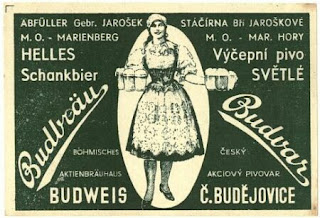
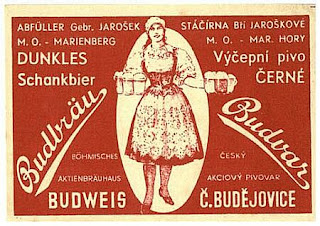
For example, once upon time, Budvar brewed a pair of 10° výčepní beers, one pale and one dark:


As you can see, the labels are in both German and Czech with exactly the same information on both. It is interesting that the dark lager version, the red one for those with no German or Czech, uses the Czech word "černé", which means "black" as opposed to "tmavé", which is more properly the translation of "dunkles". While I was not surprised to find a dark lager lurking in Budvar's history, I was marginally shocked when I saw this label:


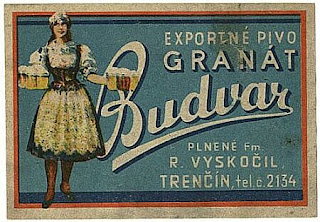
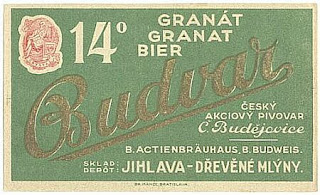
The label is for Budvar's "Granát Export Beer". The "granát" bit is pretty easy to suss out. We are talking "polotmavý", or "half-dark", usually a reddish lager that in terms of colour sits between pale and dark. Such beers often use the moniker "granát" in reference to the garnet gemstones that Bohemia is famous for. I had not seen the term "exportné pivo" though before, and through digging in this label archive, I am pretty confident that we are looking at a 12° Plato polotmavý ležák to use modern parlance. At some point though, Budvar's Granát was a 14° lager, whether it got stronger or weaker, I don't know.


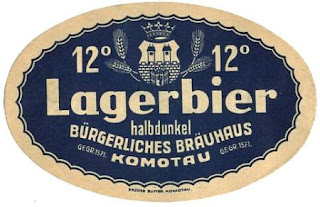
Perhaps the most startling label I have come across so far, was for the Bürgerliches Bräuhaus Komotau, which I referenced in my last post as being at one point in its history registered as a "braucommune". This label shows that at some point the notion of a beer sitting between pale and black on the colour spectrum was known to both the German and Czech speaking communities of Bohemia.


"Halbdunkel" is simply "polotmavý" in German, it was not a term I had seen or heard in relation to German beer before. Seeing it there on the label made me wonder if I could find references to "halbdunkel" in Austrian and German archival sources, but more about that some other time.

This all though does point to the truth that beer is a product of culture, and to understand a people's beer means understanding it in relation to their lived culture. As such, making a 14° pale lager and calling it a světlý ležák when it is more properly a světlý speciál just shows, in my opinion, a lazy disrespect to Bohemian brewing culture and history. Defining "tmavé" as beginning at 11° Plato, when the reality of history shows there have been výčepní beers that are dark is likewise presenting a slanted view of history.

I have argued elsewhere that tradition is an important part of being a craft brewery, but when reaching for someone else's tradition, brewers should seek firstly to be faithful and produce a beer, and label it, something that a person from that tradition would recognise. 

Many years ago, a Czech friend's father was given a bottle of Lagunitas Pils, allegedly brewed in the Czech tradition, and spat it out in disgust. Having taken a large mouthful from a bottle of Port City Downright Pilsner, his response was "tohle je České pivo", "this is Czech beer".

Wednesday, February 23, 2022

Communal Brewing in Bohemia

I really don't have that many things I wish I had done in my ten years living in Prague. I do wish I had been more interested in hiking when I was there as I would love to get up into the mountains that form the borders between Czechia, Austria, Germany, and Poland. Probably my biggest regret, if that is not too strong a word, though is that I never went to Zoigl country.

I am not going to delve deep into the roots of Zoigl, what zoiglbier is or isn't, but it has been on my mind a bit lately because of a single word I came across in one of my jaunts through the Austrian National Library's newspaper archive (yes, again). If you are, though, interested here is an excellent video on Zoigl beer production in Neuhaus bei Windischeschenbach that is worth half an hour of your time. If you want to skip the wort production stuff and see the fermentation and serving arrangements, start from here, and wait for the side pour tap...

The word that leapt from the page as I was reading something completely unrelated in Der Böhmische Bierbrauer was "braucommune", which translates as "brewing commune". Naturally, given Czechia's proximity to Zoigl country over the border in the Oberpfalz, I wondered if what I was seeing here was the remnants of a Zoiglesque communal brewing setup in Bohemia?

Digging further, I discovered that in 1895 there were just 4 "braucommune" breweries operating in Bohemia that produced more than 10,000hl:
  • Asch (Aš)
  • Krumau (Český Krumlov)
  • Kuttenberg (Kutná Hora)
  • Náchod
I also found reference to several other "braucommune" breweries, that presumably had not reached the magic 10,000 hectolitre mark, including
  • Braunau (Broumov)
  • Petschau (Bečov nad Teplou)
  • Brüx (Most)
  • Sebastiansberg (Hora Svatého Šebestiána)
  • Trautenau (Trutnov)
  • Komotau (Chomutov)
  • Teplitz (Teplice)
  • Gottesgab (Boží Dar)
  • Bohdanetsch (Bohdanec)
Try as I might, I could find little more than names and production volumes for such "braucommune" setups. Was I really seeing Bohemian Zoigl or something different? As ever Google gave me a pointer in the right direction when doing a search I came across Braucommune Freistadt, apparently the last remaining "braucommune" in Europe. What then was the difference between a "braucommune" and a communal brewhouse in the Oberpfalz model?

Here I need to give a shout out to Andreas Krennmair for helping me with the meaning behind the words. While the concepts are similar in the sense that brewing rights are invested in houses within a given town, a "braucommune" employs professional brewers and manages distribution and sales on behalf of the braucommune. In the case of Freistadt for example, where the brewery used to give a share of the beer produced to those who lived within the walls of the city, they now pay dividends. If a person decides to sell their house, the dividend remains with the property rather than the person. In Zoigl world, the rights owners have access to the communal brewhouse to make the wort, which is then fermented, and the resulting beer served through their own "zoiglstub'n".

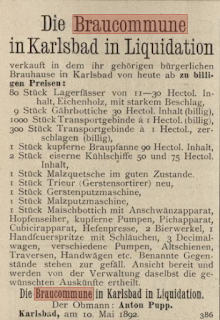
Given this, a "braucommune" was a type of business structure, based on ownership of property within town walls rather than shareholding. As to when the braucommune business structure came to its end in Bohemia, I believe it came during the Communist era of 1948 to 1989 first with nationalisation and then, somewhat ironically, collectivisation. The writing was perhaps on the wall in the latter 19th century as several of these braucommune breweries came up for sale or were placed in liquidation, such as the one in Karlsbad, modern Karlovy Vary, in 1892.


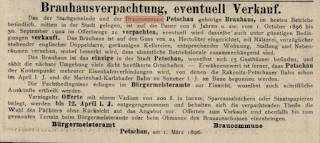
Sometimes it seems as though the braucommune decided to lease the brewery with a view to eventually selling up to a private concern, as was the case in Petschau (Bečov nad Teplou).


Interestingly, the advert above from 1896 touts the fact that this brewery had English malting technology, and that there were 15 taverns in the area as potential outlets. Unrelated, but is there a more perfect word for "hub" than "knotenpunkt"?

Will we ever see a revival in the braucommune concept? I doubt it given the mobility of the modern world, but I have to admit, if a house with rights came on the market in Freistadt...

Thursday, February 17, 2022

Of Nitro Stout

Ever since my first legal beer, stouts have had a special place in my heart. That first legal beer was Guinness, on draught, in the lounge bar of the Dark Island Hotel back home in Benbecula. Pretty soon I discovered a taste for Murphy's too, and Beamish, and we mustn't forget the long gone Gillespie's either.

When I went to Ireland in 2008 I was keen to try O'Hara's Stout, Porterhouse's stouts, and of course Guinness in its home country. In Czechia, I even developed a vague fondness for Staropramen's Kelt Stout, Primátor's wonderful Stout, or "coffee beer" as a bar owner insisted on calling it as myself, Evan Rail, Pivní Filosof, and Rob finished off the keg, and then there was Kocour Stout. One of my first beery loves in the US was Starr Hill's simply magnificent, and still their most award winning beer despite having been only an occasional brew for several years now, Dark Starr Stout. Three Notch'd do a good oatmeal stout called Oats McGoats that I wish was bottled or canned, and there is always Left Hand's gorgeous milk stout.

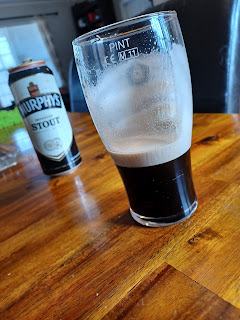
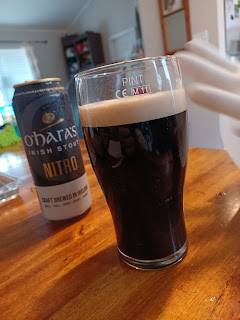
Yep, stouts are one of my favourite beer styles, so when I saw a pack of O'Hara's Nitro Stout whilst doing the shopping last weekend, a tasting hoved into view and I ended up with this selection.


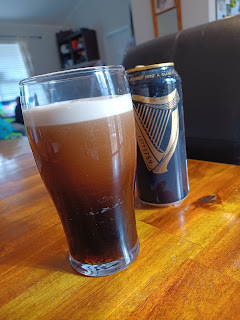
3 brewed in Ireland, one in Scotland, and I think you have a pretty good representative sampling of the major nitro stouts that hover around the 4% abv mark. I toyed with the idea of doing the tasting blind, but at the end of the day, it was a Sunday afternoon and Mrs V was a wee bit under the weather after a heavy cider session the day before, so I figured to just let her lie on the couch, and no worry too much about whether I can tell my Guinness from my Murphy's. Naturally, I started right there.


Guinness Draught
  • Sight - very dark brown, red at the edge, creamy ivory foam.
  • Smell - roasty, slightly grainy, smelt like pubs of my youth
  • Taste - some caramel, burnt sugar, bit of roasted coffee
  • Sweet - 2/5
  • Bitter - 2/5
It's Guinness, what are you expecting, a Patmosian revelation? Perhaps I should have let it come up in temperature a wee bit, I had all these straight from the fridge, but I was left wishing I had a bottle of the far superior Guinness Foreign Extra Stout to chuck in and fill it out a bit.


Murphy's
  • Sight - black with garnet at the edge, creamy tan head
  • Smell - toast, coffee, and a touch of cocoa
  • Taste - roast to the fore, backed up with some coffee and milk chocolate, bit of a hop bite in the finish
  • Sweet - 2.5/5
  • Bitter - 2/5
It never fails to impress me just how different Murphy's is from Guinness, and having these back to back just highlights the fuller body and smoother mouthfeel of the former. You still get the roasty coffee notes, but the additional sweetness of Murphy's use of chocolate malt makes it just that bit moreish.


O'Hara's
  • Sight - black, black, black, light tan creamy head
  • Smell - mostly coffee, some heady boozy notes that I wasn't expecting
  • Taste - take a spoon of Cadbury's drinking chocolate, drop it in your coffee
  • Sweet - 2/5
  • Bitter - 2/5
I remember my first ever O'Hara's at the Bull and Castle in Dublin. It was likewise served from a nitro tap, though I then had it bottled and loved it. Until last weekend I had primarily had it bottled. In this format though it has a nice medium full body, silky mouthfeel, and a balance that makes it a lovely pint. I think I need to buy some non-nitro to do a side by side comparison.


Belhaven Black
  • Sight - dark brown, red highlights, off white, creamy head
  • Smell - some roastiness, some toasted, and a subtle chocolate note
  • Taste - up front malty sweetness, chocolate and toffee, not wildly roasty
  • Sweet - 3/5
  • Bitter - 2/5
Another beer I haven't had for a while, and I think it might have to become a more regular visitor to the beer fridge. The video above shows a method of pouring a nitro beer that I learned out from a YouTube video, and it works perfectly every time. Similar in some ways to Murphy's, with perhaps a fuller sweetness and more luxuriant body.

In many ways, the tasting confirmed by expectations, that I prefer Murphy's over Guinness, at least in nitro can form, and that O'Hara's is still a storming beer that I can happily drink plenty of. I wasn't expecting to enjoy the Belhaven Black as much as I did, but I was happily surprised. As for an order of preference, it's probably:
  1. O'Hara's
  2. Belhaven Black
  3. Murphy's
  4. Guinness
That is, most assuredly, not to say that Guinness is a crap stout, rather that I prefer the sweeter notes that the other three have, but I am more than happy to drink any one of them, and pretty often do.

Tuesday, February 15, 2022

Bohemian Brewing Industry 1898

Again this week we go time travelling into the newspaper archives of the Austrian National Library, and once more we return to Bohemia and the German language publication "Der Böhmische Bierbrauer" in the year 1900.

In the June 15th issue that year, "Der Böhmische Bierbrauer" presented a snapshot of the brewing industry in Bohemia in the year 1898, based on the work of one Dr Bernat, Director of the Prague Brewing School. Now, maybe I am weird, but the numbers and stats presented by Dr Bernat are fascinating. Let's start at the beginning....

Apparently in the year 1898, a total of 8.7 million hectolitres of beer was brewed in Bohemia, which equates to 7.3 million US barrels, or a little less than five Sierra Nevada Brewing Companies, but also less than the modern production of Pilsner Urquell of about 10 million hectolitres. All of that beer was brewed by just 673 breweries, which was 21 brewers fewer than in 1897, when about 8.5 million hectolitres was produced. As such, the average Bohemian brewery in 1898 produced just 12,865 hectolitres, or 10,789 barrels. Production topped out in June, with 808,000 hl brewed, with October being the lowest month, when only 651,000 hl were produced.

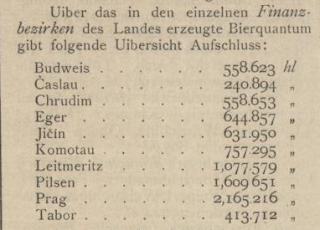
Let's take a quick look at the districts where this beer was being produced

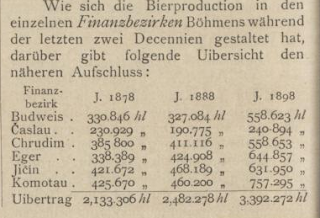
No real surprise that the leading areas were Prague and Plzeň, with about 3.8 million hectolitres brewed between them. Obviously it stood out that Leitmeritz was such a prominent player at the end of the 19th century. Leitmeritz is today known by the Czech name Litoměřice in the north west of modern day Czechia, which includes the Žatec area, perhaps better known in the brewing world as Saaz. Interesting side fact, Saaz in this time period was not just known for the quality of it's hops for brewing, but also for spruce pitch for lining barrels. Perhaps most interesting here though is the case of the Budweis district, which brewed the 3rd lowest amount, but this next picture fills out that story a little...

The table above shows the growth, or otherwise, of beer production in several Bohemian regions in 1878, 1888, and then finally in 1898. Clearly there has been major growth in Budweis between 1888 and 1898, and the elephant in the room here is that in 1895 the Czech population of Budweis decided to merge several breweries to compete with the larger, established, and German owned, Bürgerliches Brauerei Budweis. The Czech company would eventually become Budvar, and spuriously lay claim to being the "original Budweiser" despite being 100 years younger than Bürgerliches Brauerei. It seems clear though that beer production in that part of Bohemia had stagnated prior to Budvar being incorporated. It is also clear that brewing between 1888 and 1898 was becoming truly industrialised as production overall increased 36.7% in that decade, compared to 16.4% the decade before, for an impressive 59% increase in just 20 years.

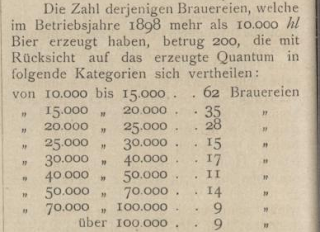
Despite this increase, and the obvious ramping up of industrial production, only 200 of the 673 breweries operating in Bohemia in 1898 brewed more than 10,000 hl, and remember the average was just over 12,000 hl per year. The 200 biggest breweries in 1898 were further broken down as follows:

Just 9 breweries in Bohemia made more than 100,000 hl of beer in 1898. That list contains several names, in brackets, that would be familiar to modern day drinkers, though several a long gone:

  1. Bürgerliches Bräuhaus Pilsen (Pilsner Urquell) - 486,700
  2. Smichov Actiengesellschaft (Staropramen) - 397,000
  3. Actienbrauerei Pilsen (Gambrinus) - 266,800
  4. Protivín - 138,936
  5. Genossenschaft Brauerei Pilsen - 135,100
  6. Maffersdorf (Konrad) - 122,522
  7. Prag-Holešovic (Holešovický měšťanský pivovar) - 112,273
  8. Bürgerliches Brauerei Budweis (Samson) - 109,485
  9. Wittingau (Bohemia Regent) - 109,306
Of the 9 biggest breweries in 1898 Bohemia, 2 are no longer in business. Genossenschaft Brauerei, from what I have found out so far, was a co-operative brewery that at least as late as 1909 was reputed to be a leading import beer in the US, according to the American Beer Review. Holešovický měšťanský pivovar closed down just before I moved to Prague in 1999, with production moved from Holešovice to Staropramen in Smichov.

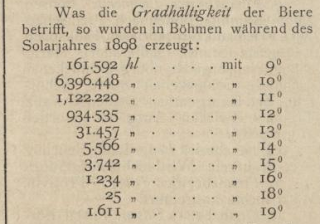
What though was being brewed by these 673 businesses? Well, Dr Bernat has given us a handy breakdown by strength...


99.5% of beer brewed in Bohemia in 1898 had a starting gravity of less than 12° Plato. That is staggering, though not surprising in the slightest really, just desítka accounted for 73.9% of all beer brewed that year. Unfortunately Dr Bernat doesn't go on to tell us what kinds of beer were being produced, but I imagine the majority of beer being made then was a variation on the theme of pale lager.

Wednesday, February 9, 2022

Life in Czech Vienna

When I lived in Czechia, the website expats.cz provided a useful and occasionally fun way to garner inside information on living in that foreign land about which, at first, I knew nothing. Once upon a time, the site had a message board which was split into themes like "Accommodations", "Life in CZ", and the ever popular "Miscellaneous" - possibly not exact titles, but you get the drift. 

It was not uncommon to see grizzled old hands rolling their cyber-eyes at the latest newly minted TEFL teacher/poet/novelist looking for a place to get a distinctly foreign product to make their new life in central Europe more akin to their home country. I know of people, and I am not exaggerating here, who whenever friends visited from the UK had them bring British milk and bread. It was just as often on the boards to see comments along the lines of "if you don't like it go home" as the 9 millionth newbie complained about Czech service.

Prague, being an international hub, was home to all manner of ethno-pubs, butchers doing "proper" bacon and sausages (which were superb by the way), places to buy Wychwood ales, and places to get cheese from across Europe. There were even a couple of Marks and Spencer stores. Fun fact there was an M&S in Prague when I first arrived in 1999, it was out at Černý Most and didn't have a food hall, ergo, it sucked.

These message boards popped into my mind as I was bimbling around the scanned newspapers of the Austrian National Library, in particular the weekly "Česká Vídeň", which from what I can see was published from 1902 to 1914, but scans only exist from 1907 to 1909. "Česká Vídeň" translates as "Czech Vienna" and obviously thus served the sizeable Czech community in the capital of the then Austro-Hungarian Empire. Another fun fact, Vienna was home to the second largest Czech community in the world in the early 20th century, the largest being Prague. Estimates range from 10-30% of the Viennese population in 1900 being Czech, and even today it is not uncommon for Austrians to have distinctly Czech family names.

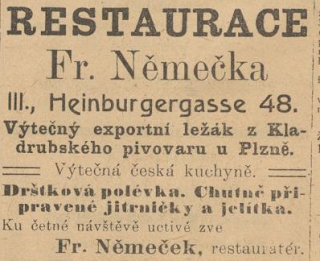
Restaurants are, I guess by nature, the perfect venue for expat communities to gather in and feel a little bit "normal" or at home in their foreign domicile. As such, it was restaurant ads that caught my eye most, for example...


At Restaurace Fr. Němečka, or František Němeček's Restaurant you could get all manner of Bohemian treats, while enjoying the irony of your host being a Mr Frank German. Mr Němeček naturally sold "delicious export lager" from Plzeň, but not from Pilsner Urquell, rather from the Kladrubský Pivovar which was based in a one time Benedictine monastery. On the food front, his menu featured such "delicious Czech cuisine" staples as tripe soup, liver sausage, and blood sausage - other than the tripe soup, you bet this Scotsman would have been there, jitrnice and jelítka are some of my favourite Czech foods. Mr Němeček, being a most congenial host, naturally invites you to visit.

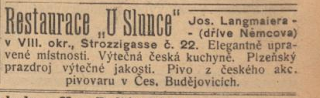
If you were looking though for a choice of beers made in Bohemia, you could always try Strozzigasse 22 and Restaurace U Slunce.

Pitching up "At the Sun" Restaurant, you would be welcomed to an elegantly decorated venue by Mrs Langmaiera (née Němcova), who as well as serving delicious Czech cuisine (is there any other kind?), can offer you a choice between Pilsner Urquell, "of excellent quality" and beer from the brewery known today as Budvar.

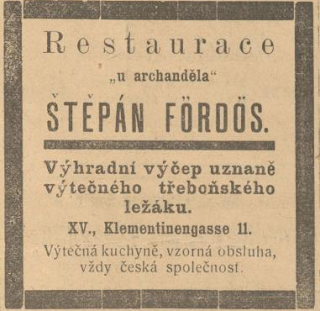
Not keen on making a decision between Pilsner Urquell and Budvar? Then perhaps you want to to visit the divine "Restaurace u archanděla" on Klementinengasse, where your host is a Mr Štěpán Fördős.

I am no expert on these things, but the family name "Fördős" looks distinctly Hungarian to me. A reminder that Vienna was capital to a multi-ethic empire, and that despite the prattlings of nationalists everywhere, none of us are pure anything other than human. At the Archangel is, if my Czech isn't entirely letting me down, the exclusive Vienna tap room for the renowned lagers from Třebon, also know as Wittingau and likely the brewery owned by the noble Schwarzenberg family, known today as Bohemia Regent. Of course, just like most of the restaurants whose ads I saw, the Archangel promises excellent food, though the "exemplary service" was new, as was a phrase I saw pop up time and time again..."vždy česká společnost".

"Vždy česká společnost" translates literally as "always Czech company", which I have to admit had me scratching my head at what it meant. The word "společnost" does indeed mean company in the sense of a corporation or business, so was the advertiser claiming to be an "always Czech owned company"? The more ads I read though, the more it became apparent that "společnost" did indeed mean company, but in the sense of "community" or "fellowship". These restaurants, like expat hangouts since time immemorial were offering Czechs in Vienna a Czech environment in which to feel at home. Pretty much each and every restaurant ad I saw in "Česká Vídeň" mentioned the beer being poured, and also that they had Czech language magazines available. Rarely did an advert mention any of the dishes being prepared in the kitchen though.

Restaurants were, for Czechs in Vienna, a place to drink Czech beer, read news in Czech, meet fellow Czechs, and eat Czech food, places to have a sense of home away from home. Multiculturalism is nothing new, people have always migrated for better lives, more opportunity, or even just for plain old adventure. I wonder if there were folks in these restaurants who told Honza, having just got of the train and adjusting to life in a modern, chaotic metropolis that if he didn't like it, he should just go home? Probably, but at least there was "vždy česká společnost" to make him feel that he belonged, and another glass full of whatever Bohemian beer was on tap.

Wednesday, February 2, 2022

19th Century Bohemian Beer Brewer

It all started by reading Andreas Krennmair's book of homebrew recipes for historic German and Austrian beers. Andreas includes in the book a recipe from 1834 for "Prague Beer" which I am thinking about brewing in the near future. I wanted to get a more contemporaneous handle on "Prague Beer" and so I started digging around in various online archives, like you do. My digging led me once again to the newspaper archives of the Austrian National Library.

It is sometimes easy to forget that for a thousand years Bohemia was very much in the German sphere of influence, whether as part of the Holy Roman Empire until 1806, or as a kingdom within the Austro-Hungarian Empire up to the end of World War 1. In the mountains and marches of much of western Bohemia there was, for centuries, a large German majority. I don't want to get into the fraught, complicated politics of Bohemia, but rather to point out that it makes sense to go looking for information about the Bohemian brewing world in the Austrian National Library.

The first publication I stumbled upon was "Der Böhmische Bierbrauer", a brewing trade journal that was published in Prague from 1874 to 1916. At the height of World War 1 it was renamed "Der Österreiche Bierbrauer", having relocated to Vienna, after a year of just being "Der Bierbrauer" and being published jointly in Prague and Vienna. In the few issues that I browsed through, I didn't find any descriptions of "Prague Beer" but that is mainly because I starting delving into the ads section of the journal.

Adverts are fascinating pieces of social history and tell us more about the reality of what was going on in a society than lengthy technical treatises about brewing processes and the like. Take, for example, this advert from the January 1st 1891 issue.

A rough translation would be:

"Best clarifying agent! American isinglass, made from thornback ray (ray skin)

Imported directly, only prime quality, cheapest offered to brewers and dealers"

I find it fascinating that there was a business in 1891 selling Isinglass finings, imported from America, to breweries in Bohemia. The address of said business, "Tuchmachergasse 9", would show up time and time again in adverts from this journal, so naturally I looked up a period map to find out where it was...and it is just a few doors down from Pivovarská Nalévárna on modern day Soukenická.

Talking about brewing businesses on streets I know well, I discovered that on the same street as my last apartment in Prague was a malting company:

Leopold Schmied was a malt manufacturer at an address that is today the address of the Autoklub České Republiký. It is fun to think that less than a five minute walk from where I lived, malt was being made. A dark malt for Munich beer, a Bavarian style black malt to be used with the dark Patentmalz for Bock. The pale Patentmalz made for full bodied beers with good foam retention apparently, and there was roast malt for brown beer, porter, and so on and so forth. Hmm...malt being sold for specifically for porter brewing in late 19th century Bohemia? There's a whole world of intrigue right there, what was Bohemian Porter, bottom fermented like Baltic Porter or top fermented as U Fleků's legendary dark beer still was at this time? Schmied could also provide you with caramel malt to meet all your brewing colour and flavour needs. Being locating right opposite a major railway station, they had logistics right on their doorstep - fun fact, the railway station opposite Leopold Schmied Malzfabrik was not the hauptbahnhof of the day, that was the station known today as Masarykovo Nádraží. Today's Hlavní Nádraží was named Franz Josef Station until 1919.

Talking about railway stations, they are the natural place for a brewery to pick up the seed yeast they need to turn lovely sweet wort into even lovelier beer, but who would be selling seed yeast in 19th century Bohemia?

Bürgerliches Brauhaus in Pilsen obviously, though these days they are better known as Pilsner Urquell. For just a single Krone, you could purchase a kilogram (2.2lb), of "excellent and pure" seed yeast. What you didn't get for your money though was packaging and delivery from the railway station in Plzeň, which if I have the right station is this somewhat ornate pile.

I am sure that there will be far more to come as I trawl my way through the digitised newspapers available through the Austrian National Library. I am focusing on the adverts for the time being as they give a sense of the reality of the Bohemian brewing industry at the time, the products available, the names in the business, and where such brewing adjacent businesses were located.

For The Keepsake of It

Usually, when Mrs V and I drive back to central Virginia from South Carolina we stop at Olde Mecklenburg Brewing in Charlotte, mainly to swa...